
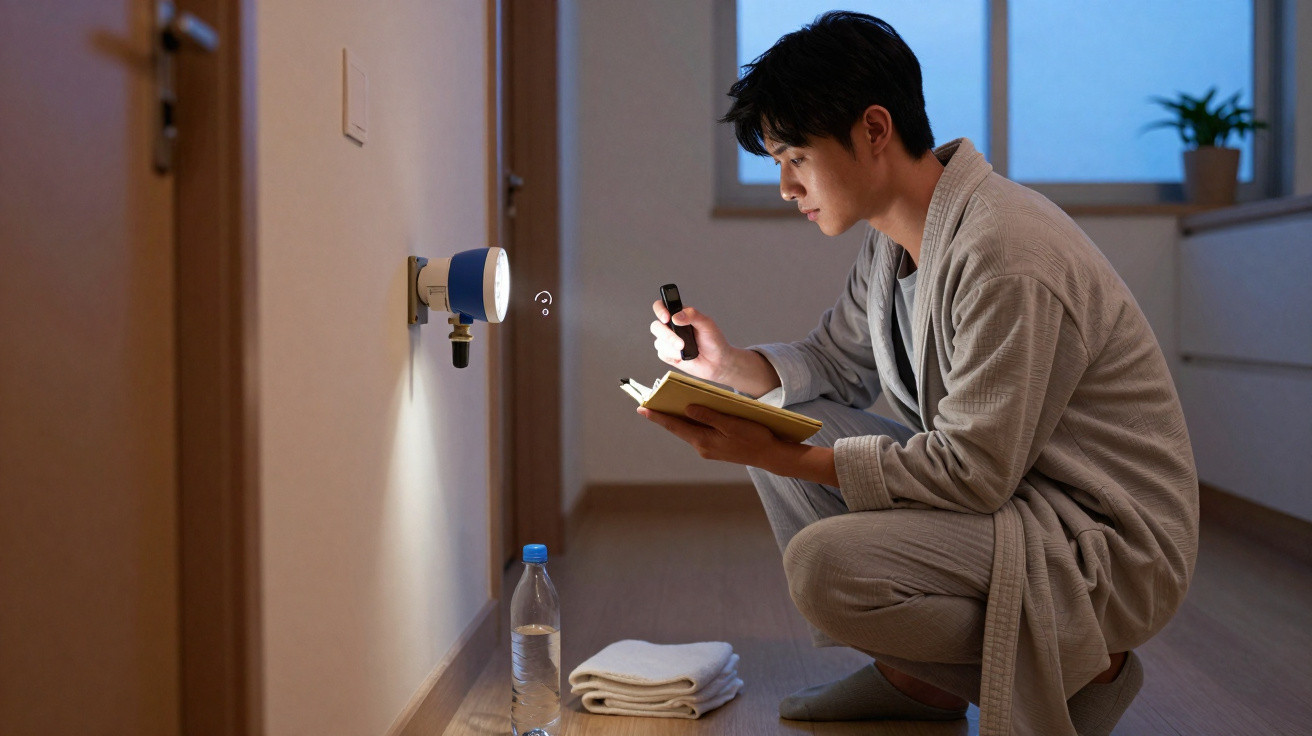
A damp patch, a rising bill and no taps running… In France, a quick check of the meter can uncover a hidden water leak.
The practical news website on which this article is based explains that a very straightforward test, promoted by several water services, can identify an invisible leak at home overnight without any special equipment. Based on this advice, the method involves carefully monitoring the water meter, whether you live in a detached house or a flat.
An overnight test for detecting invisible water leaks
Water leaks do not always come from a dripping tap or a noisy toilet cistern. Some are completely silent, concealed inside a wall, beneath a concrete slab or in the garden. Even so, they can add hundreds of euros to annual costs and lead to substantial damage.
The source website notes that, in France, the first warning is often the water bill: unusually high consumption may raise concerns, sometimes several months after the leak began. Rather than waiting for that late indication, a water meter test provides a simple way to check whether the system is sound.
“By shutting off every water outlet and monitoring the meter over a set period, it is possible to tell whether water is escaping somewhere in the home.”
Preparing your home before the test
The logic is simple: when nobody is using water, the meter should not register any flow. Any movement under those circumstances points to an irregularity. A few precautions are therefore needed before checking the meter.
- Turn off all taps, including those in the kitchen, bathroom and outdoors.
- Make sure nobody showers, flushes a toilet, or starts a washing machine or dishwasher.
- Where possible, switch off the water supply to household appliances, or check that no delayed programme is scheduled.
- Tell everyone in the household not to use water for the duration of the test.
Night-time is generally the most convenient period: everyone is asleep, no appliances are operating and routines are more predictable. The specialist outlet used as a reference recommends this time slot to achieve a reliable result without disrupting household life too much.
Reading your water meter: what to look for
In France, most domestic meters show consumption in cubic metres (m³) on the main display, sometimes alongside dials or rotating wheels that show litres. Certain models have a small needle or a “flow indicator” that turns with even the slightest flow of water.
To carry out the test, the practical information website sets out three steps:
- Record the meter reading in the evening after turning off every water outlet.
- Take another reading early the following morning, before any water is used.
- Compare the two readings carefully.
“If the figures on the meter have changed overnight even though neither appliances nor people have used water, there is a strong likelihood of a leak.”
With some meter types, simply watch the small disc or control wheel: if it continues turning after everything has been shut off, even a very low flow is still passing through the system.
Telling a minor leak from a major issue
The test cannot pinpoint the exact location of a leak on its own, but it does provide an indication of its scale. A very small change may be caused by a minor leak, such as a toilet flushing mechanism that constantly lets through a thin stream of water. A larger increase over a few hours may reveal a burst pipe inside a wall or beneath a patio.
The source outlet also points out that some public water services notify customers of abnormal consumption, which usefully complements this at-home method. However, such notification usually arrives after billing. An overnight test allows you to act earlier.
| Meter observation | Possible interpretation |
|---|---|
| No change | No detectable leak on the private supply network |
| Slight change over several hours | Likely minor leak, such as a toilet cistern, tap or hot-water cylinder |
| Major change in one night | Significant leak in pipework, faulty appliance or underground irrigation system |
Where to investigate first when a water leak is confirmed
If the test records consumption even though everything should be off, the next step is to identify the likely area. The website consulted reviews the main weak points in a domestic installation.
- Toilet cisterns: a worn seal or poorly adjusted mechanism can allow water to run continuously, sometimes silently.
- Taps: some drips are visible only after removing a cover or inspecting the pipes underneath.
- The hot-water cylinder: a safety valve that leaks constantly can result in considerable water loss.
- Buried or concealed pipes: a persistently damp area, a ceiling stain or crumbling wall should raise concern.
- The outdoor network: garden taps, irrigation pipes and automatic watering systems are often overlooked in winter.
“A buried leak is not always visible. The ground can remain dry at the surface while water seeps deeper down or towards a drain.”
To narrow down the location, professionals sometimes advise repeating the test after closing valves on particular branches of the network - for example, by isolating only the garden or upper floor supply - and checking whether the meter still moves.
What to do if you suspect a leak in France
In France, regulations govern billing where a leak occurs on pipework after the meter. The website underpinning this article refers to a legal bill-capping mechanism, subject to conditions, intended to prevent wholly disproportionate charges when an individual experiences a concealed water leak.
The usual recommended steps after confirming a leak are as follows:
- Contact a plumber or specialist company without delay to diagnose the problem and estimate the repairs.
- Have the leak repaired as quickly as possible, keeping the detailed invoice for the work.
- Notify the water service and provide the requested evidence, such as invoices and, in some cases, photographs or an intervention report.
- Contact your home insurer if internal water damage has been identified.
Water companies may offer a partial reduction on the “drinking water” element of the bill when the legal conditions are met and the leak is on private pipework after the meter. The precise arrangements vary according to service contracts and local authorities.
The particular case of blocks of flats and individual meters
In a block of flats, each home may have its own meter or a sub-meter managed by the co-ownership body. The information website behind the subject stresses that the overnight test can still be used, although it requires certain precautions.
Where an individual meter is accessible, such as in a plant room or on the landing, the approach is exactly the same: stop all water use in the flat, note the reading in the evening, then check it again in the morning. If the building’s main meter continues to turn when no flat is consuming water, the leak may be on communal pipework. This falls under the responsibility of the co-ownership body and its property manager.
“In shared housing, the distinction between the private network and communal areas often determines who pays for repairs and how costs are divided.”
Why this water meter test remains useful without visible signs
An untreated leak can weaken a house, encourage mould growth and increase bills over several years. The meter test is not dramatic, but it offers a discreet and effective check on the condition of the installation.
For a French reader, this method makes it possible to:
- carry out an occasional no-leak check after plumbing or renovation work;
- inspect an older or recently purchased home where the consumption history is uncertain;
- spot an irregularity sooner, before the water service reports excessive consumption;
- prepare for a potential bill-reduction claim if there is a substantial leak on private pipework.
This test does not replace a professional assessment, particularly for complex networks or large properties, but it provides a free initial indicator. For underground installations, such as swimming pools and automatic irrigation systems, some specialists advise repeating the test while isolating each circuit using its valves, which can help identify the section involved.
Lastly, carrying out this check regularly encourages occupants to become more familiar with their water meter, which is often ignored. Understanding the difference between a main meter, a secondary meter and a sub-meter, knowing how to read the figures and recognising the flow indicator also makes everyday consumption easier to manage, at a time when water conservation and budget control are practical concerns for many French households.




Comments
No comments yet. Be the first to comment!
Leave a Comment