
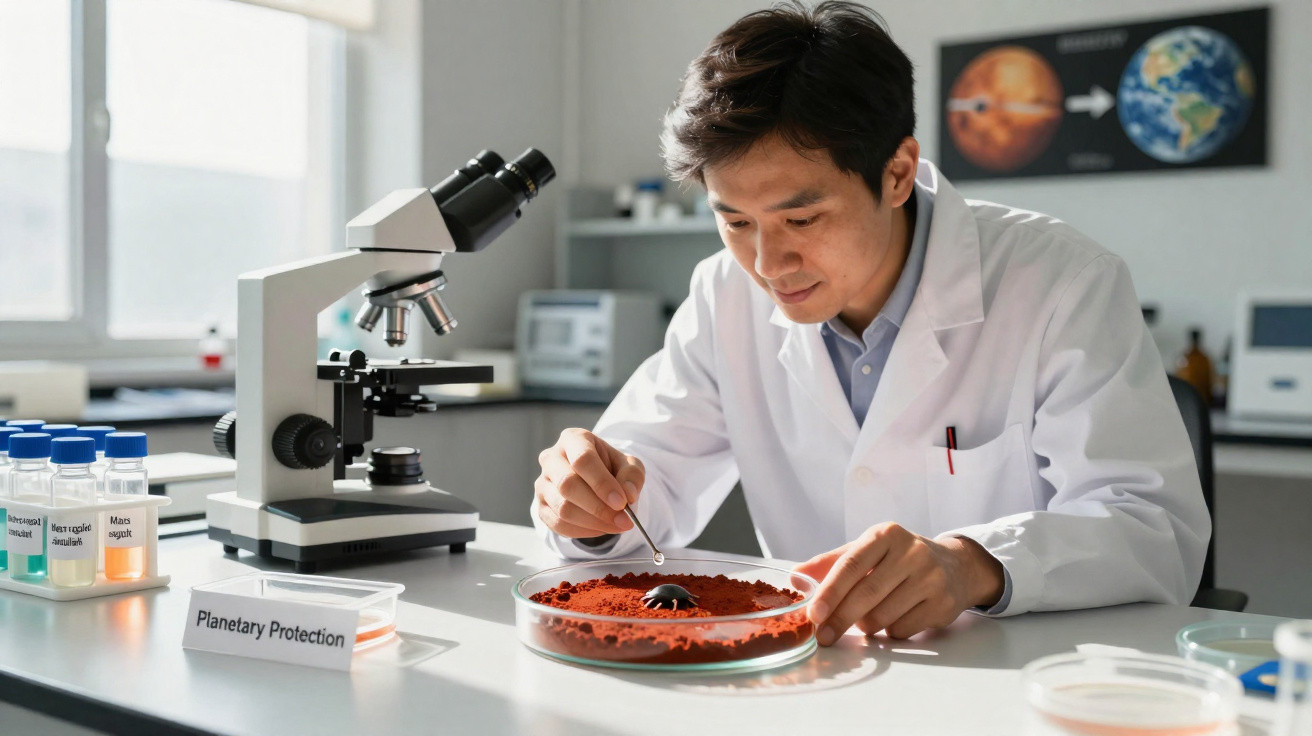
If people ever establish a settlement on Mars, their first challenge may not be constructing a home. It may be the dirt itself.
Mars is blanketed by regolith, a loose and dusty surface material. Although it resembles soil, it bears little resemblance to the fertile earth used to grow food on Earth.
Future astronauts could need this material to cultivate plants, construct shelters or obtain resources. Meanwhile, space agencies must ensure that microbes from Earth do not contaminate another world.
Striking that balance is essential. It safeguards scientific research as well as anything that may already be present beyond Earth. To investigate the issue, researchers studied one of Earth’s most resilient animals: the tardigrade.
Tardigrades test the limits on Mars
Tardigrades, commonly known as water bears, are microscopic creatures with an extraordinary record of survival. While dormant, they can withstand the vacuum of space, severe radiation, extreme temperatures and the immense pressure found deep in the ocean.
When they become dehydrated, they enter an almost complete shutdown. Once water is added, they revive. Their active form is more vulnerable, yet remains robust enough to tolerate freezing conditions and scarce food.
These traits make tardigrades valuable subjects for testing extreme settings. If an active tardigrade is harmed by something, scientists must consider what that could mean for other life forms.
An international team of researchers, co-led by Corien Bakermans, a professor of microbiology at Penn State Altoona, set out to determine how Martian-like dirt would affect them.
Simulating Mars soil on Earth
The researchers worked with two Martian regolith simulants. These laboratory-produced materials closely resemble samples gathered by NASA’s Curiosity Rover from the Rocknest deposit in Gale Crater, south of the Martian equator.
The first simulant, MGS-1, represents a broad, “global” form of Martian surface material. The second, OUCM-1, was created to reproduce more closely the precise chemical composition of the Rocknest location.
Bakermans added active tardigrades to samples of both Mars simulants, then used a microscope to monitor their activity across several days.
“For the MGS-1 simulant, we saw significant inhibition – reduced activity – within two days,” Bakermans said. “It was very damaging compared to OUCM-1, which was still inhibitory but much less so.”
After just two days of exposure to MGS-1, the tardigrades no longer showed activity. This was notable: even animals recognised for surviving space itself appeared to be seriously affected by something in the dust.
Water changes the results
The researchers suspected that a particular chemical within the MGS-1 simulant could be responsible for the harm.
“We were a little surprised by how damaging MGS-1 was,” Bakermans said. “We theorized that there might be something specific in the simulant that could be washed away.”
They therefore washed the MGS-1 with water before introducing new tardigrades. On this occasion, the animals experienced almost no decline in activity.
The findings indicate that a highly harmful component of MGS-1 - perhaps salts or another compound - may dissolve in water. The team is continuing its work to identify the cause.
“That was unexpected, but it’s good in a sense because it means the regolith’s defense mechanism could stop contaminants. At the same time, it can be washed to help support plant growth or prevent damage to humans who come into contact with it.”
Preventing contamination on Mars
This research is closely linked to the wider issue of planetary protection. Decades ago, nations participating in space exploration agreed to avoid contamination between Earth and other worlds. NASA and other space agencies regulate this matter closely.
“When considering sending people to non-Earth environments, we need to understand two things: how the environment will impact the people and how the people will impact the environment,” Bakermans said.
“We’re looking at a potential resource for being able to grow plants as part of establishing a healthy community – but we’re also looking at whether there are any inherent damaging conditions in the regolith that could help protect against contamination from Earth.”
Should Martian regolith naturally damage organisms from Earth, it could provide a built-in defensive system. In principle, this might lower the chance of human microbes spreading across the planet.
However, if the same chemistry also damages people or plants, it would pose a major barrier to establishing a long-term base.
Water introduces a further complication. It is scarce in space, so washing regolith would demand careful planning and recycling. Even so, understanding that damaging substances can dissolve provides mission planners with additional options.
Mars has other hazards
Researchers already know a great deal about the behaviour of bacteria and fungi in simulated Martian regolith. Much less is known about its effects on animals, including microscopic species such as tardigrades.
To fill this gap, the team examined the isolated effects of simulated regolith, which is intended to closely replicate the mineral and chemical make-up of the Martian surface.
Mars presents risks beyond dusty soil. Its atmosphere is thin, surface pressure is much lower than on Earth, temperatures vary dramatically and radiation is intense. The researchers are now investigating how these conditions affect life when combined with regolith.
“Regolith isn’t the only component, of course,” Bakermans said. “But we’re beginning to tease apart components of this overall system where any single piece could be a drawback or benefit the larger understanding of planetary protection.”
Tiny survivors reveal risks on Mars
The experiment may appear straightforward: place tiny animals in imitation Martian dirt and observe the outcome. Yet it addresses some of space exploration’s most significant questions.
Can local materials be used to produce food and build shelters? Could those materials harm humans? And how can other worlds be protected from our own biological footprint?
Tardigrades will not be growing crops on Mars, but their response to Martian-like soil offers scientists early indications. At times, the smallest organisms can reveal the most about humanity’s prospects among the stars.
The complete study was published in the journal International Journal of Astrobiology.
Image credit: European Space Agency





Comments
No comments yet. Be the first to comment!
Leave a Comment