
The shelves were already sagging beneath a mountain of fabric, yet she was still trying to force in one final blanket.
A gentle fabric avalanche spilled forwards and sent a lone pillow onto the floor. She laughed, then let out the sort of sigh that says, “This is ridiculous.” The cupboard door would not shut, held open by that familiar, stubborn two-centimetre gap found in every overfilled wardrobe.
A disorderly blanket family covered the bed: winter duvets, picnic throws and spare bedding for the guest room, all claiming much more room than seemed fair. She picked one up and used the standard approach: fold it in half, fold it in half once more, push, squash, hope. Nothing improved. The wardrobe seemed to take the blanket in, then reject it like a bad punchline.
Then she tested a different approach: a folding trick she had watched in a short video at 1 a.m., while scrolling half-asleep with one eye open. After a few swift movements, she had a neat, tightly packed bundle and, suddenly, the blanket was… tiny. The cupboard door clicked shut softly.
That is when you begin asking yourself what else you may have been folding incorrectly all your life.
The hidden chaos of bulky blankets
Wardrobes usually do not become unmanageable because of clothing. Blankets are often the real reason. They are thick, lofty and wonderfully generous on chilly evenings, but utterly unforgiving when shelf space is limited. You fold them as you always have, then watch the stack start tilting like an exhausted tower.
There is an understated irritation behind that clutter. You know there is a guest blanket “somewhere”, but it sits beneath three others, and retrieving it means causing a small landslide. It is not chaotic enough to qualify as an emergency, yet it lingers in the background of daily life. It quietly chips away at the sense that your home could feel calmer than it does now.
A single blanket appears harmless. Six poorly folded ones can take control of the entire cupboard.
Think back to the last time you made up bedding for visitors. Perhaps you opened the linen cupboard and immediately felt a faint pang of embarrassment: unmatched stacks, blankets slipping halfway off the shelf and the “nice” throw crushed beneath the beach towels. You end up emptying everything simply to locate the one item you need.
In purely practical terms, blankets bully your storage. A standard double blanket can occupy the same room as 8–10 neatly folded T-shirts. Own four or five, and you have surrendered a whole wardrobe section to uneven, loosely folded fabric. Add seasonal throws, children’s comfort blankets and those “just in case” spares that never quite get sorted, and the issue grows.
On a more personal level, that crammed shelf delivers a muted message whenever you open it: “You don’t really have this under control.” It may seem minor, but stress often builds quietly through exactly these small everyday frustrations. A cluttered blanket shelf is rarely only about blankets.
Fortunately, blankets themselves are not the problem; the folding method is. Most of us fold them flat into large rectangles that waste vertical space and take up depth. We handle a soft, adaptable object as though it were a solid box. It is rather like trying to park a car sideways in a narrow garage: possible in theory, but hugely inefficient.
Switch the principle from “flat and wide” to “tight and compact”, and storage space begins to emerge unexpectedly. Less blanket surface is spread across the shelf, while large blankets become dense bundles that can be stacked neatly.
From a storage perspective, it is the difference between an untidy heap of logs and a carefully built wall of bricks.
The blanket-folding method that shrinks everything
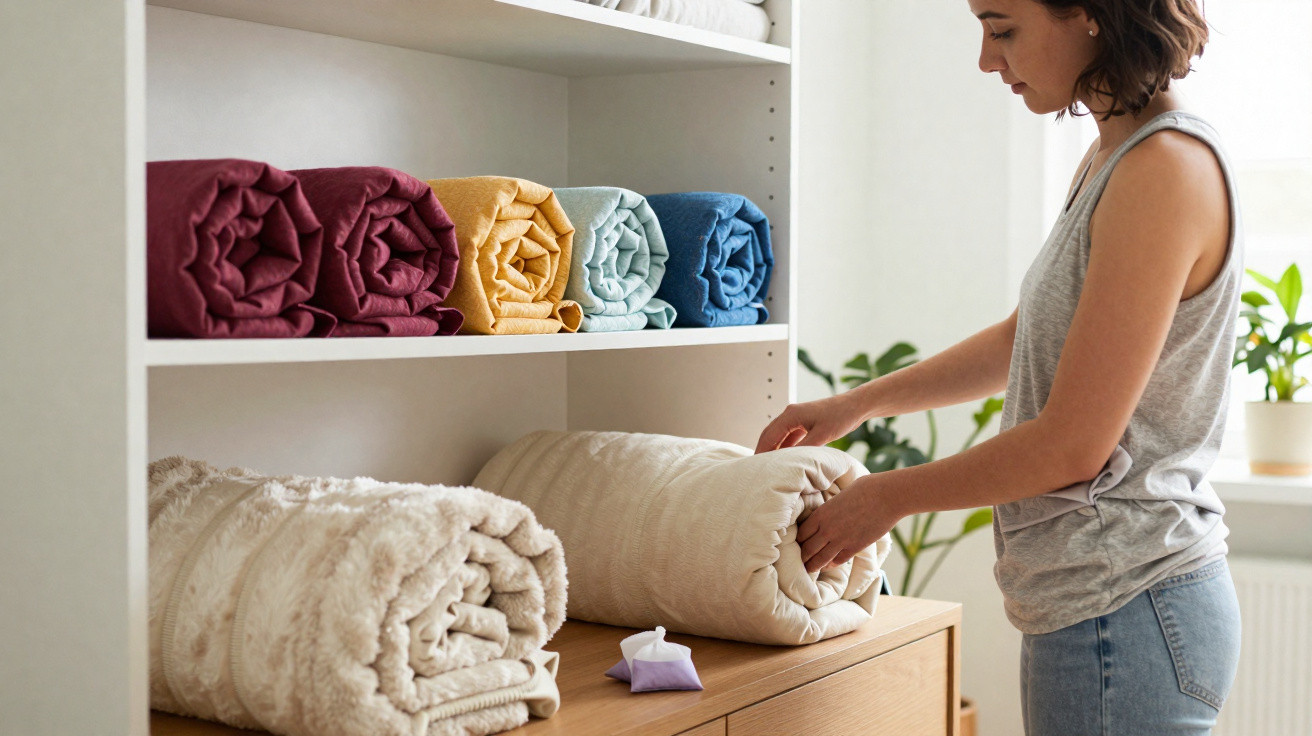
The technique quietly becoming popular with storage enthusiasts is sometimes known as the “pillow roll” or “self-pocket” fold. There is no need for gadgets, vacuum bags or expensive organisers; you only need your hands and some clear floor space. The principle is straightforward: turn the blanket into a long strip, roll it firmly, then secure it within itself so it cannot come undone.
Spread the blanket flat across a bed or the floor, giving it a quick smooth with your hands. Bring one short end in towards the centre, then fold the other short end towards that newly formed edge to make a long, broad strip. Fold the strip in half lengthways to reduce its thickness. Begin at one end and roll it as firmly as is sensible, pushing air out as you work.
The key step happens during the final 20–30 centimetres. Rather than rolling to the very end, leave a fabric “pocket”, then push the rolled section into it, much like placing a sleeping bag inside its cover. The blanket becomes a compact, self-contained bundle that remains securely in place.
Naturally, this is everyday life rather than a carefully staged video with flawless lighting and no children dashing about. Your first attempt may feel clumsy. You may roll too loosely and find the bundle collapses, or fold it in the wrong direction and create an odd sausage shape that will not sit properly on the shelf. That is entirely normal: your hands are learning a new sequence of movements.
In practical terms, those who use this blanket-folding method often say they gain up to 30–50% more usable room on their blanket shelf. Instead of two oversized heaps, you can have compact “logs” standing upright in a row like books. It also makes your belongings easier to identify: the patterned winter throw, the grey guest blanket or the child’s cartoon version.
The main error is striving for perfection. This method is meant to help your life, not audition for a magazine shoot. Let’s be honest: nobody really does this every day. The real benefit lies in finding a fold that is “good enough” and easy to repeat when you are tired on a Sunday evening.
“The first time I rolled our blankets like this, I freed an entire shelf I thought I needed to buy,” says Emily, 34, who reorganised a cramped city apartment with two kids and one tiny wardrobe. “It wasn’t magic. It was just finally folding things in a way that respected the space we actually have.”
- Fold to fit your shelf – Target a finished bundle height that corresponds with your shelf height, allowing you to stack or stand blankets without leaving unused air above them.
- Label by season – A small label or coloured ribbon can immediately show whether a blanket is for winter, guests, children or outdoor use.
- Keep one “easy grab” blanket – Leave one blanket accessible at the front for film nights or naps, so you do not disrupt the entire arrangement every time.
What changes when your blankets shrink
Clear space in a home is not merely visual; it creates a different feeling. Open the cupboard after rolling and lining up the blankets, and the atmosphere almost seems to shift. There are visible edges, gaps and order. The shelf no longer resembles a soft disaster but instead looks intentional. That small change can make it easier to deal with other areas, from the towel stack and children’s bedding to the chair piled with items “to fold later”.
At a very practical level, you spend less time struggling with fabric. You can take the blanket you want without disturbing the rest. Preparing bedding for guests no longer causes a mini tidying operation. Moving home or rotating seasonal storage is also easier, since compact bundles sit neatly in boxes, bags or a car boot. Your blankets suddenly behave like manageable possessions rather than wild animals.
Then there is a subtler shift. The cupboard you once avoided becomes a small, satisfying sign of success. You might show it to a friend almost accidentally: “Look at this, I’ve finally got it under control.” On Google Discover, advice like this spreads because it addresses a genuine need: we are all attempting to create a little more calm in homes that can feel too small for the lives we lead.
The blanket-folding method will not solve everything, of course. It can, however, alter how you relate to space. It encourages a useful question: what else could occupy half as much room while still doing its job?
| Key point | Detail | Benefit for the reader |
|---|---|---|
| Folding into a long strip | Fold the short ends towards the centre, then fold lengthways | Prepares the blanket for a compact, controlled roll |
| Rolling and tucking “pillow style” | Roll firmly, then tuck it into a pocket of fabric | Stops blankets unravelling and keeps shelves orderly |
| Storing by size and season | Group similar thicknesses together, then label or colour-code them | Makes it quicker to take the right blanket without creating chaos |
FAQ:
- How many blankets can I realistically store using this method? In most standard wardrobes, people report fitting roughly 1.5 to 2 times more blankets on the same shelf, especially when bundles are stored upright like books rather than stacked flat.
- Does this method damage fluffy or down blankets? No, as long as you don’t compress them brutally for months on end. Roll them firmly but not brutally tight, and let them “breathe” occasionally to keep the filling airy.
- Is this better than using vacuum storage bags? Vacuum bags save more space but are less flexible for everyday use. The rolling method is a sweet spot for people who want order, visibility, and quick access without plastic rustling and pumps.
- Can I use the same technique for duvets and comforters? Yes, with small adjustments: do an extra fold to narrow the strip, and accept a slightly bulkier roll. For very thick winter duvets, a partial roll plus a large fabric tie can work better.
- How often should I refold or re-roll my blankets? Any time you wash them or notice the roll loosening. In practice, that means every few weeks for high-use blankets, and a couple of times a year for guest or seasonal ones.



Comments
No comments yet. Be the first to comment!
Leave a Comment