
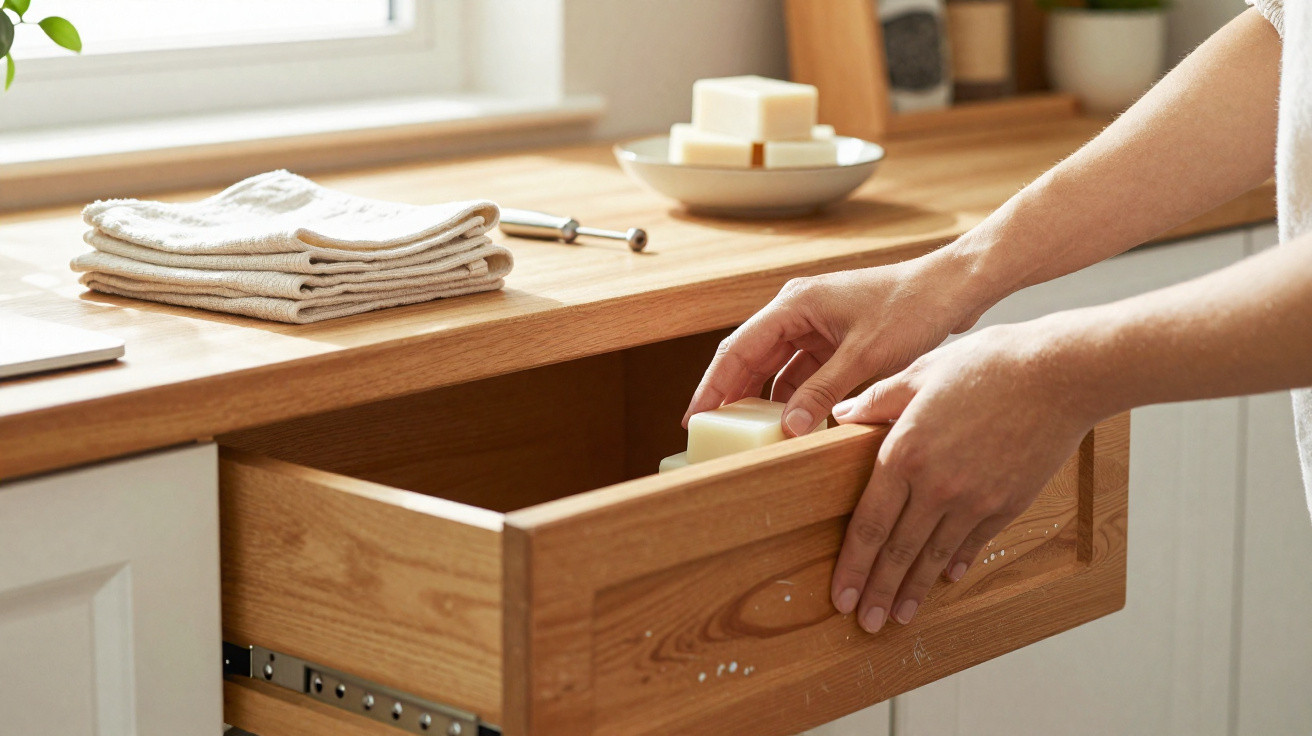
The drawer made that noise again.
It was a deep wooden groan, as though the drawer took personal offence at being asked to open. You pull a little more firmly, the entire chest trembles, and, for a moment, you imagine it giving way completely: socks and underwear everywhere, along with what remains of your dignity. Not exactly an ideal weekday morning.
You try pulling one side, then the other. It comes out by a few centimetres before catching again. You mutter a swear word. The ‘wiggle and hope’ approach has had its chance, as has pushing it shut with force and acting as if the problem is not there. Even so, you pause whenever your hand reaches for that handle.
Then somebody asks: “Have you tried a bar of soap?” You laugh at first. Soap belongs by the sink, not on furniture. Still, part of you wants to think such a straightforward solution might genuinely help. What if it does?
Why wooden drawers begin to stick
Wooden drawers almost never change from gliding smoothly to sticking solid overnight. The shift happens gradually and quietly. One humid summer, one winter with dry central heating, several drawers packed too tightly with T-shirts, and a smooth slide eventually turns into a scrape.
The earliest clue is usually easy to miss. There may be a slight resistance or a small snag halfway through opening. Later comes the scraping noise and the subtle lean of a drawer struggling against its frame. Before long, you are in the bedroom with both hands around the handle, as though you are trying to start a lawnmower that refuses to cooperate.
At first glance, it seems that the drawer is simply old. Yet plenty is happening in the narrow space where one wooden surface meets another.
I once spoke to a London furniture restorer whose work involves reviving Victorian chests of drawers. He said he encounters the same situation repeatedly: furniture that worked perfectly for decades suddenly protests every time a drawer is opened. It is not a random mishap, just the combined effects of time and physics.
Moisture causes timber to expand. Dry conditions make it contract and can create small distortions. Then there may be a slightly sagging base, a bump on a runner, or a drawer crammed with jumpers you never wear. Each issue may appear insignificant alone, but together they produce friction.
He showed me an old pine dresser whose right-hand drawer required two hands and some shoulder power. Pale scuff marks ran along its side, showing where timber had rubbed for years. Nothing was broken, and there were no major splits. There had simply been excessive contact in the wrong area for too long.
The principle is harsh but straightforward. Drawers are designed to move within tiny gaps between their sides and runners. Once something alters - shifting timber, minute warping or a sagging bottom panel - those gaps become smaller. Surfaces intended to slide now press firmly against each other.
What we describe as ‘sticking’ is really resistance increased several times over. Wood-on-wood contact naturally creates quite high friction. Add dust, grit or residue from old furniture polish, and the slim runners can start behaving like strips of sandpaper.
Lubricant alters that balance. Lower the friction and spread the pressure, and even a warped drawer may start to feel easy to move again. Soap is useful because it is soft, wax-like and made to slide over skin. That slipperiness transfers to the rails and sides, forming a thin layer between the two pieces of timber that are rubbing together.
How to repair a sticking drawer with a bar of soap
Begin with the most basic step: remove the drawer completely. Empty its contents onto the bed or floor, however inconvenient that may feel. It is impossible to repair what you cannot properly inspect. Place the drawer on its side and examine the edges that meet the frame or runners - commonly the lower edges of the sides and, in some cases, the underside.
Use a dry, hard bar of plain soap rather than a fancy gel product. Rub it firmly over these edges as if you were drawing a line with a crayon. Aim for a visible, slightly cloudy coating instead of scattered soap crumbs. Next, apply it to the internal rails or runners in the cabinet. Wherever wood meets wood, run the soap across it.
Put the drawer back in place and move it in and out slowly several times. It should begin to ease, almost as though the timber has remembered the way it was meant to work.
Here is the truth: many people make one quick pass with the soap, decide the idea has failed, and give up. The soap needs to be worked in a little. Repeated movement spreads it evenly and helps it reach the concealed points where rubbing occurs.
Do not use a damp or very soft bar, as it may form clumps and leave tacky patches that collect dust. If slight changes in colour concern you, take care around pale or unfinished timber; a mild soap normally leaves only a very faint mark that is barely visible.
Soap may still be useful on the wooden elements of a drawer with metal runners, but avoid coating moving metal parts heavily. A small amount is sufficient. If the drawer comes to an abrupt ‘stop’ at one particular point, take it out again and look for a screw head, nail or splinter - problems that require more than lubrication.
“Honestly, half of my ‘big repair jobs’ are just me cleaning the runners and rubbing on soap or wax,” the restorer admitted to me. “People think their furniture is done for. Most of the time, it just needs less friction and fewer socks.”
A few simple habits can help the soap treatment last longer:
- Choose a white or pale bar for light-coloured wood, preventing obvious streaks.
- Remove dust from the runners first, rather than trapping grit beneath the soap.
- Apply soap again every few months if your home is damp.
- Remove some contents when the drawer is regularly overloaded.
- If it continues to drag, pair the soap with a very light sanding of any clear high spots.
How a small drawer repair can change the feel of your home
Using a bar of soap to free a sticky drawer may sound insignificant. And it is. Yet it can subtly alter your relationship with the home around you. Pulling open that drawer in the morning is no longer a small daily confrontation. The groan becomes a quiet, assured glide, and you stop tensing your arm whenever you need a T-shirt.
On a broader level, another change takes place. You begin to believe that modest household annoyances can have modest, human-scale solutions. Not every problem calls for a flat-pack replacement or frantic scrolling through DIY forums. At times, all that is needed is a bar of soap and ten peaceful minutes on a Sunday afternoon, at the kitchen table, while laundry waits in the next room.
Most of us know the feeling when a minor repair is finally completed and the whole room seems lighter. A door with a usable handle. A squeak that has gone quiet. A drawer that cooperates. These are not dramatic, Instagram-worthy makeovers. They are more personal than that, almost private - and their effects build up.
After seeing this method succeed, you may find yourself viewing the other awkward parts of your home differently. There is the kitchen drawer that always catches, or the old sideboard inherited from a grandparent that has stayed half-shut for years because sorting it was ‘too much faff’. That is how this story starts to spread.
A single bar of soap can move around a house much as a good family story does. It is passed from one person to another and placed in somebody’s hand with a small laugh: “Try this, you’ll see.” There is something surprisingly satisfying about knowing the uncomplicated answer. No fuss, no new tools - simply reduced friction.
Let us be honest: nobody takes apart all their furniture once a year to maintain it. Life is busy, and drawers are easy to overlook when they are irritating rather than genuinely broken. That is precisely why this trick stays with you: it fits into the gaps of everyday life, between work emails and partly folded laundry.
Perhaps this evening you will open that difficult drawer, take it out, and sit on the floor holding a bar of soap with a curious expression. It need not be a major project. It can simply be a calming task for your hands: a small act of resistance against discarding something that still functions, and a quiet choice to repair rather than replace.
| Key point | Detail | Benefit for the reader |
|---|---|---|
| Soap as a lubricant | A dry bar is rubbed over runners and contact points | Provides a simple, inexpensive solution using something already in the home |
| Understanding friction | Humidity, warping and overloading cause resistance | Makes it easier to identify future problems without panic or guesswork |
| Small rituals matter | Quick repairs improve everyday comfort | Helps the home feel calmer, smoother and more manageable |
FAQ:
Can I use any type of soap on my wooden drawers?
Choose a dry, solid bar, preferably a plain one without heavy oils or exfoliating particles. Fancy moisturising soaps may leave a slightly greasy layer that attracts dust more quickly.Will soap damage or stain the wood over time?
A light coating on the contact areas is generally harmless. Test it first in a concealed area on very pale or unfinished wood. In any case, faint marks are normally hidden on the runners.How often should I reapply soap to keep drawers sliding smoothly?
Twice a year is normally sufficient in a reasonably dry home. In damp or older properties, repeat the treatment every few months, particularly when the drawer begins resisting again.What if the drawer still sticks after using soap?
Inspect it for warped timber, protruding nails or screws, and swollen sections. Gently sanding obvious high points, then applying another layer of soap, will often complete the repair.Is soap better than wax or specialist drawer lubricant?
Wax and purpose-made lubricants may last longer, but soap has one major advantage: you already have it. For many everyday drawers, that combination of convenience and effectiveness is sufficient.




Comments
No comments yet. Be the first to comment!
Leave a Comment