
Another one is finished. For a moment, you look at it, surprised by how solid it seems for an object whose only job was to hold a roll of paper. Then you flush, wash your hands and carry on. Recently, though, more people have begun to linger over that small decision.
Keep it or throw it away?
You begin spotting online clips where people turn these rather sad-looking tubes into cable organisers, seedling pots and even phone speakers. Suddenly, your recycling bin resembles a treasure trove you have overlooked for years. Then a rather unexpected question occurs to you.
Could the most unremarkable object in your bathroom actually be useful?
From rubbish to handy tool: why toilet paper rolls are suddenly useful
Step into almost any home and two things are likely to be there: a lit screen somewhere and a nearly empty toilet paper roll on its holder. Most of us treat the tube like a chocolate-bar wrapper – something to remove and discard. But this modest cardboard cylinder combines strength, flexibility and a useful size, making it something of a household Swiss Army knife.
It is firm enough to shield delicate cables, light enough to attach to a wall with one strip of tape, and slim enough to work as a funnel or cable guide. Unlike stylish storage containers, it costs absolutely nothing. The small brown tube is one of those rare everyday objects that arrives at home ready to be repurposed.
A few months ago, a viral TikTok featured a young woman opening a drawer full of disorder: phone chargers, hair-straightener leads and assorted USB cables tangled into a dense mess. Looking directly at the camera, she rolled her eyes before producing a shoebox packed with toilet paper rolls. Each tube contained a cable and had been labelled in pen. She placed the small cardboard cylinders in the drawer in orderly rows.
The contrast between before and after was striking. In thirty seconds, what had resembled technological spaghetti became a grid of neat little sections. The comments flooded in. Viewers posted their own pictures: Christmas lights controlled with cardboard tubes and garden sheds where extension leads were carefully stored. One electrician said he had not bought a cable organiser “in years”. The ordinary bathroom roll had gone quietly viral.
The reasoning is straightforward. We continually purchase plastic or metal organising products while disposing of an object made to be cut, shaped, folded and stacked. Cardboard is forgiving: make a mistake and another roll will turn up next week, without any guilt attached. Once it has served its purpose, it also breaks down easily, so it does not become yet more lasting clutter claiming to eliminate clutter.
At a psychological level, making a tool from “rubbish” changes the way you view your home. Rather than feeling defeated by the quantity of belongings around you, you become someone who can repair, adapt and improvise. That feeling is unexpectedly addictive.
Smart, simple toilet paper roll uses for everyday life
Start with the one trick people genuinely continue to use: cable storage. Take a toilet paper roll, press it gently flat with your hand, write “Phone charger”, “Laptop” or “Fairy lights” along the side, and place the coiled cable inside. Put several tubes upright in a shoebox and you have a free organiser that can sit on a shelf or be stored in a drawer.
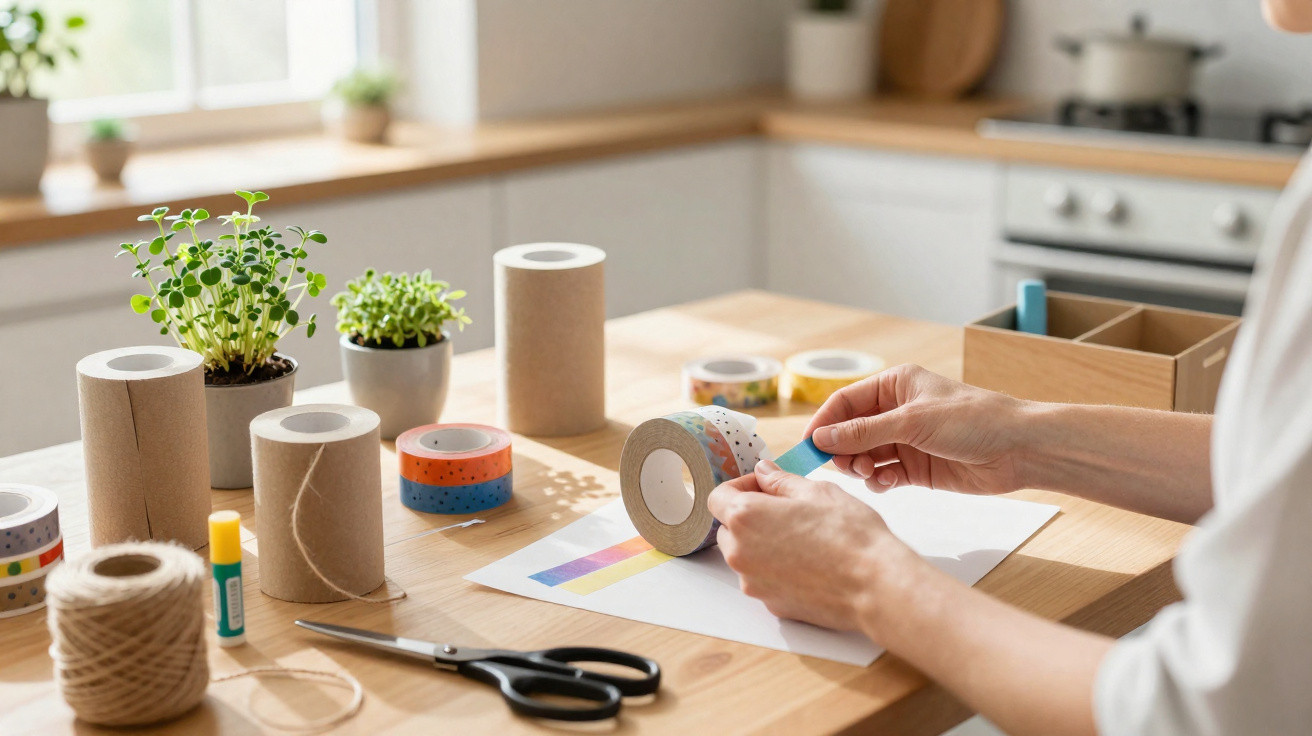
To make it look smarter, cover the tube with spare wrapping paper or washi tape. It can suddenly resemble something purchased from a design shop. You could also snip a small notch into one edge, allowing the cable end to hook out and remain in position. Opening a drawer to see those little cylinders in a row, each containing precisely what you need, is strangely satisfying.
Another quietly ingenious option is using them as seed starters for compact gardens or small balconies. Fill a tube with potting compost, place it in a tray and add two or three herb seeds. Water it lightly. The cardboard retains moisture, holds the compost together and gradually softens. Once the seedlings are large enough, put the entire tube into a larger pot or directly into the soil.
Over time, the tube decomposes and nourishes the soil, while you avoid the frustrating transplant shock caused by pulling fragile roots from plastic cells. On a wet Sunday, children enjoy drawing faces on the rolls and watching their “hair” grow on the windowsill. One family in Lyon made a whole miniature forest of basil, parsley and cherry tomatoes on their small balcony using thirty toilet rolls.
There is also an easy solution for anyone who dislikes clutter on the floor: improvised wall storage. Flatten a roll, remove the lower half to form a C-shaped holder, then tape or pin it to the inside of a cupboard door. You can slot in toothbrushes, make-up brushes, pens or even reusable chopsticks. It may not be Instagram-perfect, but it does the job.
Let’s be honest: nobody really does this every day. You are not about to remake your whole home with cardboard overnight. However, trying one or two of these understated ideas – a cable drawer here, a herb seedling there – can alter how you view every leftover item in your home. Instead of waste, you start seeing possibilities.
Eco, emotion and a small change in how we live at home
When people are asked why they save toilet paper rolls, their replies are seldom about saving the planet in capital letters. They mention feeling “less wasteful”, giving something a second life, and showing their children that not every disposable item is destined for the bin. That emotional dimension lies just beneath the surface of these ideas.
One sustainability coach I spoke to put it like this:
“You don’t change your life by buying glass jars and labeling everything. You change your life the day you stop throwing away things that could still serve you.”
Using a toilet roll as a cable protector or seed starter may feel minor, even slightly silly. But it teaches your mind to ask, “What else could this be?” one more time, day after day.
There are limits and possible problems, naturally. Cardboard and damp conditions do not mix well, so storage in the bathroom requires care. When using rolls for children’s crafts, do not leave them soaked in water for too long, and allow them to dry fully before putting them away to avoid a musty odour. Some people also take it too far, storing bags of tubes “for later” when later never arrives, creating an entirely new form of clutter.
The ideal approach is to use the rolls that naturally appear in your home, then stop when the small projects are complete. No hoarding and no guilt. Just a relaxed, almost playful way of dealing with everyday objects. That is where the real hidden value lies: not in the cardboard itself, but in the new habit.
From a practical perspective, toilet paper rolls fit into several simple uses that suit most homes:
- Organise and protect (cables, wrapping paper, small tools)
- Grow and store (seed starters, dried herbs, small packets)
- Play and create (children’s crafts, DIY toys, seasonal decorations)
- Quietly reduce waste without spending money
Every roll offers a small opportunity to experiment without worrying about “ruining” something costly. That freedom may be its most valuable quality.
The next time you reach for the bin, you may pause
Picture your home six months from now. That drawer full of tangled leads? More orderly, with each cable tucked into a hand-labelled tube that cost nothing. The windowsill? A row of cardboard cylinders overflowing with basil and mint, giving off a soft summer scent whenever you pass. Inside the cupboard, several flattened rolls prevent wrapping paper from unrolling all over the place.
None of these adjustments will put you on a minimalist blog. They will not receive design awards. But they can shift your daily life a few degrees towards less disorder, less waste and more creativity. That is the quiet revolution currently sitting in a bathroom bin.
We have all looked around our homes and wondered how so much stuff managed to accumulate. Turning a disposable tube into something practical is a modest act of resistance against that feeling. It says: I can do something, right now, with what I have.
The next time a cardboard roll falls, notice that dull little sound. It could be the starting signal for your next small home improvement – the sort nobody notices at first, but which gradually changes how you live.
| Key point | Detail | Benefit for the reader |
|---|---|---|
| Cable organisation | Use each roll to store and label a separate cable | Reduces clutter, prevents tangles and saves time |
| Starting seedlings | Fill tubes with compost, plant seeds and transplant the whole thing | Easy, low-cost gardening that is accessible even in a flat |
| Simple wall storage | Stick cut tubes inside cupboard doors | Creates discreet storage without buying equipment |
FAQ:
- Are toilet paper rolls safe to use for crafts and storage? Yes, provided they are clean and dry. Do not use rolls stored in damp places or those showing signs of mould.
- Can I use toilet paper rolls for food-related projects? Use them only as outer packaging (for example, to protect a wrapped cookie bag), not in direct contact with unpackaged food.
- How many rolls should I realistically keep? Keep what you can use in the next one or two months, usually 10–20 at most. Recycle the rest to avoid new clutter.
- Do toilet paper roll seed starters really decompose in soil? Yes, the cardboard softens and breaks down over time, especially if the soil is moist and active with worms and microbes.
- What if my DIY storage with rolls looks “ugly”? You can wrap them with paper, fabric or tape, or simply hide them inside drawers and cupboards where only you see the benefit.
Comments
No comments yet. Be the first to comment!
Leave a Comment