
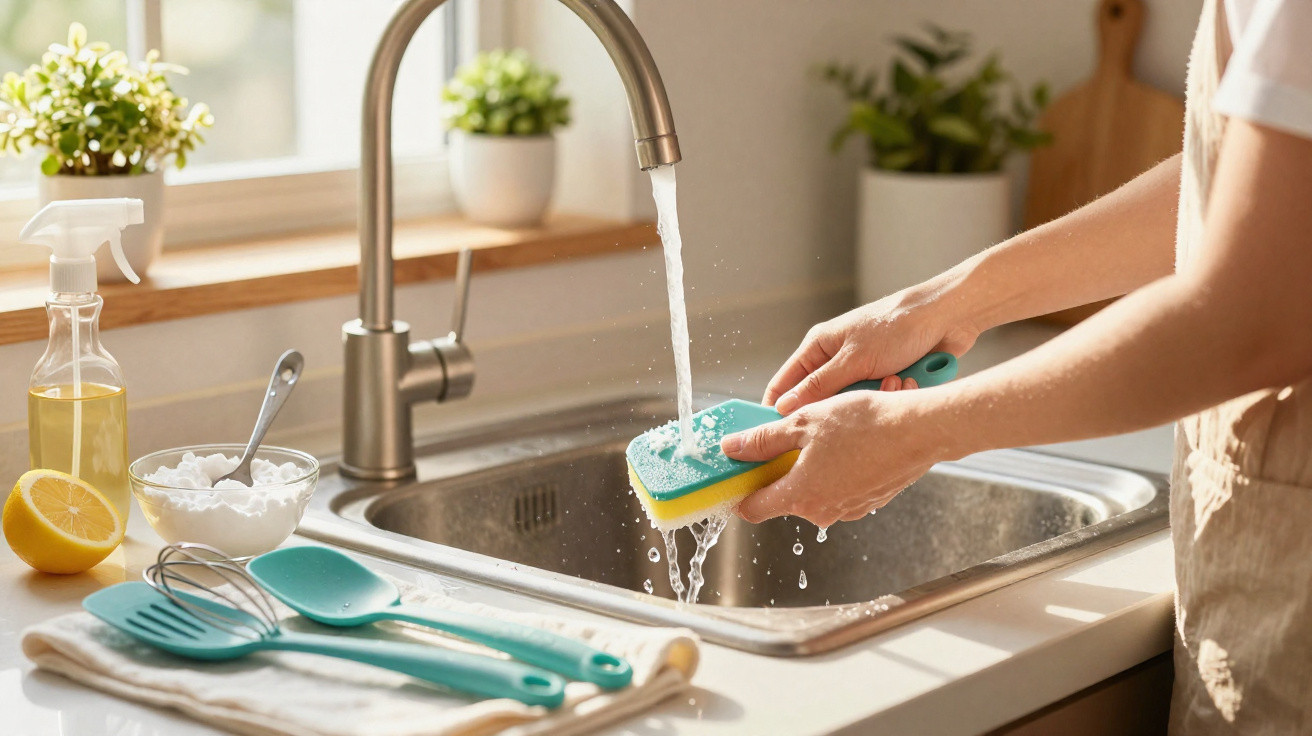
On a Sunday evening, while tidying the kitchen, it is common to come across a silicone spatula that feels sticky for no obvious reason. It has been washed, perhaps even through the dishwasher, yet the smell of tomato sauce, fish or buttery cake seems to have settled in permanently. Muffin tins can suffer the same fate: they look clean when they come out, then release a slightly rancid smell as soon as they heat up. This is not necessarily a sign of visible dirt, nor is it an issue limited to cheap accessories. Silicone is useful, flexible and almost indestructible… but it readily retains cooking fats and aromas. That small annoyance can quickly put you off baking. Fortunately, a few straightforward steps can restore its neutral smell.
Why does silicone become sticky and retain odours?
We all know the feeling of picking up a silicone spatula from an otherwise clean drawer and finding it slightly tacky. Silicone is a flexible material whose surface can hold an invisible greasy layer, particularly after dishes rich in oil, butter, cheese or sauce. A quick rinse under hot water is not always enough to lift this subtle coating, which then acts rather like a small odour sponge.
The issue is particularly noticeable with dark-coloured or frequently used baking moulds. A study published by kitchen-material manufacturers mentions the potential absorption of fatty aromatic compounds into silicone, especially when the utensil is heated repeatedly. After a gratin, roasted vegetables or a batch of financiers, the smell can linger for several days. Silicone may not look dirty, but it remembers everything it has cooked.
Heat plays a key part: in a sense, it creates a route for fats and odorous molecules to cling more easily to the material. The dishwasher may also leave a thin detergent residue when rinsing is incomplete, producing that rather unpleasant sticky feel. Let us be honest: after a rushed meal, no one truly inspects every spatula and mould. Over time, the residues build up quietly.
The gentle method that genuinely removes greasy residue from silicone
For a thorough clean, first wash the utensil in very hot water with a grease-cutting washing-up liquid, then dry it carefully. Next, make a soft paste with three tablespoons of bicarbonate of soda and just enough water to create a consistency similar to thick cream. Spread it over the sticky areas, leave it for thirty minutes, scrub with a non-abrasive sponge and rinse thoroughly.
If the smell remains, the oven may help, provided the utensil is clearly labelled as suitable for high-temperature baking. Put the clean mould or spatula on a baking tray and heat it at between 160 and 180°C for twenty to thirty minutes, leaving a window slightly open if the odour is strong. The heat helps draw out trapped greasy residues. Allow it to cool, then wash it again in hot water: the result is often surprising.
A common mistake is combining bicarbonate of soda and vinegar in the same bowl in the hope of a dramatic effect. The fizz is entertaining, but the two products neutralise each other quickly; it is better to use them separately according to the issue at hand. Bicarbonate of soda tackles odours and greasy marks, while a hot-water soak with a little white vinegar can help with mineral deposits.
“A silicone utensil should come out odourless when it is warm, not merely when it is stored in the cupboard.”
- Always wash silicone immediately after making a particularly greasy recipe.
- Avoid metal scouring pads, which scratch and weaken the surface.
- Let it dry completely before putting it away, especially in a closed drawer.
- Keep one mould for strongly scented recipes if you often cook fish or use spices.
When should you clean silicone differently… or replace the utensil?
Silicone that remains sticky after several proper cleans deserves a closer look. If the surface has cracks, deep discolouration, a powdery appearance or a greasy feel that returns by the following day, the material may be worn out. This is not necessarily dangerous at the first sign, but a damaged accessory becomes less pleasant, harder to clean and sometimes less reliable for baking.
Very cheap moulds, often filled with mineral additives or made from less dense silicone, can sometimes age faster. A useful check is to gently bend the edge of the mould: if it turns very white, cracks or gives off a pronounced chemical smell when hot, it is best not to persist with it. A quality utensil should remain flexible, stable and almost odourless, even after several batches.
The most helpful habit is modest, regular care rather than obsession. Careful washing after greasy recipes, air-drying and an occasional bicarbonate-of-soda deep clean prevent many disappointments. It is also worth asking whether the item still suits its intended use: an old spatula that retains the scent of curry may no longer belong in the preparation of crème anglaise.
Silicone utensils have changed everyday cooking because they make so many tasks easier: less fat is needed in baking moulds, less batter is left at the bottom of a mixing bowl, and there is less noise too. Looking after them simply requires a little clear-sightedness, rather than faith in miracle-cleaning claims. A stubborn smell often reveals an invisible build-up, not poor hygiene. Taking a few minutes to degrease properly extends the life of these objects we use without thinking. There is also something deeply satisfying about finding a perfectly clean silicone spatula, with no lasagne aroma on a lemon cake. Cooking habits are built through these tiny details: once someone has found their method, they often pass it on, between two recipes and a drawer that has finally been tidied.
| Key point | Detail | Added value for the reader |
|---|---|---|
| Invisible greasy film | Oils, butter and certain sauces cling to silicone, especially after repeated heating. This residue can create a sticky texture even when the utensil appears clean at first glance. | Understanding the source of the issue prevents you from throwing away a mould or spatula that can still be salvaged. |
| Deep cleaning | Washing in hot water, followed by a bicarbonate-of-soda paste left on for thirty minutes, helps loosen residue. Moderate oven heating is suitable for items certified for this use. | The method requires few products, uses items often already found in the cupboard and limits persistent smells. |
| Signs of wear | Cracks, a persistently tacky surface, excessive whitening when bent or a chemical smell when hot may indicate worn silicone or poor-quality material. | Readers can tell the difference between a utensil that needs deep cleaning and one that is better replaced for more confident cooking. |




Comments
No comments yet. Be the first to comment!
Leave a Comment