
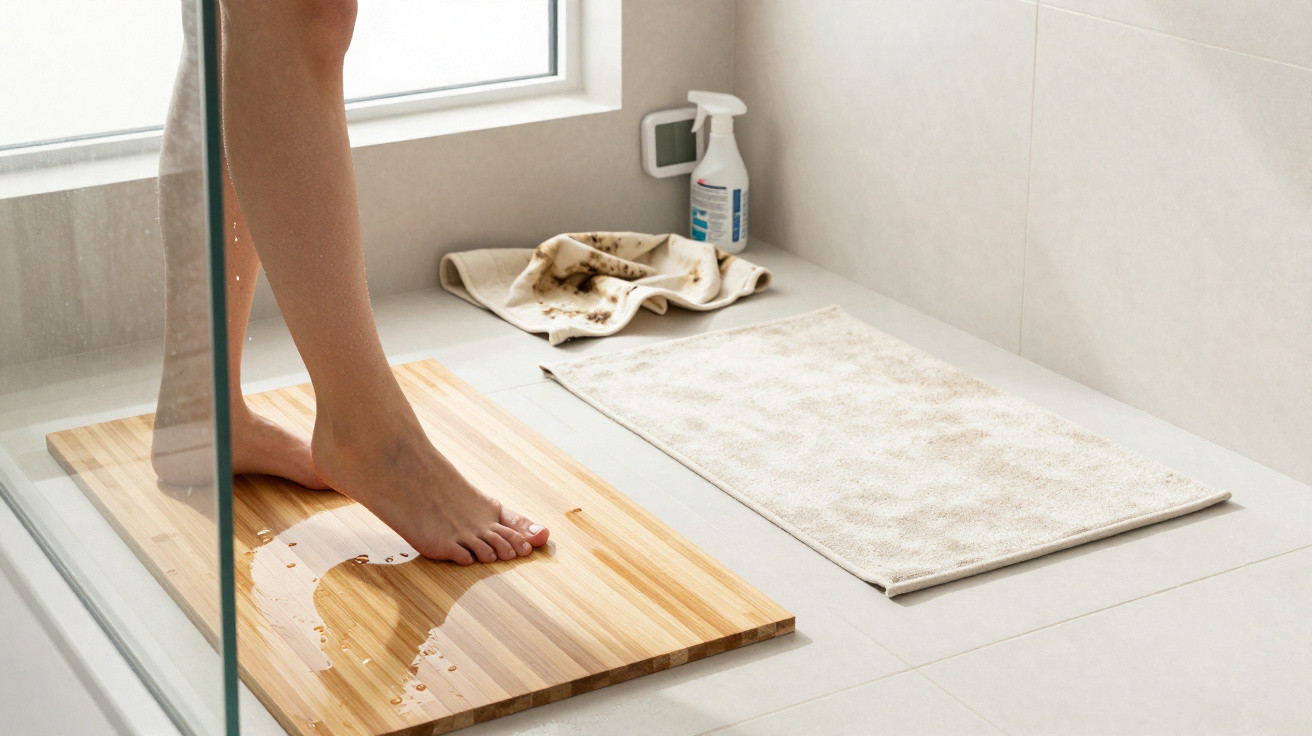
In French bathrooms, humidity can sometimes turn an everyday item into a breeding ground for microbes and mould.
Published on 22 May 2025, the supplied extract, whose original publisher is not identified, highlights the upkeep of bathroom mats. It also looks at rigid alternatives designed to dry more quickly and make day-to-day cleaning easier.
A bathroom mat often overlooked during cleaning
When stepping out of the shower, a bathroom mat has a straightforward role: it absorbs water from underfoot and helps reduce the risk of slipping on tiled flooring. This practical purpose explains why it is found in so many homes, although its maintenance is often neglected.
A textile mat collects water, soap residue, skin cells and particles brought in on people's feet. A warm bathroom with limited ventilation provides the conditions in which dampness can linger. If the mat remains wet for several hours, unpleasant smells and visible mould may develop.
“The issue is not merely the appearance of the mat: it is primarily the moisture that remains in its fibres between uses.”
The source specifically refers to bacteria including Escherichia coli and Staphylococcus aureus, as well as the fungus Candida albicans. The presence of micro-organisms in a damp setting does not automatically mean that someone will become ill. However, it does underline the value of cleaning regularly, particularly where several people share the same bathroom.
Thick mats, terry-cloth designs and highly absorbent fabrics may take longer to dry. Microfibre versions often dry faster, but they still need washing. A mat that still feels damp after several hours should be given particular attention.
Steps to reduce bathroom mat moisture
The first habit to adopt is avoiding leaving a wet mat flat on the floor after showering. Hanging it over a drying rack, towel rail or another suitable support allows air to circulate around the fibres. This is especially helpful in bathrooms without a window.
The source advises washing the mat every week at a temperature of at least 60°C, provided the manufacturer's label permits this. Washing instructions for the specific item should therefore always be checked first. Some non-slip backings, fibres and decorative mats do not tolerate high temperatures well.
- Hang the mat up after every use instead of leaving it in a heap.
- Air the room after a shower or bath.
- Follow the washing directions shown on the label.
- Keep two mats, so one can be used while the other is drying or being machine-washed.
- Replace a mat if its backing deteriorates, its smell persists or it shows signs of mould.
Cleaning the floor matters as well. A freshly washed mat placed on tiles that are still wet will quickly become damp again. After cleaning, it is best to allow the floor to dry fully before putting the mat back.
Bamboo bathroom mats: an option that dries differently
The alternative promoted by the source is the bamboo bathroom mat. Rather than being a conventional soft mat, it is a slatted platform. Water does not collect in fibres: it passes through the gaps between the slats or remains on the surface before evaporating.
This type of support can generally be cleaned using a lightly dampened cloth. It still requires maintenance, as soap deposits, limescale and dust can collect between its sections. It should also not be left continuously in a pool of water, which could damage the material over time.
“For people who want to avoid drying a fabric mat, a bamboo slatted platform mainly changes how water is managed after a shower.”
The feeling underfoot is notably different from that of a textile mat. Bamboo provides a firm, less cushioned surface. It may suit people looking for quick maintenance, although it will not necessarily meet every household's need for comfort. Before buying one, it is also important to check that the model is stable and has feet suitable for the flooring.
Diatomite, another cited option
The source also mentions diatomite mats. Diatomite is a sedimentary rock formed from the accumulation of fossilised microalgae. In slab form, it is used to absorb water after showering and dry quickly.
This option also calls for a few precautions. A slab can become stained by soap residue or cosmetic products. It needs to remain dry between cleaning sessions and should be handled carefully, because its rigid surface may crack or chip if knocked. Its non-slip properties also depend on the model, its condition and the floor on which it is placed.
What applies in France
In France, no specific rule sets a compulsory washing frequency for bathroom mats in private homes. General domestic hygiene guidance is based on keeping the bathroom clean, ventilating it and drying textiles used in a damp room.
People with respiratory allergies should be particularly alert to mould and indoor damp. Daily airing, maintaining ventilation and fixing a leak are practical measures that can limit long-term moisture in the home. Where substantial or recurring mould appears on walls, the matter goes beyond simply choosing a mat: it may indicate a ventilation problem or water ingress.
The choice between textile, bamboo and diatomite therefore depends on how the room is used. A washable mat remains practical in a family bathroom, provided it is dried and maintained frequently. A rigid surface may make everyday life easier in a small space, particularly when drying fabric mats becomes difficult.

Comments
No comments yet. Be the first to comment!
Leave a Comment