
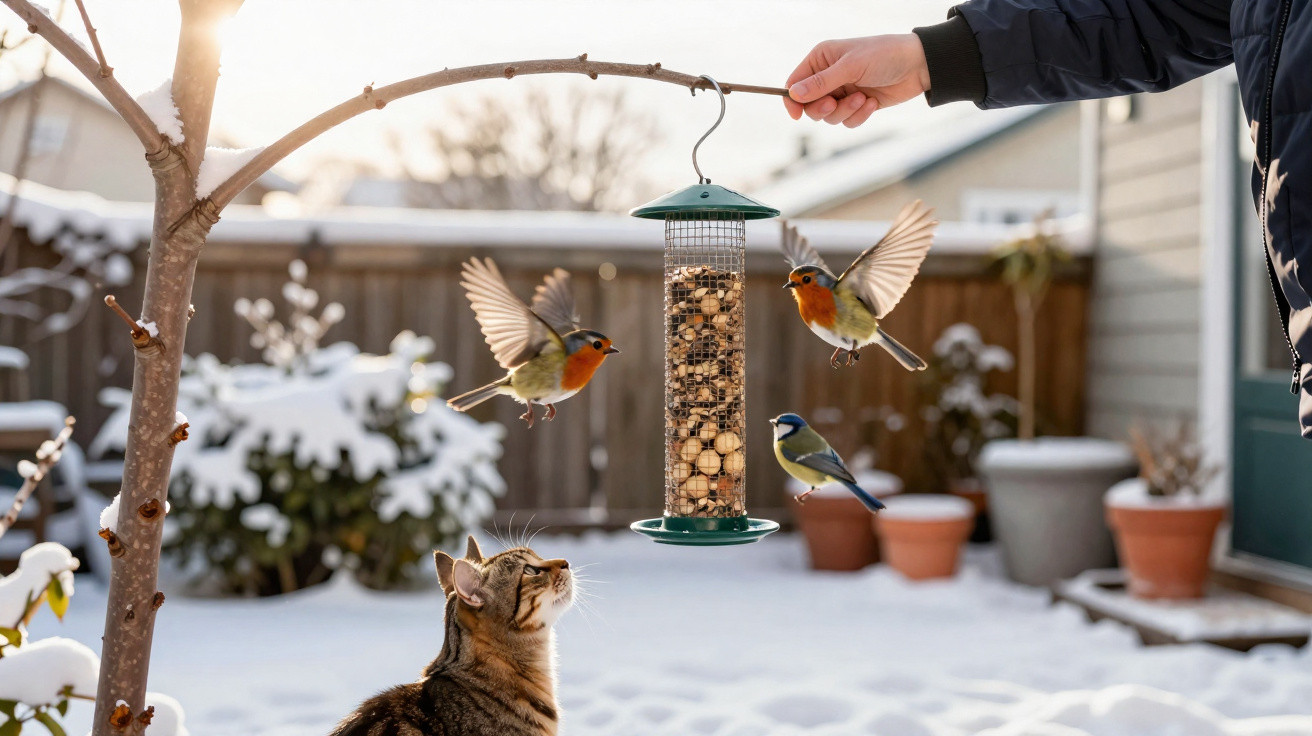
For years, it has hung unnoticed among woollen jumpers and forgotten jackets: the old metal coat hanger. While many people still regard it as junk, nature-minded households are now using it to save something very specific in winter – the lives of hungry garden birds. With just a few simple adjustments, it becomes a sturdy raised feeding spot that protects blackbirds, tits and robins from cold, hunger and, above all, cats.
Why a metal coat hanger can suddenly become a lifesaver for birds
During winter, wild birds must fight for every calorie. Frost hardens the ground, snow buries seeds and insects, and many natural food sources simply disappear. For small species such as great tits, blue tits and wrens in particular, a feeding station can determine whether they make it through a cold spell.
An old metal coat hanger becomes a robust, elevated support for seed feeders and bird tables – away from most dangers.
However, many conventional bird tables sit on unsteady stands, topple over in storms or are hung too close to walls and trees. This is where the greatest threat lies: cats, martens, rats and other predators. A poorly positioned feeding place attracts not only hungry birds, but also the animals that hunt them.
This is precisely where the metal coat hanger shows its advantages. It is:
- rigid enough to support both wind and the weight of the feeder,
- flexible enough to be reshaped without much equipment,
- slim enough to make climbing difficult for animals such as cats,
- free, because it is already sitting in the wardrobe.
When bent correctly, the feeding station can hang freely at around 1,50 to 1,80 metres above the ground – a height that cats struggle to reach and from which birds can escape in an instant.
From wardrobe to garden: turning a coat hanger into a safe feeding hook
The conversion may sound like a craft project, but it is remarkably quick. Anyone able to use combination pliers has an advantage – little else is required.
Step by step: from coat hanger to feeder support
- Choose a coat hanger: it should be as sturdy as possible, made of metal and not heavily rusted.
- Carefully straighten it until it forms a fairly straight rod measuring about 35 to 40 centimetres.
- Shape one end into a larger, closed loop – this is where the feeder will later be hung or secured with wire.
- Bend the other end into a hook suitable for the hanging point: a branch, wall hook, pergola or balcony rail.
- Carry out a trial run without food: does the bird table or seed feeder hang level? Does it move only slightly rather than tipping over?
Thin, flimsy or badly rusted hangers are not very suitable, as they quickly lose their shape or may give way in strong winds. A solid hanger that may once have carried suit jackets will last much longer and can also support heavy seed feeders.
The greatest benefit: the feeding station hangs freely, can be taken down in one movement and cleaned regularly.
Ornithologists recommend washing the feeding station with hot water at least once a week, or more often if it is particularly busy. This reduces the risk of disease spreading through droppings or spoiled seed. This aspect is often neglected with traditional permanently installed wooden bird tables, as they are more awkward to remove.
Choosing the right location: how the coat hanger really protects birds from cats and more
The metal coat hanger alone is not enough. It only becomes a protective system for birds when paired with a carefully chosen location.
Distance provides safety
For a feeding station to be as safe as possible, one simple rule of thumb applies:
| Criterion | Recommended value | Why it helps |
|---|---|---|
| Height above ground | at least 1,50 m, ideally up to 1,80 m | Cats find the jump difficult, while birds have room to escape |
| Distance from walls, trunks and fences | around 2 m on all sides | prevents climbing and jumping attacks |
| View | as clear and open as possible | birds spot danger early and can take off unobstructed |
The slight flexibility of the metal creates another useful effect: the feeder sways gently in the wind. Birds adapt to this movement very quickly and can approach the station without difficulty. For climbing animals, however, the unstable route is considerably less comfortable.
Garden or balcony: making it work in either setting
In a large garden, the middle of an open lawn or clearing is an ideal choice. There, the coat hanger can be suspended from a strong branch or from a purpose-installed metal pole. Many people place the feeding point where they can easily watch it from the kitchen or living-room window. The result is a daily live nature show.
On a balcony, the arrangement works slightly differently. The coat hanger hook attaches to the balcony rail or to a firmly screwed ceiling hook. It is important that:
- there is sufficient flying space so birds do not crash into window panes,
- droppings and seeds do not fall directly onto the terrace below,
- neighbours are informed beforehand – not everyone will immediately welcome a “bird flatshare” above their head.
A single metal coat hanger makes it possible to set the distance from potential dangers precisely – a flexibility that rigid bird tables rarely provide.
What belongs in a hanging feeder – and what is best avoided
Even the best suspension system offers little benefit if the contents of the feeder harm the birds. Most environmental organisations advise using a simple, natural mix.
Suitable winter food for garden birds
- Black sunflower seeds, preferably unsalted and unprocessed,
- ready-made seed mixes for native wild birds,
- fat balls or plant-based fat blocks without plastic nets,
- unsulphured raisins, halved apples or pears for thrushes and blackbirds.
By contrast, food from the household kitchen, including bread, cake leftovers and seasoned dishes, should be avoided. It swells in a bird’s stomach, often contains salt and additives, and can easily cause digestive problems. Milk is unsuitable too, as many birds cannot tolerate lactose.
The ideal feeding period is roughly from mid-November until the end of March, especially on frosty and snowy days. Those who continue feeding for much longer, including during summer, make birds heavily dependent on an artificial feeding place. Gradually reducing food in spring helps encourage birds to seek natural food again.
Why this trick benefits people as well as birds
Few everyday objects represent so many positive developments as the repurposed metal coat hanger: less throwaway behaviour, greater creativity and a new perspective on things that appear useless.
A piece of wire from the wardrobe becomes a symbol of a small yet very practical contribution to urban nature.
Anyone who regularly watches finches, sparrows and tits arriving and departing outside the window experiences winter differently. Many people report becoming much more aware of the seasons, the weather and their immediate surroundings. Children also learn to distinguish species, recognise behaviours and understand that their actions have direct consequences for animals.
Common mistakes – and how the coat hanger trick avoids them
In many gardens, bird tables can still be seen directly on fence posts or window ledges. Those are exactly the places where cats and martens most like to strike. A metal coat hanger can quickly reduce the usual problems:
- Feeding stations that are too low: The hanger provides extra height without the need for an expensive stand.
- Too close to a tree trunk: A slight bend moves the feeder a little farther away from the trunk.
- Unstable branch forks: The hanger distributes the weight more effectively and can bridge several thinner branches.
- Time-consuming cleaning: Thanks to its removable hook design, the bird table can be at the sink in no time.
It becomes particularly interesting when several neighbours in the same area begin adapting their metal coat hangers. This almost automatically creates a small network of safe feeding stations. Birds can move from one point to another and need to take fewer risky routes to find food.
How to combine the coat hanger trick with other measures
Once people start providing winter food, they often become interested in taking further steps. The metal coat hanger can form part of a larger, simple system:
- nest boxes positioned some distance away, so resting places and feeding stations remain separate,
- a small, shallow water source with regularly refreshed water on frost-free days,
- native shrubs such as rosehip, hawthorn or elder, which produce berries in autumn,
- flowering perennials for insects in summer, which in turn provide food for young birds.
Together, these measures gradually turn an improvised feeding hook into a fully functioning mini habitat. The metal coat hanger is only the first, surprisingly effective building block – and one that is hiding in almost every wardrobe.




Comments
No comments yet. Be the first to comment!
Leave a Comment