
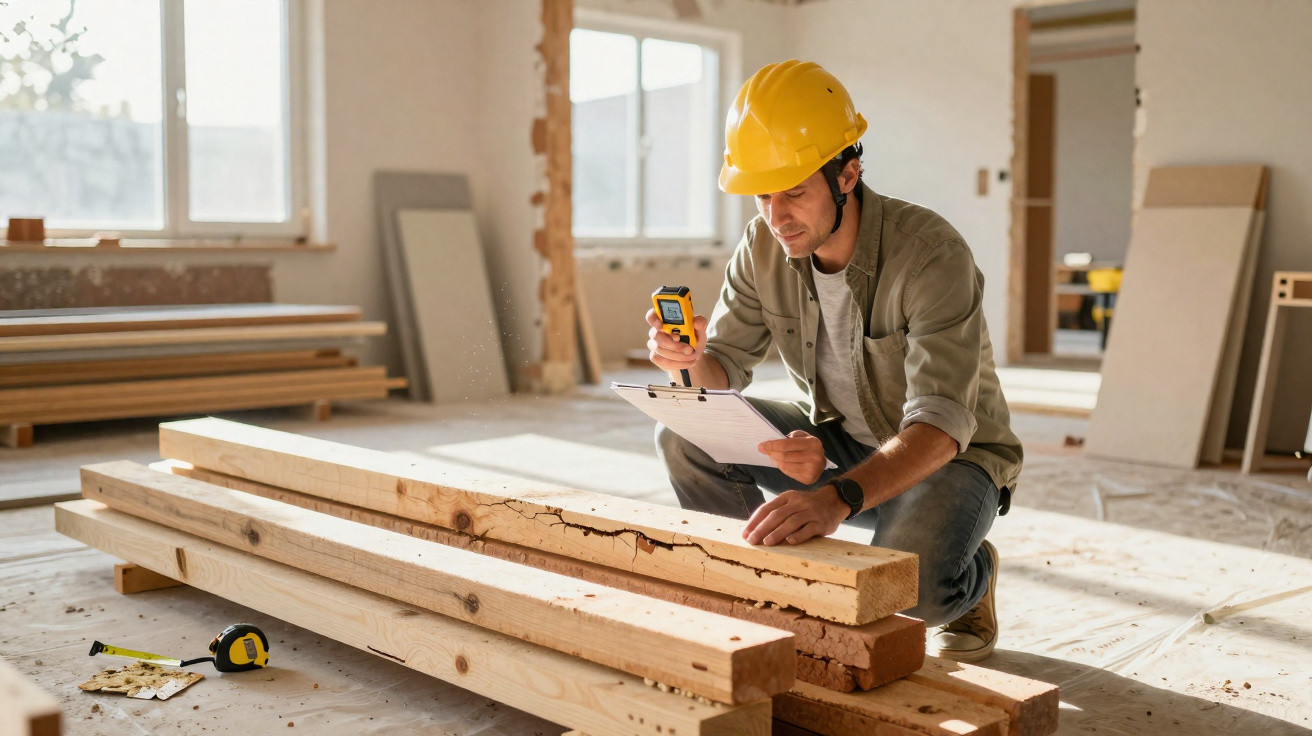
The skip lorry was still parked outside the neighbouring house when Marc noticed pallets of paving slabs, roof battens and several doors stacked behind the barriers. The site manager had apparently called out, “take whatever suits you, it’s going in the skip”, and the offer looked far too good to decline. Three years later, as he prepared to sell his home, an expert appointed by the buyer inspected his patio, garden shed and rebuilt partition wall. His expression changed. Marc believed he had saved almost €4,000. He then realised those free materials could now cost him considerably more.
When “free” materials become a genuine risk
We all recognise the moment when an opportunity appears out of nowhere: unopened bags of cement, clean plasterboard sheets, timber that looks to be in sound condition. On a building site, what is taking up space for one person may be genuinely useful to someone else. Marc collected the materials enthusiastically, already picturing his finished patio without stretching the household budget. The issue was not his wish to do DIY work, nor was it the principle of reuse. It was what he could not see.
During the inspection, the finding concerning the old slabs used outside the house was clear: their source could not be traced, and some had cracks concealed beneath a recently laid covering. The expert also noted that the roof battens came from a temporary structure and had been stored in the rain for several weeks. Marc had saved roughly €1,200 on timber and €1,800 on slabs. Three years later, the estimate for removal, inspection and remedial work had already risen above €7,500.
Reclaimed material is not automatically poor-quality material. It may be entirely suitable, provided that its origin, condition, original purpose and the rules governing the intended work are known. A fire door, for instance, no longer performs its function if it is installed without its matching frame; a slab may appear robust while being unsuitable for a patio exposed to frost. Free materials can sometimes carry a hidden cost: uncertainty. That uncertainty becomes very real when an insurer, surveyor or prospective buyer starts asking questions.
What the expert checks before assessing the damage
Before incorporating reclaimed materials into building work, the simplest approach is to obtain written evidence: a transfer note, a zero-value invoice, photographs taken when the items were collected and, where possible, the product references. This does not turn an old beam into a certified component, but it helps establish that it was acquired lawfully and provides a record of its journey. Professional advice can prevent many unwelcome surprises where structural, electrical or insulation materials are concerned.
A common mistake is assuming that a site manager can give away anything on site without paperwork. In practice, the materials may belong to the contractor, the client or a subcontractor, while certain waste products must follow a designated disposal route. Marc was not trying to bypass the rules; he heard a remark made between two tasks and took it literally. Let us be honest: hardly anyone deals with this sort of situation every day, especially when a lorry is waiting and everyone appears to be in a hurry.
An expert looks beyond appearances. They assess strength, whether installation complies with requirements, possible contamination and each party’s liability if the material causes damage. In Marc’s case, the missing documentation made discussions with the insurer more difficult and put off the potential buyer.
“A second-hand material can be an excellent option, but you must be able to show what it is, where it came from and why it is suitable for its intended use,” explains a building expert regularly called in to disputes between sellers and buyers.
- Ask for written confirmation before removing anything, even a few pallets.
- Photograph the condition of the materials and record their intended use.
- Do not reuse load-bearing, electrical or fire-resistant components without inspection.
- Keep quotations and installation evidence where a tradesperson carries out the work.
Reusing materials: sensible savings without creating a problem
Reuse makes sense: it cuts waste, gives sound materials a second life and can reduce the cost of renovation work. Being cautious does not mean refusing everything; it means sorting carefully. Decorative paving blocks, metal shelving or boards used to build a compost bin do not carry the same consequences as roof structures, waterproofing membranes or consumer units. The intended use of the material changes everything.
In Marc’s case, the problem was not solely the damaged slabs. It was the wider situation: work completed without precise supporting evidence, a patio that could not be properly checked without taking it apart, and a property sale in which every uncertainty becomes a bargaining point. The buyer does not necessarily have to prove that a defect exists in order to seek assurances or revise their offer. Sometimes it is enough to find that nobody can clearly answer the technical questions.
A saving made on a building site can therefore remain a good idea when it is supported by a basic method: identify the item, document it and arrange inspection when the stakes go beyond straightforward DIY. Reuse is not the problem; improvisation can be. Many homeowners learn this distinction too late, when dealing with damage, a neighbour dispute or a house sale. Sharing this kind of experience may encourage other DIY enthusiasts to look differently at materials piled up behind a site hoarding.
| Key point | Detail | Benefit for the reader |
|---|---|---|
| Origin of materials | Verbal permission is not always enough to demonstrate that materials were legitimately transferred. | Avoiding a dispute with the contractor, site owner or insurer. |
| Actual condition | Cracks, moisture damage and wear may not be visible at first glance. | Reducing the risk of expensive repairs after installation. |
| Intended use | A decorative item is not subject to the same requirements as a load-bearing component. | Choosing the appropriate level of inspection before starting DIY work. |




Comments
No comments yet. Be the first to comment!
Leave a Comment