
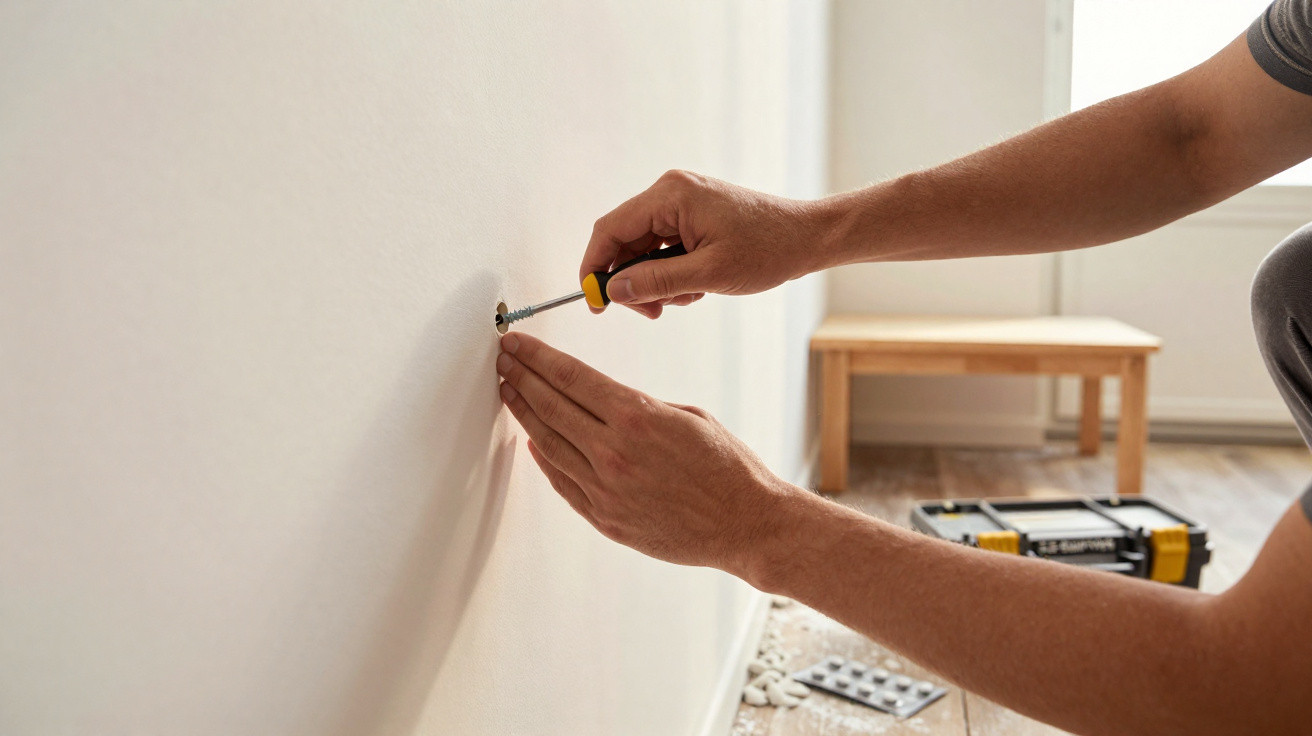
In many French homes, a stripped screw can leave an unsightly hole in the wall. One DIY enthusiast has revealed a solution costing only a few euros.
A damaged wall where a screw simply spins, a picture frame that no longer stays up, or a piece of furniture on the verge of falling: this is a familiar situation for many tenants and homeowners. In an article published on a DIY advice website and subsequently shared by a general-interest outlet, a DIY enthusiast sets out a straightforward, low-cost way to put things right without filling and repainting the entire wall.
A frequent issue in French homes
Whether in modern flats or older houses, loose screws are far from unusual. The problem often affects:
- plasterboard partitions;
- crumbly or ageing walls that break away around the wall plug;
- walls subjected to repeated strain, such as those behind heavy furniture or curtain poles.
Over time, the wall plug works loose, the hole gets wider and the screw eventually spins freely. Tightening it is no longer possible, while removing it can leave an even more noticeable hole. Traditional DIY guides generally advise filling the hole with plaster or filler, allowing it to dry, drilling again and then repainting. Although this method works, it requires time, materials and at least some DIY ability.
A roughly three-euro trick makes it possible to use the same fixing point again, without redoing the whole wall or opening a tin of paint.
That is exactly the approach highlighted in the tutorial described by the specialist website cited by the media outlet. It is aimed at householders who are not especially confident with DIY jobs.
The three-euro trick: an insert that gives the screw fresh grip
Rather than filling the hole, this technique gives it firm material again, allowing the screw to bite securely once more. It relies on a small piece of hardware, available from DIY shops for a few euros: an insert system or repair wall plug designed for enlarged holes.
According to the article, the process is as follows:
- Carefully remove the screw that is spinning freely, taking care not to enlarge the hole further.
- Clean out the hole, removing dust and any remaining plaster or concrete.
- Fit a repair component - a special wall plug, insert or expanding fixing - with a diameter slightly larger than the existing hole.
- Screw the screw back in, or use a screw of a suitable length to ensure it holds properly.
The DIY enthusiast behind the tip stresses the very low cost of the product: around three euros for several pieces, meaning that one packet can repair a number of holes. This type of accessory is often a slightly wider wall plug, sometimes made of metal and sometimes of reinforced plastic.
With a simple repair insert, a damaged hole can be used again within minutes, without filler or paint.
The article also points out that this option helps tenants avoid causing further damage, particularly when they do not want their walls to become a building site before a check-out inspection.
Why does a screw spin freely in a wall?
For French readers, the issue is readily explained by the materials most commonly used in construction. In newer homes, internal partitions are very often made from plasterboard fixed to a metal framework. It is easy to drill into, but does not cope well with weight concentrated at one point.
If the screw is too short, the wall plug is unsuitable for the wall type, or the item is too heavy, the material around the plug begins to deteriorate. The hole widens, the plug shifts slightly and the screw gradually loses all purchase. The same sequence can occur in hollow brickwork or friable concrete: material breaks away around the plug and the thread no longer grips correctly.
When should you use the trick, and when should you fill the wall?
The three-euro solution can restore an isolated fixing point, for example:
- a picture frame or mirror that no longer stays in place;
- a light shelf that has started to sag;
- a coat hook or small coat rack that is pulling away from the wall.
For these situations, a repair insert or wall plug intended for enlarged holes is often enough. The furniture or object can be secured properly again without major work. However, the media outlet, drawing on the advice of the DIY enthusiast interviewed, notes that this solution is not a substitute for genuine structural reinforcement when dealing with substantial loads, such as:
- a heavily loaded wall kitchen cabinet;
- a large television mounted on the wall;
- a bookcase full of books.
Where a wall is badly damaged or the load is heavy, the specialist instead recommends:
- using more fixing points over a wider area;
- choosing a different type of wall plug suited to the material, such as a Molly fixing for plasterboard;
- or removing the installation altogether to reinforce the partition or move the furniture to a load-bearing wall.
What this means for tenants in France
For tenants in France, the issue is about more than simply keeping a picture frame in place. Damage to walls can be deducted from the security deposit during the check-out inspection. Inexpensive, discreet hole-repair accessories can help to:
- repair an enlarged hole without repainting a large area;
- avoid several visible layers of filler beneath the paintwork;
- reduce the time spent on minor repairs at the end of a tenancy.
These repair inserts or oversized wall plugs, sold for around three euros, screw or clip into the existing hole and can easily be hidden behind the item being fixed. For a check-out inspection, they leave the wall looking far less marked than a succession of poorly filled holes.
Equivalent and complementary solutions available in France
Major DIY retailers and hardware shops in France offer several product ranges to address this kind of problem. Without naming particular brands, these include:
- expanding metal wall plugs for plasterboard, tightened using dedicated pliers;
- oversized repair wall plugs designed to fit into a hole that has already widened;
- chemical wall plugs, in which a resin bonds the screw to the wall and which are well suited to crumbly materials.
These options complement the three-euro trick described in the source article. The principle remains the same: restore solid material around the screw without having to redo the whole wall. The National Agency for Housing Information (ANIL), which provides guidance to tenants and property owners, also states that “minor maintenance work” is generally the responsibility of the occupier. This encourages people to seek out straightforward, economical options when screws come loose.
Checks to make before starting a wall repair
Before trying this kind of fix, a French DIYer should carry out a few checks:
- identify the wall type - plasterboard, brick, concrete or stone - by looking at the drilling dust or listening to the sound made when tapping it;
- assess the actual weight of the item to be fixed;
- select a screw and wall plug that can support that weight;
- avoid drilling repeatedly in the same spot, as this weakens the partition further.
Using a three-euro insert does not remove the need for common sense: if the furniture is particularly heavy or the wall already has cracks, calling in a professional may be the better option.
A simple method to combine with other good fixing habits
This quick repair tip can form part of a broader wall-maintenance approach. Several habits can reduce the risk of screws spinning freely:
- spread the load across several fixing points instead of relying on a single screw;
- use the fixings recommended by the furniture manufacturer, which are often designed for plasterboard walls;
- plan for wall rails or mounting bars during installation, so that items can be moved without drilling again.
A practical example is a kitchen: first secure a metal rail using several strong wall plugs, then hang the wall cabinets from that rail. If one hole deteriorates, the three-euro trick may be enough to restore it without removing the entire row of cabinets, while still relying on a set of reinforced anchor points.
For small everyday home improvements, combining an inexpensive repair accessory with sound fixing practice offers an appealing alternative to more extensive work. This is especially true for anyone who lacks the time or inclination to bring out the filler, paint roller and dust sheets every time a troublesome screw comes loose.




Comments
No comments yet. Be the first to comment!
Leave a Comment