
A wooden table that travelled with us from our first flat to the “proper” home, gathering scuffs from removals and stains from spilled wine. Nowadays, an increasing number of new flats arrive without one. Or they come with a flimsy folding surface propped against a wall, almost as though someone is apologising.
The real action has moved elsewhere in the home. It unfolds on a plush rug, around a low table, or on an oversized sofa with broad arms and pull-out trays. Mealtimes resemble picnics more than rituals. We sit cross-legged with laptops open and television screens glowing, while children sprawl across cushions.
The large rectangular table at the centre of the room can suddenly seem… dated. A waste of space. A foreign trend is quietly entering one room after another, reshaping the way we eat, chat and entertain. It may well be here for good.
The gradual disappearance of the “serious” dining table
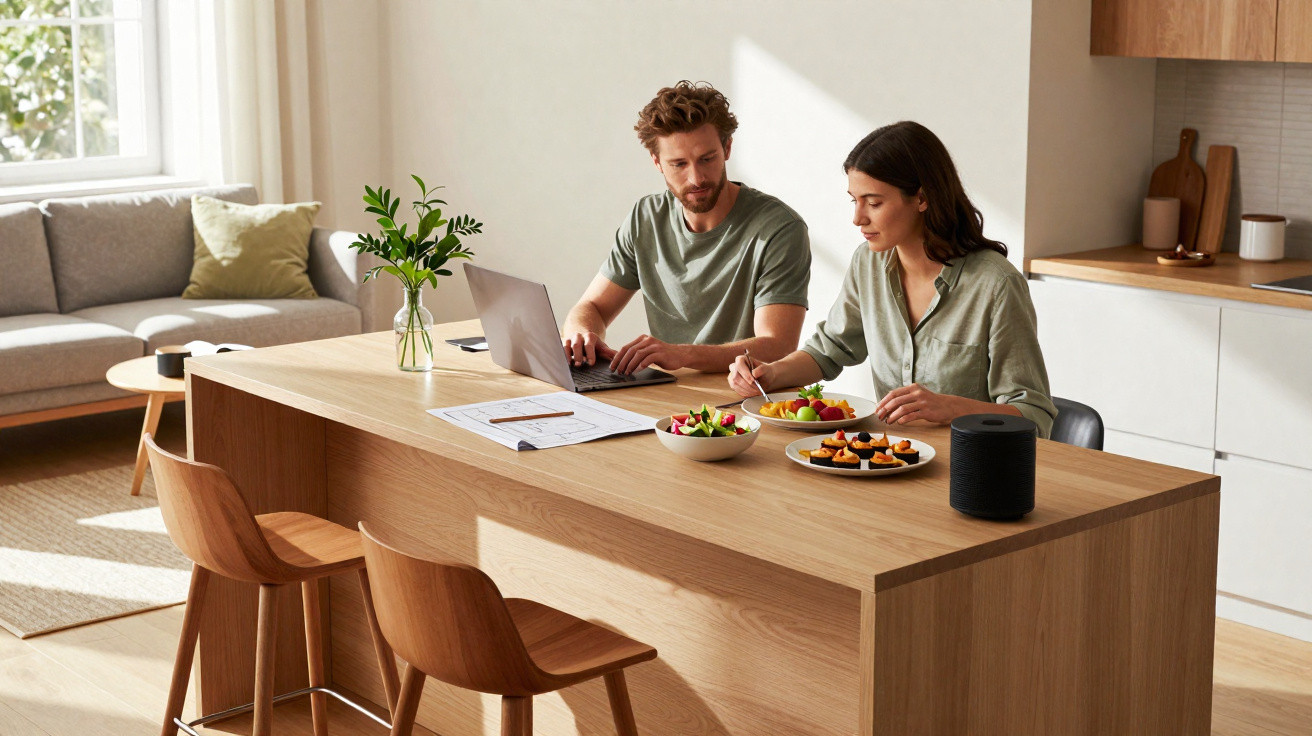
Step into a show flat in any major city and notice where you instinctively look. Instead of being drawn to an imposing dining table beneath a chandelier, your attention lands on the sofa, the low modular coffee table, or the kitchen island with two bar stools standing in for a dining area.
The idea is clear: everyday life takes place on the sofa and around the island. The familiar picture of a family seated at a table twice a day is fading away. Furniture is becoming lighter, lower and simpler to move aside for yoga, gaming or a brief workout. A formal dining table is beginning to resemble an exhibit from a museum of “adult life”.
In a compact London or Paris flat, a full-size dining table consumes a ridiculous amount of square metres. For many younger homeowners, it feels like an obligation rather than an aspiration. They would prefer to spend on a generous sectional sofa that serves as a guest bed, workstation and place to curl up together. The foreign trend arriving in Western homes is not really table-shaped at all. It draws on the Japanese chabudai, Korean floor-table customs, Moroccan salons where platters are shared on low surfaces, and Scandinavian kitchen benches. Eating is moving nearer to the floor, the sofa and the screen.
A 2023 survey of European urban renters revealed a striking pattern: more than 60 % of respondents aged 25–35 said that they seldom use a formal dining table, even if they own one. That represents a major change over only one or two generations. Their “main eating spot” is frequently a coffee table, kitchen counter or a low, wheeled multipurpose table.
Designers are responding accordingly. Major brands are promoting “living tables” that raise and lower, extend, hold blankets and conceal chargers. Property adverts depict weekday suppers at the island and friends squeezed onto the sofa, with platters balanced on a pouffe. The traditional six-seat oak table now tends to appear only in brochures for suburban homes with separate dining rooms, as though it belongs to a different social group and a different pace of life.
At its heart, this change concerns more than furniture. It shows how we bargain with time, closeness and screens. A formal dining table once represented a pause, a clearly bounded sequence: sit down, eat, talk, clear away, finish. These new layouts, influenced by foreign traditions, merge those activities together. We eat while working, watching or scrolling. Breakfast slips straight into emails without us even getting up. Eating at floor level or around the sofa may feel warm and relaxed, but it also takes away the old “border” that kept distractions away from conversation.
Architects describe “soft spaces” that accommodate small changing moments rather than fixed rituals. A floor table can host sushi with friends, an extended laptop session or an evening of board games without the room being rearranged. Yet there is a quiet downside: if every area is designed to do everything, no area properly protects a particular moment. That is the understated battle the dining table is losing.
Living without a dining table: making the arrangement work
When the large wooden altar of mealtimes leaves your home, you need an intentional alternative. “We’ll eat anywhere” cannot be the entire plan. Otherwise, before long, you are wolfing down pasta over the sink every evening with your phone in your hand.
Start by choosing a single main place for eating, however small it may be. It could be a rising coffee table in front of the sofa, a low floor table with cushions stored in a drawer, or a solid island with comfortable stools that do not leave your knees cramped. Create a small ritual around it: keep placemats in a basket, put condiments and cloth napkins on a tray, and use a lamp that is switched on only at mealtimes. Your mind needs visual signals that this is a proper moment rather than a gap between tasks.
One straightforward approach is remarkably effective: leave the surface largely clear. No laptops, stacks of post or unfinished Lego castles. If your “table” is a coffee table or island, clutter builds up within hours. Try a reset rule: before each meal, place everything unrelated to eating in a nearby “catch-all” box. Yes, it is a cheat box. Yes, it protects your sanity.
Plenty of people imagine elegant Asian-style floor dining, then discover that their knees are not made for it. Test the idea in real life instead. Spend an entire weekend eating on cushions or at a low bench, and see how long it takes before your back begins to object. Then choose equipment that suits your body, rather than simply your Pinterest board.
Let’s be honest: nobody really does this every day with the same care as an interiors magazine. The most frequent mistakes are intensely human. You eat on the sofa every night with plates balanced on your lap, then shout at the children when juice spills over the remote. The low table turns into a permanent snack shrine covered in crumbs. Every meal becomes “screen plus something to chew” because the television is right there, glowing away.
Abandoning the dining table also means abandoning some of its structure. You will have to create fresh phrases and routines. Say “let’s turn the TV off for just 15 minutes” before eating. Make a small rule such as “no laptops on the coffee table when there is food”. It may sound strict, but these measures mostly create a protected bubble in a room now required to perform ten different roles.
On the right evening, however, it can feel magical. People settle on the floor, shoulders loosen, shoes come off, and the conversation meanders for longer. Snacks and shared dishes move around more naturally when there is no rigid seating arrangement. It can feel a little like camping indoors.
“We sold our heavy oak dining table when our second baby arrived,” explains Clara, 34, living in a two-bedroom flat. “It felt like a wall in the middle of the room. Now we eat around a low table with storage inside. The kids lie on cushions, we sit on a bench. It’s messier, yes, but it’s the first time our living room actually feels alive.”
A few simple anchors can preserve that liveliness without letting chaos take over:
- A washable rug that visually defines the “meal zone”, no matter how small it is.
- Stackable stools or floor cushions that can be put away once the meal is finished.
- One dedicated tray to carry everything from the kitchen to the living area in a single trip.
- Gentle yet focused lighting above, or close to, the main eating space.
These are not merely decorative devices. They are small boundaries drawn through the haze of modern life, saying that here, briefly, we share something other than a notification.
What the foreign trend reveals about contemporary life
The foreign influence behind this shift is often misunderstood. It is tempting to cite “Japanese floor tables” or “Korean-style living rooms” as though they are simply visual themes. In fact, they embody broader ideas about adaptability, intimacy and the way our bodies occupy a room.
Traditional Japanese homes made use of low tables that could be moved, folded and stored away. A room took on different purposes over the course of a day. A mattress could be rolled up to turn a bedroom into a sitting room, while a dining room could become a workspace in minutes. Contemporary micro-flats in Europe and the United States face the same issue, with much less space than homes had in the past. That makes the foreign trend not merely fashionable, but brutally useful.
Moroccan salons provide another example: a large U-shaped sofa surrounds a low table and encourages everyone to lean in. There is no “head of the table”. Food is shared and tea is poured again and again. A similar arrangement is gradually appearing in Western living rooms, through giant sectional sofas and communal dishes placed in the middle. The previous hierarchy of dad at the head of the table, children at the corner and a guest at the side is quietly disappearing.
For many families, that can feel freeing. Even so, something valuable may be lost if we allow the dining table to disappear without reflection. Symbolically, the table acted as a pause button. You had to leave the sofa, keep the laptop in another room and physically gather around wood and plates. It offered a reason to say things that might never be said while half-watching a series.
The real question, then, is not “will dining tables disappear?” but “what kind of shared space do we want instead?” Some households will retain a small extending table for special evenings. Others will fully embrace floor-style dining with cushions and platters, while keeping a clearly visible phone basket nearby. A few will eat contentedly at the island and keep the rest of the room free from screens.
On a calm evening, when the main light is turned off and a low lamp beside the eating area shines, the furniture’s shape almost ceases to matter. What remains is the short-lived sense of being together, whether you are eating on a rug, a bench or a floating board attached to the arm of the sofa. The foreign trend is here to stay, certainly. But the way you adapt it, or reshape it, may become one of the most personal decisions you make at home.
Some people will insist on keeping a substantial table in the middle of the room, even if it also functions as an office, laundry station and homework base. Others will happily say that they have not owned a dining table for years and enjoy being able to move their plates wherever the day takes them. Neither position is wrong. Both are dealing with the same pressures: smaller homes, longer working days, brighter screens and a stronger desire for softness.
At one level, this is not a conversation about furniture at all. It concerns what we are prepared to shield from the endless current of everything else. Are we content for dinner to merge with emails and TikTok? Or do we still want a corner, high or low, where time slows for twenty minutes and faces replace feeds?
The old family table may disappear from floor plans, showrooms and Pinterest boards. Perhaps it will survive only in holiday homes and country kitchens. Yet the need it met has not disappeared. It is now concealed in low tables, deep sofas, kitchen benches, islands and rugs. The real trend is not foreign at all: it is our persistent wish to sit together, even as the world keeps trying to draw us apart.
| Key point | Details | Why it matters to readers |
|---|---|---|
| Select one main eating spot | Decide whether your “main table” will be a coffee table, kitchen island or low floor table. Keep it largely uncluttered and provide a simple meal kit: placemats, napkins and basic condiments on a tray. | A designated location stops meals spreading into random parts of the home and helps preserve at least one daily moment from constant multitasking. |
| Test floor or sofa dining properly | Spend a weekend eating only in the arrangement you intend to use, noting back pain, plate stability and children’s behaviour. If your body objects, alter the height with risers, benches or thicker cushions. | Trying the layout before spending money prevents you from purchasing attractive furniture that you secretly dislike using after 20 minutes. |
| Establish a quick “pre-meal reset” ritual | Before every meal, use one storage box or basket to clear laptops, toys and paperwork from the eating surface. Switch on a lamp or light a candle reserved for mealtimes. | A small, repeatable routine shows everyone that this time is different, even when you remain in the same room and on the same sofa. |
FAQ
- Is it really okay to live without a traditional dining table? Yes. Many urban households work perfectly well with only a kitchen island, convertible coffee table or floor table. The important thing is to give one of these areas some structure and ritual, so meals continue to feel shared rather than chaotically improvised.
- What’s the most practical alternative in a small flat? A lift-top coffee table is often the strongest compromise. It allows you to eat at a comfortable height in front of the sofa, includes hidden storage and lowers again when you want more open space or an unobstructed view.
- How can I keep kids from making a mess when we eat on the sofa or floor? Choose a washable rug and introduce a simple rule: food stays on the rug and drinks stay on the table. Low, stable cups and trays with raised edges also limit accidents. More fundamentally, children adapt quickly when boundaries are clear and calmly repeated.
- Does eating without a dining table hurt family communication? Not necessarily. Constant distraction is what damages conversation. If you can turn off the television, put phones aside and sit facing one another, a low table or island can encourage discussion just as well as any oak table from the past.
- Can I still host guests without a big table in the middle of the room? Absolutely. Many people now hold “sofa dinners” or floor-style buffets with cushions and shared dishes. The key is to plan portions and surfaces: use large platters, small plates and stable places for glasses, so guests do not have to balance everything at once.

Comments
No comments yet. Be the first to comment!
Leave a Comment