
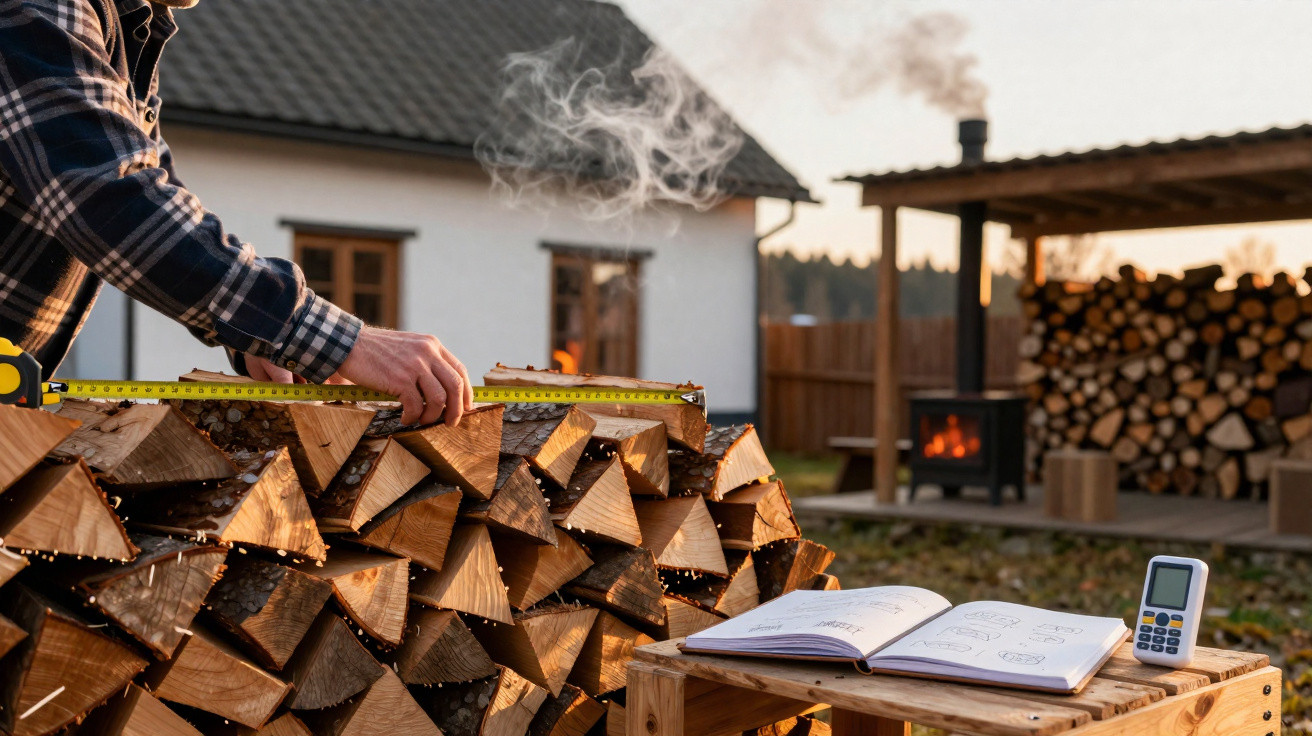
Wood heating brings a cosy atmosphere, may reduce reliance on fossil fuels and gives you a degree of self-sufficiency - yet getting your firewood order wrong could leave you cold in February or paying too much in October. This is how to calculate the cubic metres of firewood you genuinely require for an entire winter using a wood burner or insert.
What a “stère” means for your firewood stack
In France, firewood is often measured in “stères”, a unit broadly equivalent to one cubic metre of logs stacked at one-metre lengths. It appears straightforward, although what arrives on your drive can be rather less clear-cut.
Most current wood burners and inserts cannot accommodate one-metre logs. Merchants usually cut them into 50 cm, 33 cm or even 25 cm lengths. Shorter pieces fit together more closely when stacked. The amount of timber is unchanged, but the space it appears to occupy is smaller.
A “stère” is officially 1 m³ of one‑metre logs, but once cut shorter, the same wood may only occupy around 0.7–0.8 m³ on your floor.
In the UK and US, suppliers are more likely to use descriptions including “cubic metre bag”, “loose cubic metre” and “cord”. In North America, a cord traditionally measures 3.62 m³ of neatly stacked logs (4 ft high, 4 ft deep, 8 ft long). Always check whether a quoted amount is stacked or loose-tipped, as well as the length of the logs supplied. That seemingly minor distinction can substantially affect how long your delivery lasts through winter.
The main factors affecting how much wood you burn
No two households burn identical quantities of wood. Five principal factors determine whether five cubic metres sees you through winter comfortably or whether you get through twelve.
Home size and volume
Heating a compact 60 m² bungalow is very different from heating a 180 m² farmhouse with tall ceilings. Floor area alone does not tell the full story: ceiling height and open-plan spaces increase the volume that needs warming.
A typical modern, well-insulated 90–110 m² home using a wood burner as main heat source often needs around 5–7 m³ of properly seasoned hardwood per year.
In older homes with draughty windows and high rooms, that amount can readily be twice as high.
How effectively your home retains heat
Insulation usually makes a greater difference than any other consideration. A well-insulated property retains the warmth generated by the stove for longer, so fewer logs are needed.
- Homes with effective loft insulation, cavity-wall or solid-wall insulation, and double glazing can consume 30–50% less wood than comparable poorly insulated properties.
- Straightforward measures - such as sealing draughts around doors, chimneys and floorboards - can make a noticeable reduction in log use.
Appliance type and efficiency
An open fireplace may look impressive, but much of its heat escapes through the chimney. A contemporary wood burner or closed insert performs quite differently.
| Appliance type | Typical efficiency | Impact on wood use |
|---|---|---|
| Open fire | 20–30% | Uses large amounts of wood for limited room heat |
| Older stove (pre-eco design) | 50–70% | Delivers fair output but consumes more logs |
| Modern eco‑design stove or insert | 75–85%+ | Produces more heat from every log, requiring less wood |
If your appliance is more than 15–20 years old, replacing it may lower your yearly firewood requirement while also improving air quality both indoors and outdoors.
The type of wood you burn
Logs do not all perform equally. Dense hardwoods contain more energy per cubic metre and provide heat for longer.
- Hardwoods including oak, beech, ash and hornbeam are well suited to sustained heating. They burn slowly, create consistent embers and produce strong heat.
- Softwoods such as pine and spruce ignite easily and burn hot, but are used up quickly, requiring more visits to the log store.
For a main heating system, combining softwood for kindling and lighting with hardwood for the long burn offers a good balance of convenience and efficiency.
Climate and the way you use your stove
Homes in milder coastal locations may only need to light the stove for three or four months. In colder northern or inland regions, the heating period may last six or seven months. Daily routines matter as well: working from home, warming rooms throughout the day or running the stove until late at night will all increase wood consumption.
How many cubic metres of firewood suit your use?
After considering your home and your routines, you can identify a realistic firewood range.
Occasional “cosy evening” use
If you mainly light the stove at weekends and on a handful of weeknights while another system provides your primary heating, you will fall into the lowest range.
For decorative or occasional comfort use, plan for around 1–3 m³ of seasoned hardwood for the whole winter.
This quantity is appropriate for small to medium-sized, well-insulated homes where the stove is used several times weekly.
Regular back-up heating
Many households use a wood burner as a meaningful back-up heat source, reducing demand on gas, oil or electric heating, particularly during the coldest weather.
In this situation, a broad guide is:
- 3–6 m³ per winter for a reasonably insulated 80–120 m² home
- Nearer the upper end of this range for an older building or a colder area
Main or near-main heat source
When a wood burner or insert provides the primary heating, the size of your log pile is crucial. Running short can mean discomfort or costly emergency electric heating.
For full-time wood heating, most households fall somewhere between 5 and 12 m³ of dry hardwood per winter, depending on size, insulation and appliance efficiency.
A small, modern and exceptionally well-insulated semi-detached house may need around 5 m³. By contrast, a large, old rural property with high ceilings and an average stove can easily need 10–12 m³, particularly in more severe winters.
Practical ways to reduce wood use without getting cold
Cutting log consumption need not mean turning down the thermostat and being uncomfortable. A few specific actions can make a substantial difference.
- Burn dry wood only: Target a moisture content below 20%. Damp logs use energy to create steam rather than heat, while also producing more soot and creosote in the flue.
- Monitor your burn: Stove glass blackening rapidly and thick chimney smoke indicate poor combustion or wet wood.
- Maintain and sweep regularly: A clean stove and flue improve draught and combustion. In many countries, an annual sweep is a legal safety obligation.
- Match log size to the appliance: Evenly cut, shorter logs fit the firebox more effectively and burn more efficiently.
- Operate the controls correctly: Restricting the air supply too much all evening leads to tar deposits and reduced heat. It is better to maintain lively flames before allowing the embers to do their work.
Storing winter firewood: where genuine savings begin
The way you store logs often determines whether you benefit from all the energy they contain. Even properly cut hardwood can act like a wet sponge if it is placed directly on damp ground and tightly wrapped in plastic.
Good storage means air, protection from rain, and time - ideally at least 18–24 months’ seasoning for many hardwoods.
Raise the woodpile above ground level using pallets or rails. Protect its top with a rigid roof, sheet or tarp, but keep the sides open for unrestricted airflow. A south- or west-facing position lets sun and wind assist the drying process. Rotate supplies by burning the oldest and driest logs first, making each winter’s usage easier to predict.
Planning scenarios: two everyday examples
A modern, well-insulated family home
Consider a 100 m², three-bedroom new-build with strong insulation and a modern eco-design stove rated at around 7 kW. The family has gas central heating, but enjoys using the stove on most evenings and weekends between November and March.
- Usage pattern: 4–5 evenings per week, plus weekend days during cold spells
- Estimated wood need: 3–5 m³ of dry hardwood per winter
- Potential savings: better loft insulation and draught sealing could move them closer to 3 m³ than 5 m³
An older rural home using wood as main heat
Now consider a 150 m² stone house in a colder area, with partial insulation and a 10 kW wood burner as its principal heat source, supported by electric radiators.
- Usage pattern: stove lit from morning until late evening, from October to March
- Estimated wood need: 8–12 m³ of hardwood, according to winter severity
- Levers to reduce: window upgrades and internal wall lining could reduce wood use by several cubic metres annually
Key firewood terms and risks to understand
Two terms appear frequently in conversations about firewood: “seasoned” and “green” wood. Seasoned wood refers to logs dried for at least one to two years, normally outdoors under cover. Green wood has been freshly cut and still contains considerable moisture.
Burning green wood wastes energy and increases the risk of chimney fires due to sticky creosote build-up.
Burning mixed species without knowing their individual characteristics may also create difficulties. Quick-burning softwoods can look good value initially, but when a stove is the main heating source, you may require up to a third more volume than dense hardwoods to achieve equivalent comfort.
Lastly, consider pairing wood heating with other measures: programmable electric heaters in seldom-used rooms, heavy curtains over draughty windows and basic thermostatic controls. When your house loses less heat in other places, every cubic metre of properly stored logs will go further towards a relaxed, worry-free winter.




Comments
No comments yet. Be the first to comment!
Leave a Comment