
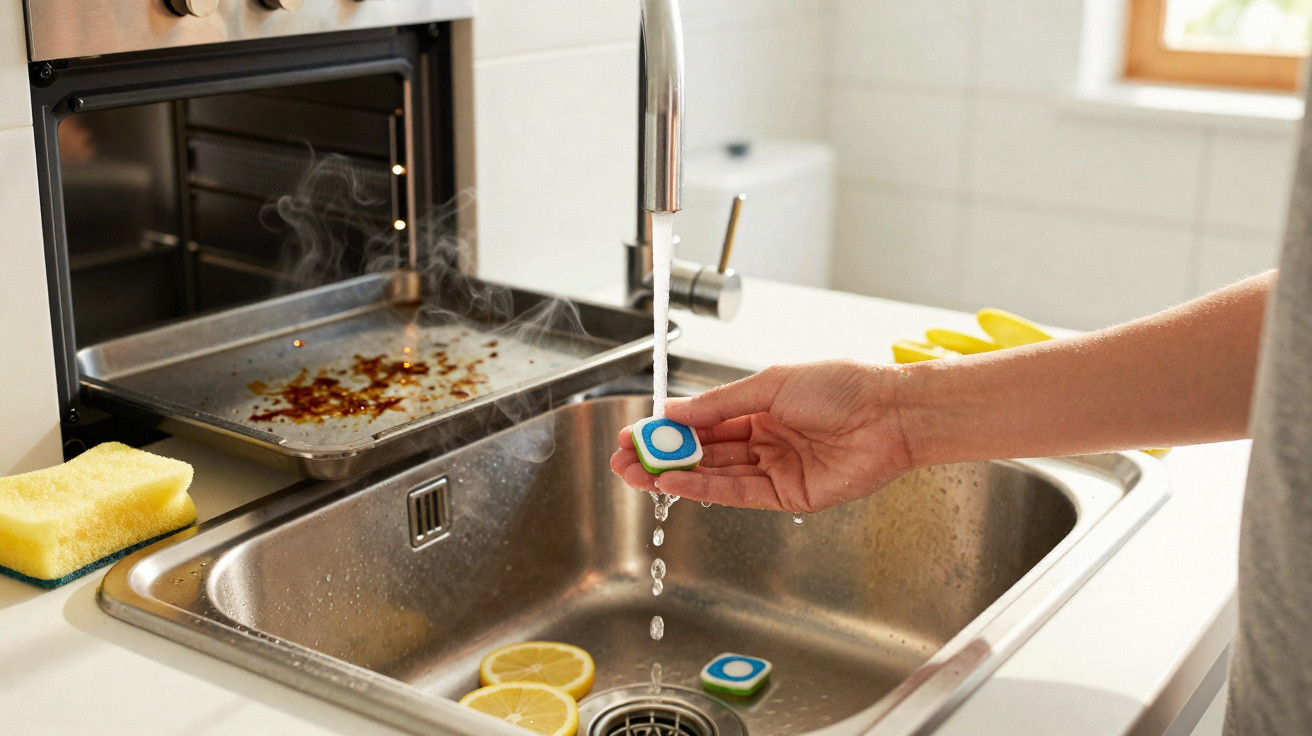
Almost everyone has them at home, but hardly anyone uses them anywhere other than in the machine: dishwasher tablets. Behind this compact cube is a remarkably powerful cleaning product that can do far more than wash plates and glasses. Used correctly, it can save time, scrubbing – and often the cost of specialist cleaners.
Why dishwasher tablets work throughout the home
A dishwasher tablet is essentially a concentrated blend of several cleaning functions. That is precisely what makes it so versatile.
“The tablet works as a degreaser, limescale remover and odour neutraliser at the same time – a combination that tackles many common problem areas around the home.”
When dissolved in hot water, its ingredients are released gradually. This helps soften stubborn layers of grime instead of requiring them to be scrubbed away with sheer effort. Burnt-on grease, limescale marks and unpleasant-smelling deposits in particular respond well to this mixture.
Where not to use a dishwasher tablet
It is still a powerful cleaning product, however. Keep a few no-go areas in mind so that a cleaning trick does not cause damage:
- do not use it on bare aluminium
- do not apply it to unsealed wood
- keep it away from natural stone, such as marble or travertine
- take care with delicately painted or coated surfaces
If in doubt, always test the tablet first on a very inconspicuous area. Wearing gloves also helps protect the skin from irritation.
Most importantly, never mix dishwasher tablets with other cleaning products, especially chlorine-based products or other strong bleaches. Rinse surfaces thoroughly with clean water after use and wipe them dry so that no residue remains.
Grease and burnt-on residue: how a dishwasher tablet helps in the oven
The oven is among the most unpopular cleaning jobs. Burnt-on splashes of fat, dark crusts and cloudy glass – it can be hard to know where to begin. This is exactly where a dishwasher tablet can show what it can do.
Cleaning an oven with the steam method
For the oven, all that is needed is one tablet and a heatproof container:
- Preheat the oven until lukewarm, around 50–70 °C and no hotter.
- Fill an ovenproof dish or roasting tray with very hot water.
- Dissolve the tablet completely in the water.
- Place the container in the oven and close the door.
- Wait around 10–15 minutes, then switch off the oven and allow it to cool slightly.
The steam produced distributes the cleaning ingredients around the oven cavity, loosening grease and baked-on deposits. A damp sponge or microfibre cloth is then often enough to remove the softened layer. Finally, wipe everything over thoroughly with clean water.
Do not overlook oven glass and shelves
The oven door and viewing panel can be treated separately. Put a little of the warm tablet solution onto a soft cloth, apply it to the glass, leave it briefly, then remove it with a second cloth and water. Avoid abrasive sponges, as they can scratch the glass.
Oven shelves and the roasting tray can be soaked directly in the sink or bath in hot water with a tablet. After half an hour, most baked-on residue can be removed using a soft brush or non-abrasive sponge.
Burnt pots and pans: when nothing else works
Look away for a moment and the base of a pan turns black. Normally, that means lengthy soaking and vigorous scrubbing. A dishwasher tablet can often speed up the process.
How the dishwasher tablet treatment works for pots
Use the following method for stainless-steel or enamel pots and pans:
- Fill the pot or pan with very hot water, ensuring the burnt area is fully submerged.
- Add one tablet and allow it to dissolve.
- Leave it for at least one hour, or overnight for particularly stubborn cases.
- Lift away the loosened residue with a wooden spatula or soft sponge.
- Rinse thoroughly several times.
The burnt-on layer will often come away in larger pieces. If further rubbing is still needed, avoid steel wool to prevent permanent damage to the surface.
Take particular care with non-stick pans: use a weaker tablet solution, do not leave it to work for too long, and avoid aggressive rubbing so that the coating remains intact.
Toilet bowl: a tablet for grey marks and limescale
Limescale rings and deposits can quickly build up at the waterline and beneath the rim of a toilet. A dishwasher tablet can provide targeted help here.
Instructions:
- Place the tablet directly in the toilet bowl.
- Let it fizz for several minutes until it dissolves.
- Use the toilet brush on the noticeable areas.
- Flush and ventilate the bathroom well.
A tablet will not remove deposits that have built up and hardened over years, but it can reduce typical limescale traces and odours. Heavily scaled toilets will also need a dedicated limescale remover. For occasional use, though, a tablet can noticeably improve the appearance.
Drain odours: how a dishwasher tablet helps in the drain
Kitchen and bathroom drains often collect grease, soap residue and food particles. This quickly leads to unpleasant smells. A tablet is not a replacement for clearing a fully blocked pipe, but it can help tackle deposits.
Freshening up a kitchen drain
Here is the simple way to stop odours:
- Put the tablet into the drain as close to the trap as possible.
- Slowly pour roughly two litres of boiling water after it.
- Allow it to work, without running cold water for several minutes.
The combination of heat and cleaning agents at least partly loosens grease and dried-on residue, flushing them further down the pipe. In many cases, the drain will smell noticeably more neutral afterwards.
If water is already draining poorly or only very slowly, however, a tablet cannot replace mechanical cleaning with a plunger, drain snake or removal of the trap.
Black bathroom grout: the dishwasher tablet as a grout helper
Tile grout in showers and around baths provides an ideal breeding ground for dirt and discolouration. Soap residue, shampoo, shower gel and constant moisture create dark edges and marks. Here too, a dishwasher tablet can form part of the solution.
Cleaning paste for greyed grout
A thicker mixture works best for grout:
- Dissolve one tablet in a small amount of hot water, using only enough to create a thick paste.
- Optionally add a little bicarbonate of soda or baking soda to thicken the paste.
- Apply it to the grout with an old toothbrush.
- Leave it to work for several minutes.
- Rinse carefully with water and a sponge.
The effect is particularly noticeable on light-coloured grout. Anyone dealing with grout badly affected by mould should monitor the affected areas closely: where stains are deeply embedded, long-term results will only come from replacement or a specialist anti-mould product.
Keeping grout lighter for longer
A few simple habits help prevent fresh discolouration:
- After showering, use a squeegee to remove water from the tiles.
- Ventilate the bathroom, ideally with cross-ventilation or an extractor fan.
- Clean the first grey marks early, before they become properly dark.
Risks, limits and useful combinations
Dishwasher tablets are powerful. Using them too frequently or in the wrong places can result in dull surfaces, skin irritation or damaged materials. Children and pets should not come into contact with the tablets. Residue should not enter open waterways; instead, dispose of it through the normal drain with plenty of water.
They work particularly well alongside mechanical cleaning: soak with a tablet first, then work over the area with a wooden spatula or soft brush. This can save the use of many specialist products. Even so, it is worth choosing gentler everyday cleaners for ordinary dirt. The dishwasher tablet trick is most suitable for problem jobs that would otherwise require a great deal of effort.
Anyone familiar with their own home can test it selectively: a pot here, the oven door there, or a shower corner in the bathroom. It soon becomes clear where the small cube can become an unsung household star – and where conventional cleaners remain the better choice.


Comments
No comments yet. Be the first to comment!
Leave a Comment