
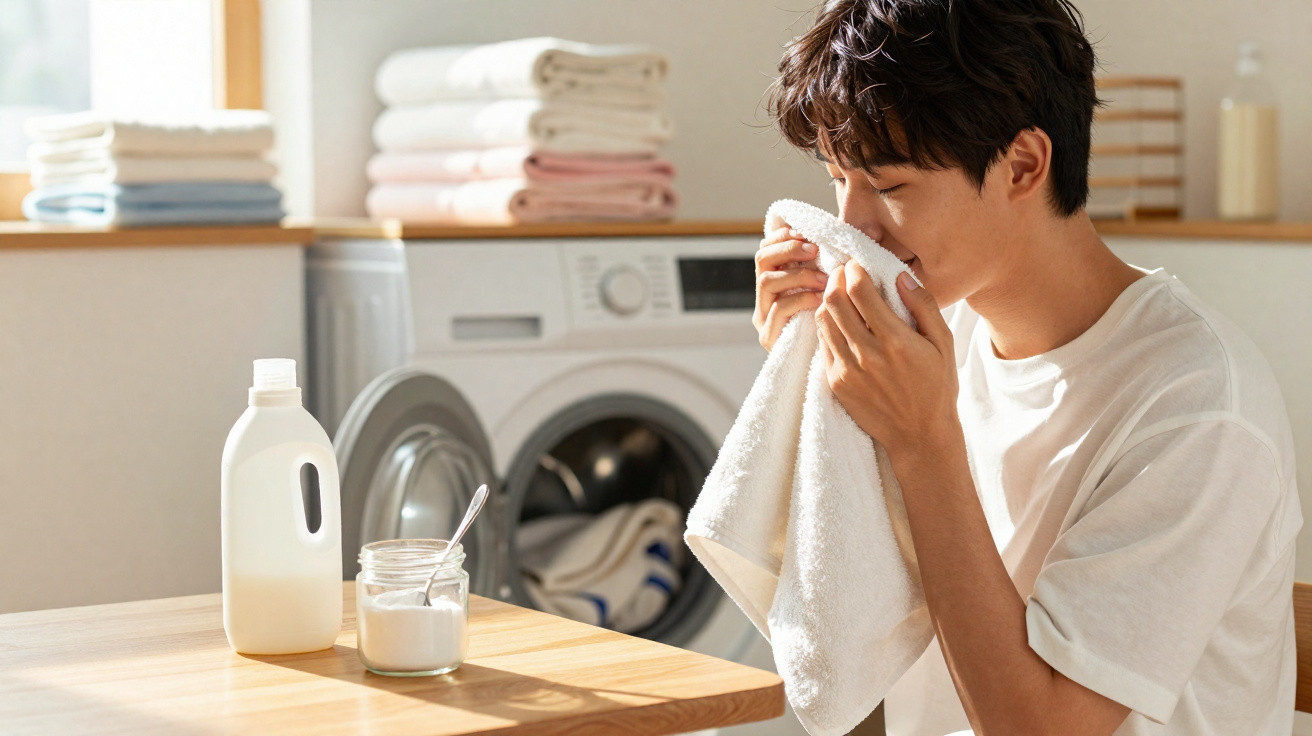
You leave the shower with your skin still warm, reach for a soft towel… and catch that slight sour smell. It is not quite rubbish-bin bad, yet it is far from spa-fresh. You press your nose to the cotton and sniff once more, puzzled. It has been through the wash. Still, it smells like “humid gym locker meets lavender detergent.” Hardly the atmosphere you wanted.
You look over at the towel rail. The material appears clean - even bright - but that persistent, dull odour will not go away. In your mind, you begin listing possible reasons: an ageing washing machine, bargain detergent, a windowless bathroom. Anything other than the possibility that your own routine is responsible.
Then an unpleasant little question appears.
What if the way you wash your towels is actually causing it?
The hidden dirt your washing machine does not reveal
The awkward reality is that many towels that seem “clean” are not truly clean at all. They contain unseen layers of body oil, shed skin, product residue and detergent that was not fully rinsed away. Because you cannot see these deposits, they are easy to overlook. The smell is often the only clue.
Each time you dry yourself, you work that combination further into the fibres. The towel is then left slightly damp, folded up or scrunched on a hook, creating a warm little environment for bacteria. The following wash may cover the problem with fragrance temporarily. But when the towel becomes wet again, the unpleasant smell returns.
That is how towels can appear immaculate while still smelling like a wet dog in a basement.
A woman I interviewed had precisely this issue in her compact city flat. She blamed the old radiators, the tight bathroom and the “bad air”. She bought costly detergent, changed to hypoallergenic fabric softener and even tested the brightly coloured fragrance beads advertised on television. Her towels emerged smelling of tropical flowers… for roughly 30 minutes.
By the following morning, after a single shower, the same sour undertone had crept back. She began washing loads again, sometimes twice or three times, in pursuit of that “hotel towel” feeling. Her electricity costs rose, her patience disappeared, and the whole thing became almost embarrassing. A clean person with smelly towels is not exactly something to boast about.
Once she altered one small part of her washing routine, the odour was gone within a week.
The explanation for that smell is fairly straightforward, if a little unpleasant. Towels behave like sponges for sebum, dead skin and soap scum. Gradually, the accumulation coats their fibres, preventing water from reaching far enough in to rinse everything away. Detergent attempts to get through the grime, does not manage it, and then leaves another layer behind.
Next come bacteria and mildew. Damp, dark and warm fibres are ideal for them. They consume the residue and give off volatile compounds that we interpret as “musty” or “sour”. Adding more fragrance merely perfumes an unwashed body. That weird smell is proof that your towels are slowly being marinated in their own history.
The real surprise is that one laundry error nearly everybody makes is what keeps this cycle going.
The one mistake: you are using too much of the wrong things
The major, unexciting and slightly uncomfortable truth is this: most people use far too much detergent and fabric softener on towels. That is the mistake. It is not a case of using too little, but of using too much. You see a large, fluffy pile in the machine, assume it is a “heavy load”, and pour generously. Perhaps you add a little extra “just in case”.
The problem is that dense towel fibres cling to this excess stubbornly. Detergent that remains after rinsing becomes sticky in the heat of the tumble dryer. It forms a film that retains moisture and bacteria. Fabric softener has a similar effect: it coats the fibres to make them feel soft, while gradually reducing their capacity to absorb and breathe.
The result is attractive towels that smell odd and no longer dry you effectively. Excellent for Instagram; dreadful in everyday life.
Picture a familiar situation. It is Sunday laundry day and there is a substantial pile of towels. You put them in the machine, choose a long programme, and fill the detergent drawer nearly to the top. You may add a cap and a half of softener for that “hotel” sensation. The drum looks packed, the suds are reassuring, and it feels as though you are being especially thorough.
When the programme finishes, the towels feel heavy, pleasantly scented and slightly warm from spinning. You put them into the tumble dryer or hang them up quickly. Everything appears fine. Yet after a couple of showers, that faint damp odour is back. You sigh and repeat the process, perhaps adding even more detergent because they must clearly be “very dirty”.
Let us be honest: hardly anyone studies the tiny dosage markings on the cap every time.
What you can smell is “product buildup” combined with old dampness. Excess detergent means the rinse programme cannot remove it all. Hot water dissolves part of it, but not everything. Softener is designed to leave a coating, and that coating works against freshness in towels. It obstructs the fibres, retains sweat and water, and prevents air from moving through them properly as they dry.
Eventually, the washing machine can begin to smell as well. The drum, rubber seal and detergent drawer all gather the same sticky mixture. Each fresh towel load is therefore being washed in mildly contaminated water. The odour becomes embedded in the whole system, rather than remaining only in the fabric.
This is why a small adjustment to your products and dosage can seem almost magical.
The routine that actually gets your towels fresh again
Start with a reset: one thorough detox wash followed by a simpler ongoing routine. For the reset, wash your towels on the hottest programme their care labels allow, without fabric softener and with far less detergent than you would normally use. Put a cup of white vinegar straight into the drum or the softener compartment. Instead of masking odours, vinegar can help break down residue and neutralise them.
If your towels are especially smelly and stiff, run a second programme with a scoop of bicarbonate of soda in the drum and no detergent whatsoever. This can help release any buildup that remains. When washing is complete, dry the towels straight away, either in a tumble dryer on medium heat or outdoors in genuine sunlight. The speed matters: do not leave them sitting in a damp heap.
After that, think of towels as items that need “low product, high air”.
For normal washes, keep things minimal. Use around half the bottle’s recommended detergent quantity for a full towel load. Avoid softener altogether, or keep it for special-occasion towels if you genuinely enjoy how it feels. Wash towels separately from clothing so they have enough room to move and rinse well. An overloaded drum leaves fabrics only partly washed.
Remove them as soon as the programme is over. Leaving them draped over a door for “a few minutes” easily becomes several hours. Focus on airflow: lay them out rather than folding them while they are warm, and do not stack them damp in a cupboard. At least once a week, make sure your bathroom towels dry fully on a broad rail instead of being bunched on a hook.
Be kind to yourself about this: having smelly towels does not mean you are “gross”. It simply means you live as most busy people do, with habits that nobody has taught us to examine.
“People assume bad smells mean dirt, so they throw more soap at the problem,” explains a domestic hygiene specialist I spoke to. “What towels usually need is the opposite: less product, more rinsing, more drying time. Freshness comes from clean fibers and moving air, not perfume.”
- Use less detergent - Half the usual dose is often enough for towels.
- Skip or reduce softener - Especially on everyday bath towels you want to stay absorbent.
- Wash hot, rinse well - Choose a hot cycle and, if possible, an extra rinse.
- Dry fully, and fast - No sitting in the machine, no bunched-up heaps on chairs.
- Deep-clean sometimes - Run an empty hot cycle with vinegar to freshen the machine itself.
Once this becomes routine, the “old towel smell” slowly disappears instead of coming back every week.
Fresh towels, lighter mind
There is something unexpectedly calming about reaching for a towel that smells of nothing at all. Not artificial sea breeze or overpowering flowers - simply dry, quiet, clean cotton. It can subtly transform the start of your day, much as a made bed can make a room feel more peaceful. Small household wins can have that effect.
Smelly towels are one of those minor everyday annoyances we learn to live with, like a dripping tap or a creaking door. We put up with them until suddenly we do not. When you address the cause instead of battling the symptoms, the sense of relief can seem out of proportion to the issue. That is the appeal of modest improvements to daily life: when they work, they become invisible.
Perhaps your next towel wash will not be an automatic task. You may use a little less product, spend a little less time between programmes, and leave more room when hanging them up. You might also spot other small household rituals running on autopilot that quietly bother you. The day you change one, your entire routine moves one step closer to ease.
| Key point | Detail | Value for the reader |
|---|---|---|
| Residue causes smells | Oils, skin cells and excess detergent coat towel fibres and trap bacteria | Helps you understand why towels stink even when they “look” clean |
| Too much product is the mistake | Overusing detergent and softener leads to buildup and poor rinsing | Shows what to change in your routine without buying expensive products |
| Simple reset, lasting results | Hot washes, vinegar or bicarbonate of soda, full drying and lighter dosing | Gives a clear, doable method to restore fresh, absorbent towels |
FAQ:
- Question 1: Why do my towels still smell bad right after washing?
- Answer 1: Because residue and bacteria remain trapped inside the fibres. Your detergent’s fragrance conceals the issue for a short time, but the underlying odour returns as soon as the towel becomes damp again.
- Question 2: Should I stop using fabric softener on towels?
- Answer 2: For everyday bath towels, yes - or at least use it only rarely. Softener coats the fibres, leaving them less absorbent and more likely to develop musty odours.
- Question 3: What is the best temperature to wash towels?
- Answer 3: Choose the hottest temperature listed on the care label, often 60°C. Greater heat helps eliminate bacteria and dissolve oils and product buildup.
- Question 4: Can vinegar damage my washing machine?
- Answer 4: Using reasonable amounts of white vinegar occasionally is generally safe for most machines and may help limit limescale and odours. If you are concerned, consult your machine manual or begin with smaller quantities.
- Question 5: How often should I replace my towels?
- Answer 5: With proper care, good-quality towels can last for several years. If they remain smelly, thin or rough after a deep clean, the fibres are likely worn out and it may be time to invest in replacements.






Comments
No comments yet. Be the first to comment!
Leave a Comment