
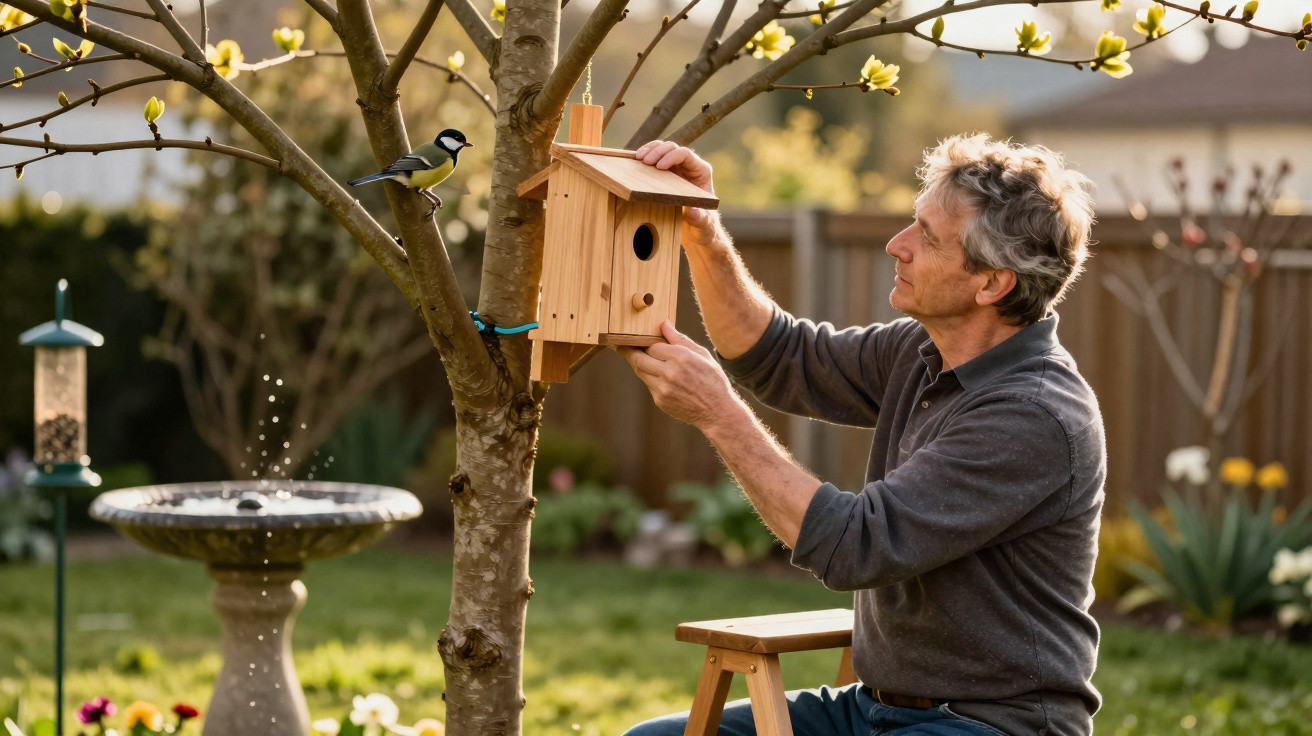
Many amateur gardeners recognise the situation: the nest box has been hanging for months, yet it remains unoccupied when spring arrives. The birds are rarely the reason; the problem is usually down to details such as entrance-hole size, positioning, cleanliness and peace. Getting a few essentials right now gives great tits and blue tits precisely what they need to raise a family – while bringing hands-on wildlife conservation right outside the window.
Why now is the ideal time for a tit nest box
Tits begin their breeding season early. From April to June, they generally lay five to twelve eggs, which are incubated for around two weeks. The chicks then spend almost three further weeks in the box before fledging. Well before the first egg appears, however, prospective nest sites are already being inspected.
In very early spring – often as early as March – pairs visit tree hollows, fence posts and nest boxes. They assess every aspect: security, quietness, dimensions, light and smell. A box that has been cleaned, prepared and installed correctly at this stage can quickly become their first-choice property during this “house viewing”.
“Cleaning, checking and correctly orientating a nest box before courtship begins significantly improves the chances of raising young tits.”
One important point: as soon as you notice a pair regularly entering and leaving, or carrying food inside, do not inspect it. Tits are strictly protected, so the box must not then be opened or moved.
How a nest box for tits should be built
Appearance may matter to people, but tits prioritise practicality. Decorative painted boxes with large openings and thin plywood may look appealing, but birds often regard them as unsafe. A suitable box is usually plain-looking, but robust and functional.
Suitable materials
- Untreated timber, preferably at least 18 mm thick
- No toxic paints or wood treatments inside the box
- Natural materials rather than plastic, as they moderate temperature better
- A roof with an overhang that channels rain away effectively
Unfinished timber creates a better climate inside and gives fledglings grip when they later climb towards the entrance hole.
The crucial entrance-hole size
Many boxes fail simply because the entrance is the wrong diameter. For tits, this is far from a minor detail: it determines both safety and competition.
| Species | Entrance-hole diameter |
|---|---|
| Blue tit | 25–28 mm |
| Great tit | 32 mm |
| Small birds generally | 28–32 mm (depending on the target species) |
From around 34 millimetres, the opening becomes attractive to larger species such as house sparrows. They may displace tits or take over the box themselves. Anyone aiming specifically to support tits should therefore pay close attention to entrance-hole size.
It is equally important not to fit a small stick or ledge beneath the opening as a “perch”. These projections mainly help cats, martens or magpies reach the entrance more easily.
Setting up the interior and hygiene correctly
The distance from the floor of the box to the lower edge of the entrance should be roughly four to six centimetres. This leaves a sufficient air space beneath the nest, ensuring the young are not level with the opening – providing extra protection from predators and the weather.
A hinged roof or sliding front panel makes cleaning straightforward. Once a year is generally sufficient:
- Remove the old nesting material in autumn.
- Scrape out the dry interior and clear away loose debris.
- Rinse with water, avoiding harsh cleaning products.
- Allow it to dry thoroughly before closing it again.
A brief check at the end of winter will reveal any dampness, mould or rodent droppings. Once tits begin making interested visits, the box should remain closed.
The perfect location for a tit nest box: height, direction and peace
Even an excellent nest box can stay empty if its location and orientation are unsuitable. Tits are happy close to the house, but avoid constant disturbance.
How high to hang the box
A height of two to three metres is ideal. This is:
- high enough to make access harder for cats and dogs
- low enough to be reached safely with a ladder
The box can be fixed to a tree trunk, a sturdy pergola or an outside wall. Tilting it slightly forwards helps rainwater run off instead of entering through the opening.
The right direction and a peaceful setting
The entrance should not face west or north, where rain and cold winds are more likely to hit the front directly. The following positions work well:
- East or south-east: gentle morning sun, dry conditions and a pleasant temperature
- Light shelter from branches or hedges, while retaining a clear approach route
The space in front of the box does not need to be completely bare like a runway, but birds do need an unobstructed flight path. Dense ivy immediately in front of the entrance is more likely to deter them.
Peace and quiet are particularly important. A nest box directly above a patio, beside a swing or by a frequently used front door can seem risky. Placing it close to a feeding station also creates too much activity.
“The feeding station can remain in the garden – but position it at least a few metres to one side so there is no constant traffic in front of the nest box.”
How to make your garden even more attractive to tits
One box may attract birds, but a wildlife-friendly garden can turn it into a permanent territory. Supporting tits means considering three essentials: food, water and cover.
Plants that genuinely benefit tits
During summer, tits feed their young mainly on insects and larvae. These do not come from a packet; they live on native plants. Useful choices include:
- Hedges of hornbeam, privet or hawthorn
- Fruit trees and berry bushes
- Herb patches with thyme, oregano and sage
- A wildflower meadow instead of closely mown lawn
Leaving some areas less than perfectly tidy, with leaf piles, a few dead stems and deadwood, creates countless insect hiding places – the ideal pantry for tit families.
Water and winter feeding
A shallow bowl of water or a small bird bath within sight of the nest box provides an additional attraction. Change the water regularly and scrub it with a brush when necessary.
Winter feeding stations help tits become familiar with the garden as a safe place. In spring, however, feeders and nest boxes should not be positioned too close together, so the breeding territory remains protected.
What you should never do
Good intentions alone are not enough: several mistakes can quickly make a box unattractive or even dangerous.
- Open or move the nest box during the breeding season
- Line the interior with carpet offcuts, cotton wool or fabric
- Use strongly scented wood preservatives or paints
- Allow cats to climb easily up to the trunk or wall
- Leave the nest box unprotected in intense midday sun
If you keep cats, you can avoid putting a bell on their collar by fitting a wide metal or plastic collar around the trunk that they cannot climb over.
Why the effort benefits people and nature
While feeding their young, a pair of tits catches thousands of insects, including aphids, caterpillars and mosquitoes. The nest box therefore becomes a biological “garden police force” against pests. At the same time, children and adults can observe an entire breeding cycle at close range – from the first cautious flight inside to the day the young leave the box.
Setting up a box also introduces useful terms: a design with a small round entrance is called a “hole-nesting box”, and tits are among these hole-nesting birds. Species such as robins and blackbirds, by contrast, prefer open-fronted nest sites or open nests. Different box types can be used to support particular bird species without causing them to compete with one another.
Over the long term, it can make sense to distribute several nest boxes around the garden rather than relying on just one, at different heights and in different directions. This creates small “bird neighbourhoods” where other native species can settle alongside tits. A quick clean every year in late autumn and a check in late winter provide the best conditions for a lively tit nursery in spring, rather than an empty wooden box in the tree.



Comments
No comments yet. Be the first to comment!
Leave a Comment