
Misted-up panes every morning, dark specks around the frame and a musty smell: many homes quietly struggle with excessive moisture.
Ignoring it can lead not only to flaking paint and crumbling silicone seals, but also to allergies and respiratory complaints. Alongside airing rooms and heating them, there is an often overlooked aid for damp windows: carefully chosen houseplants placed directly on the windowsill.
When the window ‘sweats’: what moisture really indicates
Warm indoor air can hold considerably more water than cold air. When this warm, humid air meets a cold windowpane, it cools rapidly. The water suspended in the air then settles into tiny droplets: condensation.
If these droplets remain on the glass, frames and seals day after day, they create a constantly damp microclimate. This is exactly what mould fungi thrive on. They initially appear in corners, then spread into silicone seals and may later affect the walls surrounding the window.
Specialists recommend relative humidity of between 40 and 60 per cent. If readings stay above this level for extended periods, typical warning signs can develop:
- windows that are regularly misted up or wet in the morning
- a musty, ‘cellar-like’ smell in individual rooms
- small black marks in seals and window frames
- peeling paint in corners above windows
An inexpensive hygrometer can be used to check this in every room. If it regularly shows more than 60 per cent, it is worth taking action before mould becomes permanently established.
Damp window frames are rarely only a cosmetic issue. They indicate an indoor climate that provides mould fungi with ideal starting conditions.
How houseplants on the windowsill can improve the air
Many houseplants do not react badly to humid air; instead, they make use of it. Through their leaves and roots, they absorb water from their surroundings and release it again later. Their effect on the indoor climate is therefore less like that of a dehumidifier and more like a mild buffer that can slightly reduce upward spikes.
Some species also filter pollutants from the air. NASA experiments into air purification by plants, among other research, point to this. In practical terms, a sensible combination of ventilation, heating, suitable furniture placement and carefully selected plants can make vulnerable window areas considerably more resilient to mould.
There is, however, a clear limit: plants alone cannot solve a moisture problem in a seriously affected home. They are one component, not a miracle cure. Without regular rapid ventilation, working ventilation systems and sound masonry, even the best-planted windowsill will achieve little.
Common mistakes with plants by damp windows
Anyone wishing to use houseplants to help combat mould should keep several points in mind:
- Avoid standing water: Empty saucers after watering, as waterlogging encourages mould in the pot.
- Use a well-drained pot: Drainage holes and a layer of expanded clay or gravel prevent waterlogged roots.
- Leave space from the wall: Do not press leaves directly against cold external walls, as concealed damp patches can form.
- Wipe leaves regularly: Dust and a film of moisture on leaves encourage fungal growth.
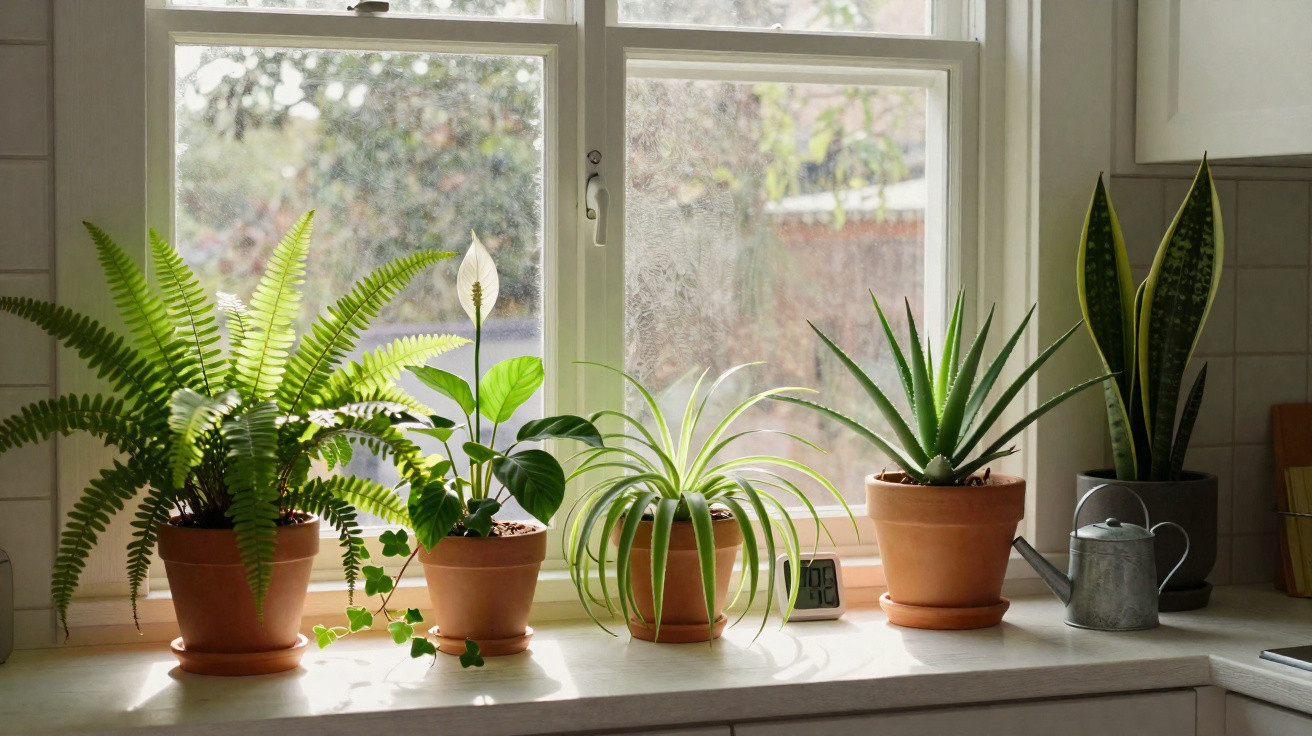
These six houseplants are particularly helpful by damp windows
Some species are much better suited than others to the humid, and often cool, conditions around windows. Here are six options that repeatedly stand out positively in studies and in practice.
1. Boston fern – the classic choice for bathrooms and kitchens
The Boston fern loves humid locations. It is generally very happy in a bright bathroom window without harsh midday sun. Its fine fronds absorb plenty of water from the air, and it usually copes well with temperature fluctuations.
The compost should remain evenly moist, but never wet. If the pot dries out completely, the fern quickly sheds leaves. Too much water in the saucer, on the other hand, causes the roots to rot. Loose, humus-rich compost helps maintain the right balance.
2. Peace lily – an air humidifier with a side effect
The peace lily is a near-classic among plants used to support indoor air quality. It absorbs moisture and certain pollutants from the air, while tolerating locations where many other plants would fail: partial shade, periods of very high humidity and positions close to a window.
There is an important point for pet owners: its leaves are toxic to cats and dogs. Anyone with pets should place a peace lily out of reach or select another species.
3. Ivy – a hardy mould competitor
Indoor ivy is fairly tolerant and manages surprisingly well with the slightly cool currents of air near a window. Whether grown in a hanging pot or placed on a windowsill, it uses the more humid air close to the glass and may help filter mould spores from the air.
It prefers bright to partially shaded positions and compost that remains relatively evenly moist. Strong, direct sunshine in high summer can scorch the leaves; light curtains or a place by an east- or north-facing window can help.
4. Spider plant – undemanding and quick-growing
The spider plant is rightly considered almost indestructible. It needs bright light without full sun and will forgive the occasional missed watering. Window recesses in living rooms or hallways are ideal.
Its long, narrow leaves increase the surface area through which water can be absorbed and released again. Positioning several spider plants next to one another enhances this effect, while also creating a small jungle look on the windowsill.
5. Aloe vera – for bright, relatively cool windows
Aloe vera is actually a succulent, meaning it stores water in its leaves. It copes very well with drier compost and tolerates temperature changes at the window more effectively than many delicate flowering plants.
It does well at very bright windows, such as south- or west-facing ones, provided that unfiltered midday sun does not shine on it for hours during high summer. Aloe is often a good choice for those who want to water infrequently while still doing something for the indoor climate.
6. Snake plant – minimal care, maximum resilience
The snake plant is among the easiest houseplants of all to care for. It tolerates dry air from central heating but also copes with slightly elevated humidity levels by windows. Its thick, upright leaves retain water and release moisture into the room only gradually.
It handles bright, even sunny light as well as partially shaded corners. For frequent travellers, this plant is a reliable companion for bare, sparse windowsills – and provides a small contribution to better air at no extra cost.
Combining houseplants with a sensible ventilation routine
Plants can only help if the rest of the indoor-climate management is reasonably effective. A simple routine is often sufficient:
- Open windows fully for 5–10 minutes in the morning and evening to air rooms quickly.
- Do not turn radiators off completely, so that walls do not become cold.
- Avoid pushing furniture directly against cold external walls; leave a little space.
- Place suitable plants specifically at vulnerable windows.
Brief cross-ventilation after showering or cooking in the bathroom or kitchen prevents large amounts of water vapour from spreading through the rest of the home in the first place. Plants that enjoy humid air benefit from this short burst of steam, without droplets remaining permanently on the windowpane.
Risks, limits and useful additions
Despite their advantages, plants also involve a certain risk: overly wet compost and permanently damp saucers can themselves become sources of mould. White fluff on the compost surface, a stale smell or small flies (fungus gnats) are clear warning signs. In that case, water less, replace the top layer of compost and improve the pot’s drainage.
Those who are particularly sensitive to mould should monitor growth in the pots and replace old or unhealthy plants promptly. Regularly removing dead leaves also reduces the risk.
| Plant | Ideal for | Light requirements |
|---|---|---|
| Boston fern | Bathroom, kitchen, humid rooms | Bright, without direct midday sun |
| Peace lily | Living room, bedroom (without pets) | Partial shade to bright light |
| Ivy | Windows with slight mould marks | Bright to partial shade |
| Spider plant | Almost all living spaces | Bright, but not permanent full sun |
| Aloe vera | Bright, cooler windowsills | Very bright, partly sunny |
| Snake plant | Bedroom, hallway, office | Bright to partial shade |
When help from plants is no longer enough
If substantial mould patches keep returning despite consistent ventilation, heating and plant placement, this often points to structural problems: leaking façades, thermal bridges, damaged seals or poorly adjusted ventilation systems. In that situation, professional assessment is difficult to avoid.
Those who act early have more options. A hygrometer, a critical look at windows and seals, and a few carefully positioned plants offer valuable clues. This can sometimes turn a mould-prone window into an attractive, healthy green feature rather than a permanently damp problem area.






Comments
No comments yet. Be the first to comment!
Leave a Comment