
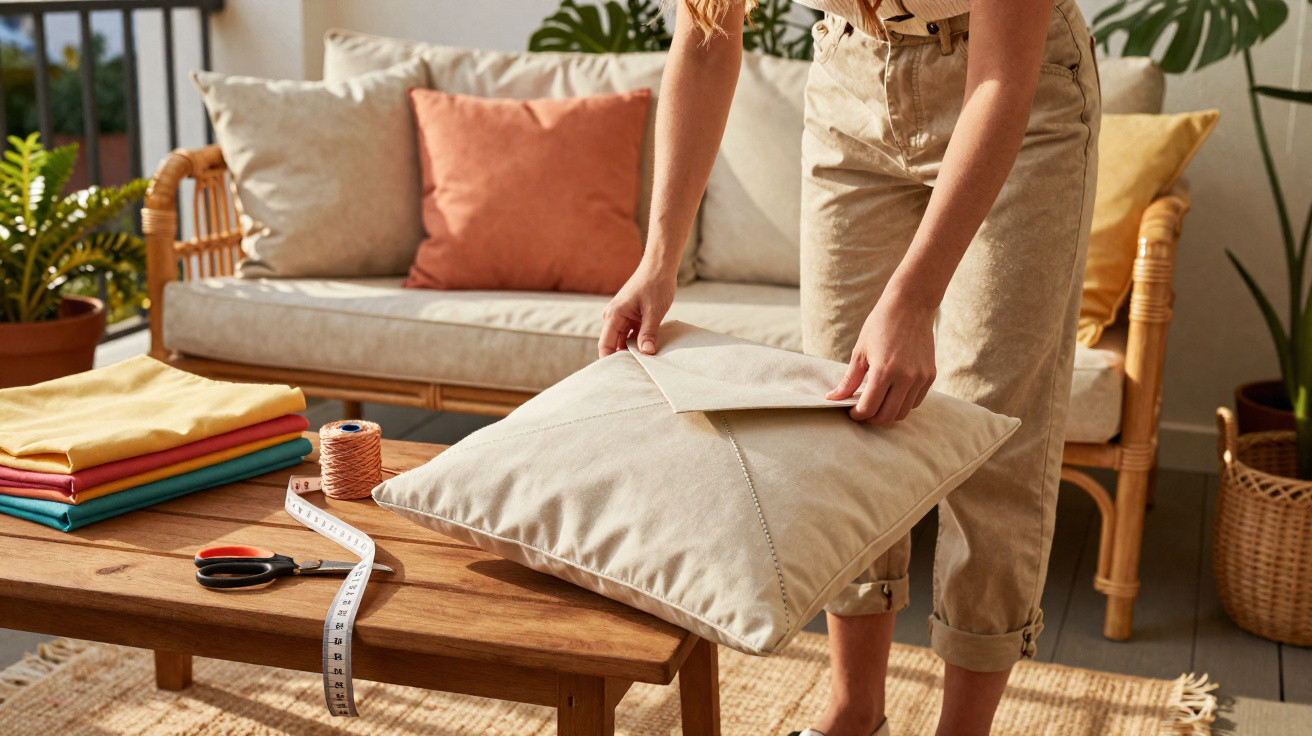
With a smart sewing idea, they can be restored surprisingly easily.
Many garden owners will recognise the problem: after several summers, seat cushion covers have faded, become stained and started splitting at the seams. Yet the filling is often still perfectly sound. This is where a straightforward sewing method comes in, giving old cushions fresh covers in next to no time – with no zip, specialist tools or extensive sewing experience required.
Why old patio cushions are still worth saving
When autumn or spring arrives, the first instinct is often to replace everything: new covers, or perhaps an entirely new lounge set. That soon becomes expensive and also adds to the contents of the bin. In fact, many supposedly worn-out cushions still have considerable value left in them.
Reusing the existing foam filling saves real money and cuts waste – a clear benefit for both your wallet and the environment.
The foam pads are often still shape-retaining, springy and hygienic; it is only their outer cover that has deteriorated. Sunlight may have drained the colour, drink stains may have become ingrained, and pets may have left claw marks or hair behind. These issues affect the surface rather than the core.
Addressing that problem instead of throwing everything away is a practical form of everyday upcycling. Rather than following the cycle of “buy – use briefly – throw away”, the materials remain in service for longer. This fits with modern efforts to reduce waste and the growing focus on making better use of existing resources.
The key solution: sew a simple envelope cover
The main idea is a cover that works like a pillowcase: an overlapping envelope design that needs neither a zip nor buttons. Instead of relying on a vulnerable fastening, the tension is carried by sturdy side seams.
Why this cut is so durable
Zips often tear away precisely when cushions receive the hardest use – when someone sits down, jumps onto them or shuffles about. Buttons can also pop off easily, especially with children, guests or pets around. Metal components may rust too when they are regularly exposed to damp conditions.
With the envelope version, the fabric overlaps at the back. The opening remains flexible and pressure is spread across a larger area. Delicate fittings are eliminated altogether. The cover is also far easier to put on and remove, particularly for large patio cushions that would otherwise have to be squeezed laboriously into tight cases.
The envelope cover brings together three benefits: easy construction, strong everyday practicality and quick cleaning.
How to calculate the measurements for the new cover
In this case, a pattern is not necessary: a tape measure, a straight ruler and a little mental arithmetic are enough. The crucial point is that the cover fits snugly without being overly tight.
For a square cushion, use these approximate steps:
- Width: Measure the cushion width and add around 3 cm for the side seams.
- Length: Double the cushion length and add roughly 20 cm for the envelope overlap.
- Overlap: The two fabric layers should overlap by about 15 cm at the back.
An example makes this clearer: if the foam insert measures 60 x 60 cm, the fabric piece should be approximately 63 cm wide and 140 cm long. The 63 cm covers the cushion width plus seam allowance, while the 140 cm consists of twice the cushion length and the additional fabric needed for the envelope flap.
Step by step: from fabric piece to cover
Anyone with a basic domestic sewing machine can get started. Sewing by hand is possible as well, although it will take longer.
- Hem the short sides of the cut fabric to prevent fraying.
- Fold the fabric so that the eventual outer sides face inwards and the short edges overlap by roughly 15 cm.
- Secure the overlapping edges with pins so that the fabric cannot shift.
- Stitch both long sides closed with a straight seam around 1.5 cm from the edge.
- Turn the cover right side out: the overlap will now sit inside, at the back of the cushion.
The foam pad can then be slipped inside. In most cases, the cover immediately fits neatly and tautly, creating a smooth surface with no creasing and no visible opening at the front.
What you really save by making your own cover
Ready-made patio cushions of good quality are costly. Large lounge-style seat pads can quickly cost between €40 and €80 each. For a full seating group with six or eight cushions, the total often runs into several hundred euros.
Buying only fabric and sewing the covers yourself can easily reduce the cost per cushion by more than half.
A typical example is a pallet seating set in the garden. After a few summers, the covers may be faded, scratched by a pet or damaged by sparks from the barbecue. Rather than buying a completely new set, only a few metres of outdoor fabric are needed. Within one afternoon, each foam pad can be given a new “dress”. The furniture looks renewed overall, without a single cushion ending up in the bin.
Choosing the right fabric for outdoor use
Material choice determines whether the work will last for several seasons or need repeating after the first summer. Fabrics designed specifically for outdoor use have a clear advantage here.
- High density: Tightly woven fabric withstands abrasion better, for example from sliding and shifting on the cushions.
- Lightfastness: UV-resistant fabrics fade more slowly.
- Fast drying: Water-repellent or quick-drying materials prevent the padding from staying wet for hours.
- Easy care: Wipe-clean surfaces make stain removal simpler.
An envelope cover without a zip creates a fully removable cover, and many versions can be machine-washed without difficulty. Choosing durable quality from the outset can significantly extend its usable life.
Invisible protection: a moisture barrier layer
Many cushions sit directly on timber, stone or pallets. Following rain or a damp night, moisture can rise from below into the foam. This can cause mildew marks, a musty smell and, over time, damage to the filling.
A simple barrier layer on the underside protects the filling without altering how the cushion feels to sit on.
An old shower curtain or a worn waxed tablecloth is often enough. Sew the material as an additional layer onto the inside of the underside – the section where the cushion touches the patio. This forms a barrier against rising damp, while the rest of the cover can remain breathable.
Useful extra tips for enjoying cushions for longer
Anyone putting the effort into sewing new covers can improve comfort and extend their life even further with a few simple additions.
- Removable labels: Small sewn-on tabs showing the size make sorting easier when washing.
- Contrast stitching: Visible stitching in a contrasting colour disguises minor irregularities and doubles as a design feature.
- Concealed handles: Short loops at the back make large cushions easier to carry without disrupting their appearance.
- Rotation system: Turn cushions from time to time so that sunlight and wear do not always affect the same side.
Those with limited sewing experience should begin with one cushion. The learning curve is steep: once the first cover is complete, the second is much easier to make. Minor imperfections are usually barely noticeable in everyday outdoor use – a strong, even seam and fabric that suits your own style matter more.
As well as saving money and preventing waste, the project has another benefit: it gives the seating furniture an individual character. Colours and patterns can be chosen freely, and offcuts or old curtains can be combined too. The result is one-off pieces that stand out clearly from the standardised range available in shops.
Comments
No comments yet. Be the first to comment!
Leave a Comment