
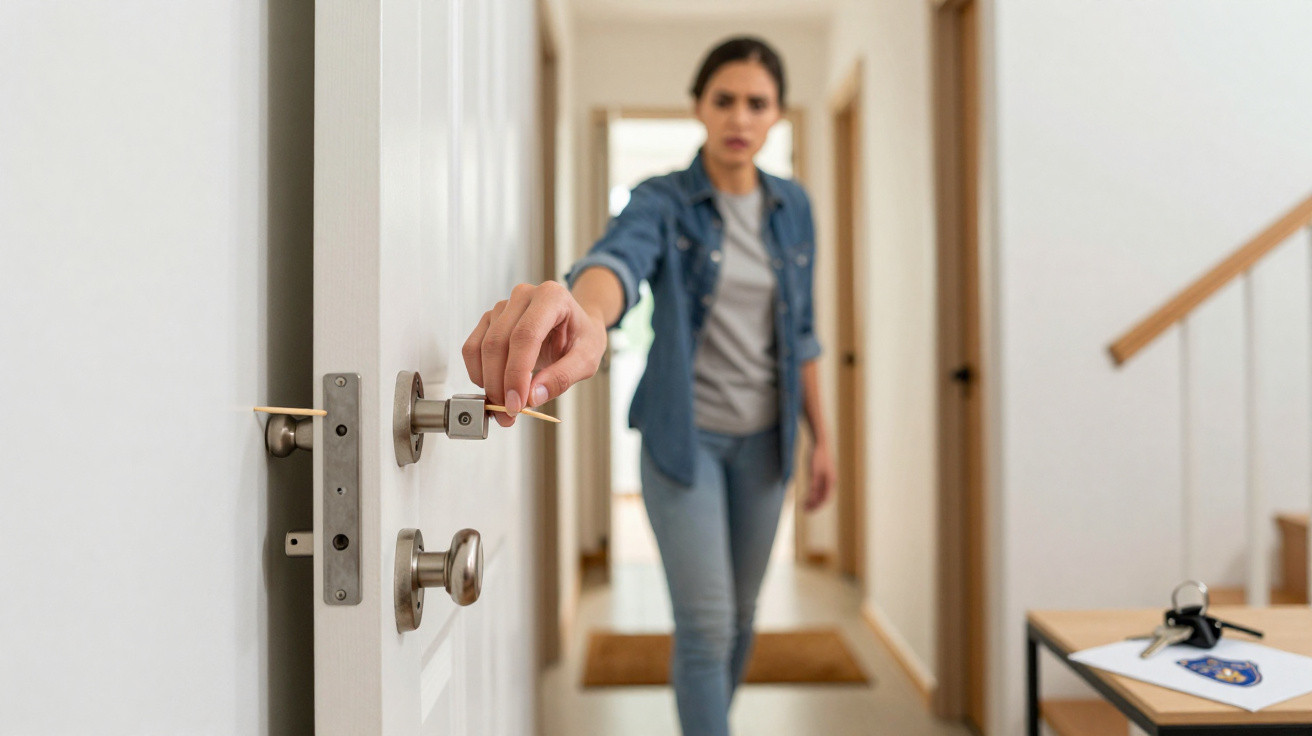
A tiny piece of wood suddenly appears in the front door – it may look harmless, but it can be a discreet signal for criminals.
Reports from several European countries are increasingly highlighting a striking clue on residential doors: a toothpick, almost invisible, concealed in the door or lock cylinder. Security authorities warn that burglars may use it to check whether a house or flat is genuinely unoccupied, allowing them to select targets without pressure.
How burglars scout houses using simple tricks
For years, burglary gangs have relied on small, inconspicuous markers to monitor flats without drawing attention. Before striking, they want confirmation that nobody is at home. Their chances of being caught increase where lights are on, people are coming and going, or neighbours are alert.
Common methods include:
- a tiny dab of glue or silicone on the door frame
- a narrow strip of paper placed in the gap around a door
- advertising leaflets deliberately left where they are
- brochures or sheets wedged into a letterbox
If these markers remain untouched for several days, criminals take this as a clear message: nobody is currently returning home, so the property is considered a worthwhile target.
The toothpick in the door: how this new method works
What is particularly new is the audacity of misusing an entirely ordinary item: the toothpick. In several cases in France, investigators independently came across the same pattern – a small wooden stick, discreetly wedged into a front door.
“The toothpick acts as a silent guard: if it does not move, burglars treat it as an invitation.”
The technique is straightforward:
- Offenders select a residential area with little activity during the day.
- They wedge a toothpick into the door gap or carefully insert it around the lock.
- It is barely noticeable from outside, especially if the toothpick is an unobtrusive colour.
- The following day, or several days later, they check whether the piece of wood remains in precisely the same position.
- If it is unchanged, they assume nobody has opened the door – the property is regarded as empty and therefore “safe” for a burglary.
This approach appeals to offenders because it is quick, cheap and difficult to prove. A toothpick that has fallen out can hardly be linked to a particular individual, while many residents would not notice such a small detail in everyday life.
Why Germany can also be affected
Burglary techniques do not stop at national borders. Organised gangs often travel across Europe, trial successful methods in different areas and adapt them to local circumstances. A tactic that works in one country frequently appears elsewhere after a short delay.
Crime statistics have shown for years that flats and detached houses are especially vulnerable when they are located in quiet residential areas, are difficult to see from the street and their occupants are regularly away at similar times. This is exactly where marking methods such as the toothpick are effective, as they reveal routines.
Anyone who commutes, works shifts or regularly goes away for weekends should therefore pay close attention to minor changes around their front door and in communal hallways. Even a tiny piece of wood in a lock may indicate systematic surveillance.
Warning signs at the front door: what to look out for
Small traces with major significance
Seemingly insignificant details can precede many burglaries. Typical reasons for suspicion include:
- a toothpick or matchstick in the door gap or around the lock
- thin plastic strips, scraps of paper or threads in the gap between the door and frame
- leaflets repeatedly hanging on your door in exactly the same way
- unusual chalk symbols or markings on doorbells, letterboxes or exterior walls
- door locks that suddenly become stiff or feel sticky
Anyone finding something like this should do more than simply remove the foreign object: note the time and take a photograph if possible. If comparable markers appear repeatedly, or if they are found at several flats in the same building at once, it is worth calling the police.
Take action rather than looking away
“Every early report of suspicious traces makes burglars’ work harder and protects entire neighbourhoods.”
Useful steps when you are concerned include:
- Remove all visible markers immediately.
- Speak to neighbours and ask whether they have noticed anything similar.
- Inform the property manager or landlord so that everyone in the building is made aware.
- Contact the police if there is a specific suspicion or repeated incidents.
How to make your flat less appealing to burglars
Create the impression that somebody is home – even when nobody is
Burglars avoid situations that appear active and unpredictable. Simulating occupancy can significantly reduce the risk. Practical measures include:
- Light timers: Set living-room or hallway lamps to switch on and off automatically in the evening.
- Outdoor motion sensors: Bright lights near the entrance or in the garden can deter unwanted visitors.
- Radio or TV simulators: Quiet background sounds can make a flat seem convincingly occupied.
- Vary blinds: Ask neighbours to raise and lower blinds or roller shutters at irregular intervals.
It is important that the pattern does not look too rigid. If lights come on at exactly 20:00 every day and switch off at 22:00, criminals will also spot the routine. Slightly varying times are better.
Involve neighbours and arrange cover during absences
No technical system can replace watchful neighbours. Maintaining a good relationship with people in the building creates an important layer of security. Helpful arrangements can include:
- emptying the letterbox while someone is on holiday
- accepting parcels for one another
- occasionally moving the curtains or roller shutters of a neighbour who is away
- asking suspicious people in the communal hallway whom they are looking for
Many towns offer schemes that allow residents to register periods when they are on holiday, so patrol cars can pass through the residential area more frequently. These arrangements are often organised through the local police or council crime-prevention services.
Technology and behaviour: what genuinely protects you
Mechanical protection for doors and windows
Marking methods such as the toothpick are primarily intended to establish whether a burglary is “worthwhile”. If an attempt follows, the resistance provided by doors and windows determines whether offenders succeed. Recommended measures include:
- robust strike plates and tested security locks
- additional crossbar locks on flat doors
- lockable window handles, particularly on the ground floor
- burglary-resistant glazing on easily accessible windows and patio doors
Many insurers reward approved security equipment with better terms. In the event of a claim, they often ask which security measures were in place.
Using alarm systems and cameras effectively
Smart-home solutions and low-cost camera systems are becoming widespread rapidly. They may not deter every professional, but they can shorten burglaries or at least provide evidence. A realistic approach is important:
- Cameras should be positioned lawfully, meaning they must not record neighbouring properties or public paths.
- Dummy cameras can discourage opportunistic offenders, but they are not a substitute for real security.
- Alarm sirens need to be loud and audible from outside, otherwise they offer little benefit.
The crucial factor remains the combination of technology and attentive behaviour: anyone who ignores toothpicks, glue spots or other traces on the door makes life easier for burglars. Those who pay attention, ask questions and report anything unusual significantly reduce the risk for themselves and their neighbours.



Comments
No comments yet. Be the first to comment!
Leave a Comment