
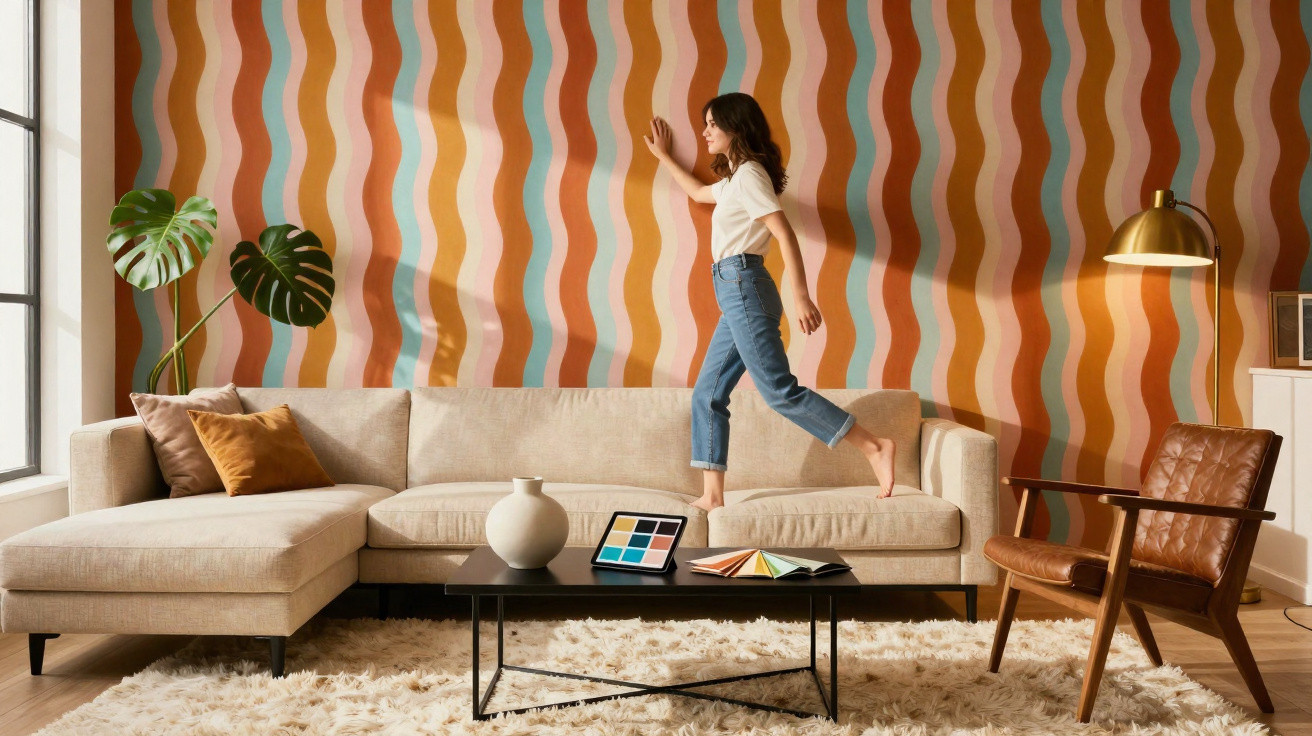
On a Saturday morning, in a flat still cluttered with moving boxes, a couple stands uncertainly in front of a slightly uninspiring white wall. Between two cups of coffee on the table, one sample draws every eye: thick, rounded lines in tobacco, cream and burnt orange that appear to shift as you step back. It brings to mind 1974 living rooms, our grandparents’ holiday homes and, at times, a faded photograph found in an old album. Yet in a contemporary interior, this wallpaper feels anything but dated. It introduces rhythm, warmth and the extra character that perfectly neutral walls do not always provide. Interior designers have understood this well: 1970s wavy stripes are making a major comeback in schemes planned for 2027. And they can transform a room completely.
Wavy stripes: the retro pattern that lifts overly restrained walls
In showrooms and home décor shops, one feature keeps appearing with striking consistency: walls are no longer confined to beige, off-white or mineral grey. They are welcoming graphic waves, usually vertical but sometimes horizontal, in earthy shades that instantly evoke the 1970s. The pattern catches the eye without taking over the entire room, provided it is given some breathing space. We all know the feeling: a living room can be clean and tidy yet somehow impersonal. A section of curved stripes may be all it takes to break that showroom-like effect. That is also part of its appeal: this wallpaper tells a story before guests have even crossed the threshold.
In Lyon, an interior architect recently covered the back wall of an alcove in chocolate brown, sand and ochre wallpaper, selected to echo the velvet of a vintage armchair found second-hand. The once-overlooked wall became the starting point for the whole room: ecru cushions, an opaline lamp and a walnut coffee table. According to several home décor retailers, searches for retro prints and seventies tones have risen sharply over recent seasons, driven by the desire to personalise homes without undertaking extensive work. One roll, one wall, one weekend: it is an appealing proposition. Retro is no longer about recreating the past; it is a way to make a space feel more alive.
This revival is far more than a passing nostalgic whim. Interiors in 2027 are seeking less catalogue-perfect styling and more texture, visual comfort and reassuring materials. Wavy stripes bring a gentle, almost organic energy, far removed from the cool geometry that dominated trends for so long. They suggest movement without making a room feel busy. The palette has changed as well: gone is the era of vivid orange on every wall, replaced by smoky khaki, honey, clay brown, petrol blue and terracotta pink. The seventies pattern has become softer and easier to introduce, whether in a period flat or a newer house. It does not need to overstate itself to make an impact.
How to use this wallpaper without turning your living room into a vintage television set
The simplest approach is to select just one wall that truly deserves attention. The wall behind a sofa, a headboard wall, an entrance area or the inside of a recess are all strong options, as the wallpaper creates an immediate effect without overwhelming the space. In a narrow room, vertical waves give an impression of greater height, while horizontal lines can visually widen a compact dining corner. Before placing an order, tape a sample to the wall and study it from morning to evening. Light changes everything: warm beige can turn grey, while a subtle orange may become far more intense. Let us be honest: hardly anyone does this every day, but with such a prominent pattern, this test can prevent plenty of disappointment.
The most common mistake is trying to match every object to the wallpaper, from the vase and throw to the curtains. It is understandable: when you love a pattern, you want to extend the pleasure. Designers, however, recommend keeping the surrounding surfaces calm. A plain sofa, a pale rug, medium or dark wood, and a few brushed-metal accents are more than enough. If the stripes combine three colours, pick out just one for accessories rather than using all three at once. The wall needs room to breathe. In a bedroom, a design with gentler contrasts encourages a cocooning atmosphere; in a kitchen or hallway, a bolder version can provide that welcome spark you had stopped expecting.
Before hanging it, measure the area carefully, check the pattern match and allow a safety margin: this type of design is unforgiving of rough cuts. The drops must align perfectly, particularly where the curves continue from one panel to the next. A well-prepared wall is often more valuable than expensive wallpaper installed in a hurry.
“Successful wallpaper does not fill a wall: it gives it presence.”
- Choose a focal wall rather than covering the entire room.
- Order a sample and view it at different times of day.
- Pair the pattern with furniture featuring simple lines.
- Allow 10 to 15% extra wallpaper for cuts and pattern matching.
In 2027, real luxury may mean daring to create an interior that is uniquely yours
The return of wavy stripes says something broader about our homes. After years of tightly controlled minimalism, many people are looking for rooms that feel less polished, where a preference, a memory or even a small risk can be sensed. Wallpaper inspired by the 1970s may recall a family kitchen, a childhood bedroom, a hotel seen while travelling, or simply the urge to move away from white without descending into clutter. It is not reserved for vintage enthusiasts or large, light-filled flats. In a studio, it can define a sleeping area; in a corridor, it can create an unexpected moment; and in a rental property, repositionable versions are now available. Most interesting of all is this renewed freedom: the freedom to create a setting that does not seek everyone’s approval.
| Key point | Detail | Added value for the reader |
|---|---|---|
| Pattern to follow | Wavy stripes inspired by the 1970s, in warm, muted shades | Create a standout wall without weighing down the overall décor |
| Best location | Wall behind the sofa, headboard wall, alcove, entrance or recess | Showcase the pattern with a manageable budget and workload |
| Successful pairing | Understated furniture, wood, plain textiles and carefully chosen accessories | Achieve a current, warm look that avoids a full retro theme |



Comments
No comments yet. Be the first to comment!
Leave a Comment