
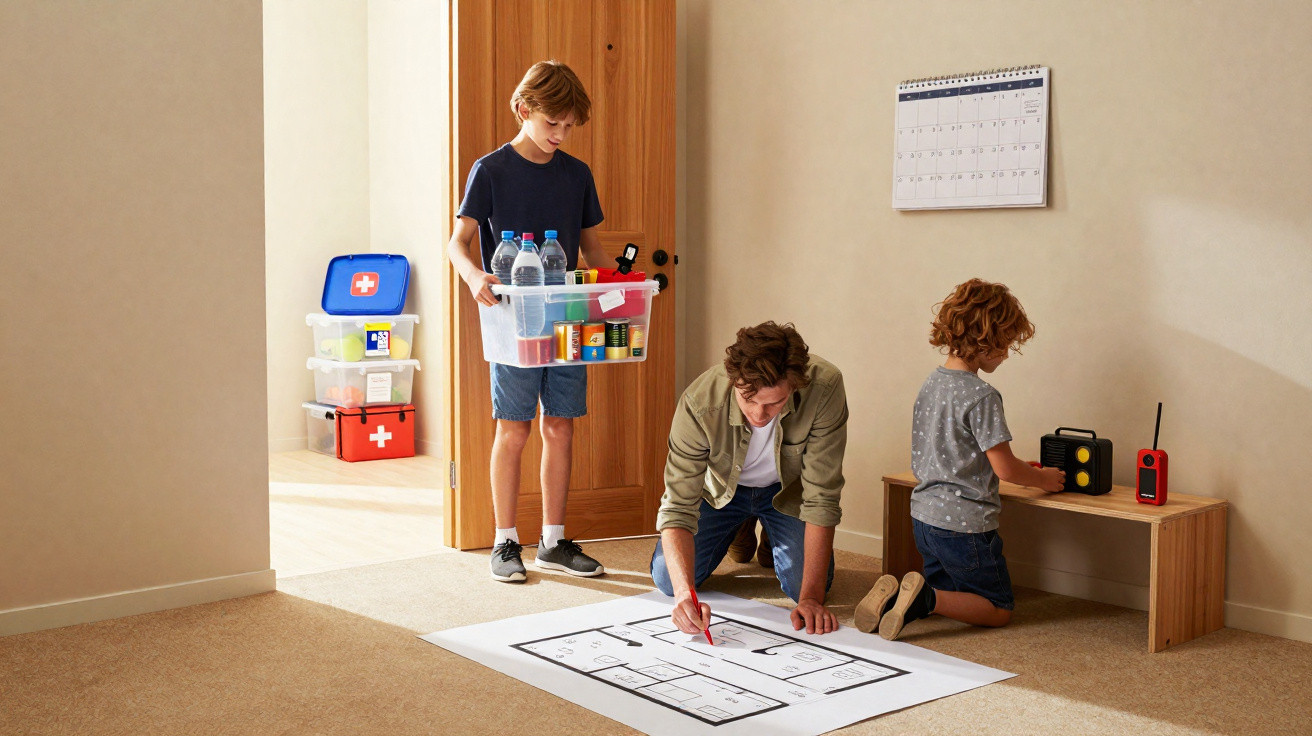
Experts warn: a different room is more likely to save your life.
Nuclear weapons and reactor accidents can feel abstract, almost like scenes from a distant film. Yet the question is increasingly being raised across Europe: where should you shelter if a nuclear alert really does sound? Recent assessments and simulations suggest that the place which appears safest in a home is often a misleading choice – while an inconspicuous windowless room can offer substantially better odds.
Why a conventional cellar can quickly become a death trap
The instinct is rooted in history. During the Second World War and the Cold War, cellars were regarded as protection from bombing raids. Many people now apply that image to every type of emergency. In a nuclear incident, however, the situation is more complicated.
An ordinary domestic cellar is generally not designed as a shelter. It may have thin walls, a timber floor above it, and perhaps small light wells or ground-level windows. If a powerful blast wave strikes the building, the ceiling and the storeys above may collapse. Anyone sheltering below would bear the full weight.
There is also a less obvious but serious issue: air. Heavy gases collect in deep, poorly ventilated spaces. Smoke, carbon dioxide and other toxic substances are more likely to remain low down. If such a cellar is completely sealed in a panic, the risk of suffocation rises – long before radiation or the blast wave becomes the problem.
A typical domestic cellar rarely protects against the blast wave, falling debris and toxic gases – it may even increase the risk.
Experts recommend using a cellar only when it was specifically built as a shelter: with thick concrete walls, reinforced ceilings, separate ventilation and robust doors. Very few homes meet those conditions.
What a nuclear explosion can actually do inside a home
A widely cited computer simulation by a university in the Mediterranean region modelled the blast wave from a large nuclear explosion. It assumed an explosive yield of several hundred kilotonnes, detonated several kilometres above the ground. Close to the point of explosion, no room can help – the building itself would no longer exist.
As the distance increases, the building’s construction becomes more important. Reinforced-concrete structures in particular withstand far more than lightweight buildings. Within these properties, a clear pattern emerges: glazed fronts, external doors and long corridors act as channels that speed up the blast wave. Glass shards, doors and fragments of furniture can then race through the space at high speed.
Particularly dangerous locations include:
- rooms with large glazed areas or patio doors
- long, uninterrupted corridors leading directly to the façade
- entrance areas and stairwells along external walls
Corners and internal rooms, by contrast, perform better, especially where several walls and ceilings separate them from the outside. Every solid layer of concrete or masonry reduces radiation, slows debris and softens the pressure.
Radiation-protection specialists use straightforward rules of thumb: every additional concrete or brick wall can noticeably reduce the absorbed dose of gamma radiation. More distance, more material, more protection – that is the basic principle.
The “nuclear protection core” in your home
Emergency-planning experts refer to an internal protection core within a building. This means rooms at its centre, as far as possible from window fronts and external walls. Taking refuge there uses the entire mass of the house as a shield.
Typical options include:
- small corridors in the interior of the home
- windowless toilets or bathrooms
- storage cupboards, pantries or walk-in cupboards without an external wall
In many detached homes, this area is in fact where an internal bathroom or narrow hallway is located. In a block of flats, the middle floors often provide the best balance of protection from blast pressure and radiation. The highest storeys are closer to the explosion, while the ground floor and areas immediately beside the street are more frequently exposed to debris or pressure.
The safest area is usually a small, windowless internal room in the middle of the house – surrounded by as many walls and floors as possible.
Three simple steps for finding your “shelter room”
Anyone who does not want to improvise once an alert is issued can assess their home in advance. A simple method can help with the choice:
- Rule out every room with windows or large glazed surfaces.
- Mentally draw a cross across the floor plan and check how close each room is to the centre.
- Choose a room surrounded by several walls and within reach of water and a toilet.
Ideally, the chosen room should contain a few sturdy places to sit, a torch, bottles of water and a battery-powered radio. There is no need to build a bunker in the living room, but some preparation reduces stress in an emergency.
How to act if a nuclear alert really arrives
When a warning comes through on a mobile phone, radio or siren, every minute matters. Even so, there is little benefit in rushing around the home without thinking. Anyone who has already chosen their shelter room saves time and anxiety.
The key steps are:
- go into a solid building immediately; do not remain outdoors
- close doors and windows, and lower shutters
- switch off ventilation systems and fans, reducing draughts
- move into the prepared internal room
- seal the gap beneath the room door with wet towels, without completely blocking the air supply
- keep a radio or official warning app on and remain calm
The greatest danger from the blast wave lasts only for the first few seconds. Radiation then becomes the main concern. Endurance matters here: the longer someone stays in the protected internal room, the lower the dose received, because some short-lived radioactive substances decay relatively quickly.
The real role of radiation – and what walls can do against it
Nuclear incidents involve several forms of radiation. Gamma rays are especially difficult because they penetrate deeply into matter. This is precisely where the building core’s “sandwich technique” helps: placing several dense layers between the body and the outside.
For context, a single concrete wall around 20 centimetres thick can substantially reduce exposure to gamma rays. Add a room partition, perhaps another room or a stairwell, and the dose continues to fall. Even ordinary bricks contribute when several walls are positioned one behind another.
Protection does not come from one magical room, but from the combination of distance, wall thickness and the time spent indoors.
Windows and thin external walls are the weak points. They allow a large proportion of radiation to pass through comparatively easily. This is exactly why windowless internal rooms offer better protection than any panoramic loggia – regardless of how modern the building may look.
What you can prepare today
Nobody wants to experience the day when this advice becomes immediately relevant. Even so, a few useful preparations require little effort and can also help during other emergencies, such as widespread fires or chemical incidents.
Practical examples of basic supplies for a shelter room include:
- several bottles of drinking water and some long-life snacks
- a torch, spare batteries and a battery radio
- any medication needed regularly
- a lightweight sleeping bag or blanket
- a notepad and pen for recording information
Such “mini reserves” are not a sign of panic; they are simply sensible preparedness. Many aid organisations already advise preparing for at least several days with limited freedom of movement – even without a nuclear scenario.
Why accurate information protects more than fear alone
The prospect of a nuclear attack understandably causes fear. A sober look at the facts shows, however, that people who know where to go and what to do there have significantly better chances in an emergency. Blind action, frantic car journeys or hiding in the wrong room increase the risk.
Radiation, blast waves, debris and toxic substances are all threatening. At the same time, many of these dangers follow clear physical rules. Solid walls, the building’s internal core and a few targeted actions can dramatically reduce exposure. The crucial step can be taken today: consider your own home carefully once, and identify the one room that could become the safest address in the house in an emergency.






Comments
No comments yet. Be the first to comment!
Leave a Comment