
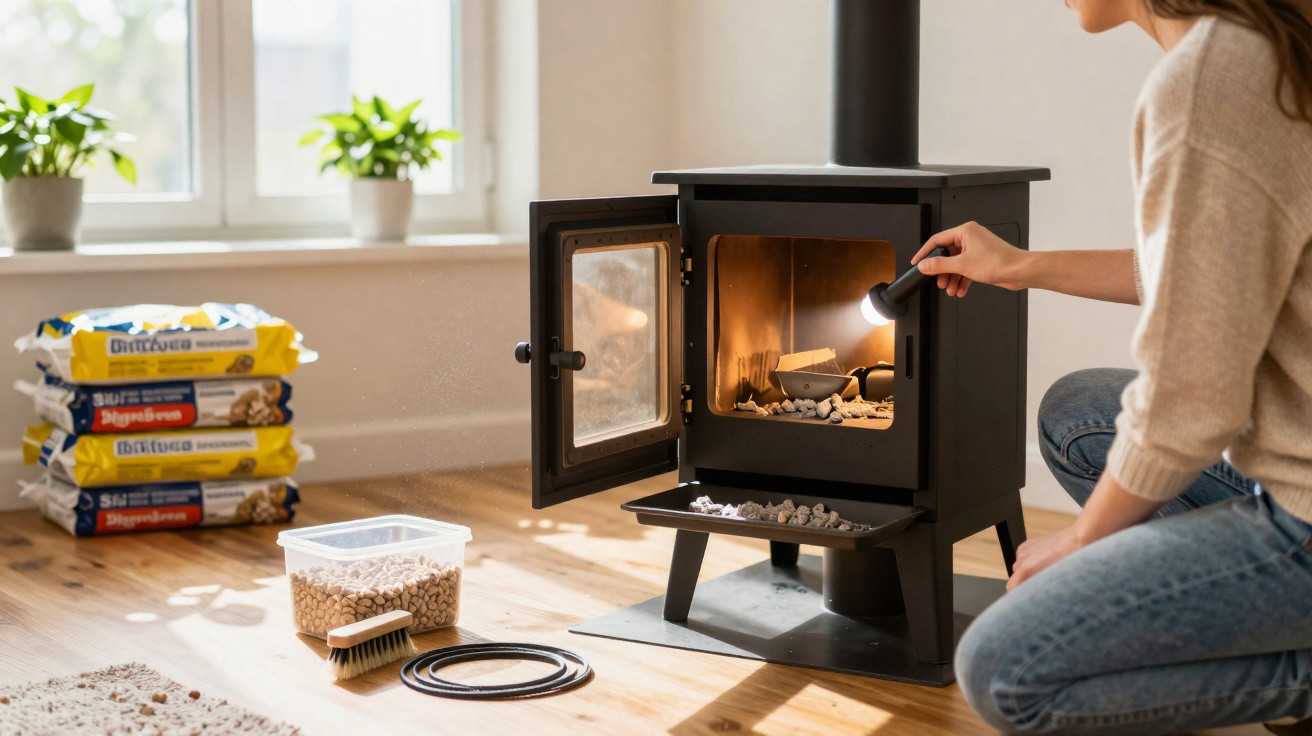
When the sun started to feel stronger in May, I simply switched my pellet stove off - as I do every year. No spring service, no quick inspection, no cleaning. Months later, the appliance gave up: fault codes, smoke, and an expensive repair. Only then did it hit me how essential a proper spring maintenance routine really is.
Why spring service for a pellet stove is so crucial
Even if you only run your pellet stove occasionally in spring, it still operates under significant load each time it fires up. Every burn leaves residue behind: fine ash, soot, and dust. Much of it is out of sight because it settles in narrow passages and tucked-away corners.
"If you don’t look after your pellet stove in spring, you risk faults in winter, higher consumption and, in the worst case, a safety issue."
These deposits can:
- block the air supply,
- restrict the flue gas outlet,
- noticeably reduce efficiency,
- push pellet consumption up.
In the end you pay twice over: more money spent on fuel, plus repair bills that a bit of care could have prevented.
The most important steps in a spring check
1. Clean the burn pot and ash pan thoroughly
The burn pot - sometimes also called the burner cup or firebox - is the stove’s core component. This is where the pellets combust. If ash clogs the air holes, the fire struggles: the flame becomes sluggish and the stove soots up more.
A sensible schedule:
- during the heating season: daily to weekly sweeping out, depending on how much you use it,
- in spring: a particularly deep clean before it sits unused.
A dedicated ash vacuum with a HEPA filter is ideal. A normal household vacuum can be damaged quickly by the fine ash and may blow particles straight back into the room. One key rule: only vacuum ash once it is completely cold.
2. Check seals and replace them if needed
Door seals and other rubber gaskets ensure a clean, controlled burn. When they become brittle, the stove pulls in false air. The knock-on effects are predictable: the controls respond incorrectly, combustion becomes unstable, and soot and ash build-up increases.
If you look closely, worn seals typically show up as:
- cracks or crumbly sections,
- warped areas that no longer sit neatly against the metal,
- glass that soots up far faster than it used to.
Many manufacturers supply matching seal kits, and a qualified technician can fit them quickly. Especially with older appliances, it’s worth paying attention to this often-overlooked weak point.
3. Clean the glass - for appearance and safety
A clear viewing panel is not a luxury. It’s also an indicator of how cleanly the stove is burning. If the glass is constantly blackened, there is usually a problem with the air supply or the fuel.
For cleaning, you usually only need:
- a soft cloth or kitchen roll,
- a specialist stove-glass cleaner, or
- a paste made from a little fine, dry ash and water as a simple, inexpensive option.
Avoid metal scouring pads and harsh chemicals - they can scratch the glass permanently.
4. Keep air paths and flue gas routes clear
A small shovel, a dusting brush and an ash vacuum are useful for cleaning air channels. Air needs unobstructed routes so pellets burn evenly. Blocked passages can trigger error messages, cause a dirty flame, or make the stove shut down unexpectedly.
The flue gas routes are just as critical. If soot accumulates there, the risk rises of a smouldering fire in the pipework or a dangerous carbon monoxide exposure. This is also where the chimney sweep becomes important.
The non-negotiable: annual service by a professional
In many countries there are now clear requirements: if you run a pellet stove, you must have it serviced regularly by a qualified specialist. The aim is to keep the appliance safe, efficient and environmentally responsible.
A typical annual service includes:
- a full clean of the stove inside and out,
- checks of the burn pot, ignition element, fans and sensors,
- inspection of safety devices,
- fine-tuning of settings where necessary,
- cleaning or inspection of the flue pipe and chimney.
After the service, the operator normally receives a certificate. This acts as evidence for insurers and authorities that the stove has been maintained in line with regulations.
Why spring service brings so many benefits
Spot problems early
If you have the pellet stove checked straight after the heating season, issues are caught in time: torn seals, corroded panels, faulty sensors. In autumn, spare parts are often harder to get, appointment slots are scarce, and waiting times stretch out. In spring, these jobs can be handled calmly and usually more cheaply.
More availability at the specialist
Heating engineers and stove installers are often operating at full capacity in autumn and mid-winter. Between October and January it can be difficult to secure a service visit. April, May or June is different: appointments are more flexible, you are not left freezing until someone can attend, and there are sometimes early-booking discounts for service packages.
Better efficiency, lower costs
A clean, properly adjusted pellet stove needs fewer pellets to deliver the same heat output. That reduces heating costs and cuts emissions. With energy prices rising, even a few per cent gain in efficiency is noticeable in your household budget.
"Clean stove, clean combustion: if you maintain it in spring, you save real money in winter."
Typical mistakes pellet stove owners make - and how to avoid them
- No regular ‘housekeeping’ for the stove: even with light use, residues form and build up layer by layer.
- Cheap pellets from a questionable source: lower-quality pellets often contain more dust, bark and binders - leading to more ash and clogged components.
- Leaving the pellet hopper full for months: in damp cellars, pellets absorb moisture, swell and break down. That can jam the auger feed.
- Constantly putting off the annual service: if you act too late, the nasty surprise often arrives in the middle of a cold snap.
Practical tips for day-to-day pellet stove use
A small maintenance plan makes it easier to stay on top of things:
| Interval | Task |
|---|---|
| weekly during the heating season | empty the burn pot, remove ash roughly, give the glass a quick wipe |
| monthly | check air routes, look over seals, inspect the pellet store |
| spring | thorough internal clean, empty the ash pan completely, empty the pellet store |
| annually | professional service with measurement and testing of all safety functions |
If you pin these steps to your calendar, you reduce the risk of the stove - as happened to me - eventually “presenting the bill” with an error code and a cold home on a frosty January evening.
What many people don’t realise: risks and added value from proper care
Pellet stove operators often underestimate the issue of carbon monoxide. The gas is invisible, odourless and can be dangerous even in small quantities. A poorly maintained system with blocked flue gas paths increases that risk. A CO alarm near the stove adds an extra layer of protection and costs only a fraction of a repair.
On the flip side, a well-maintained pellet stove offers a real advantage: run efficiently, it can be comparatively climate-friendly because pellets are often made from residual timber. The better the stove is set up, the less fine particulate matter and unburnt residue is released into the air.
For households considering energy-efficiency renovation, a properly serviced pellet stove can also be an important building block: combined with a heat pump, solar thermal or photovoltaic panels, it creates a flexible heating set-up that smooths peak demand and saves money over the long term. The condition remains the same: regular care - and the spring check I ignored for far too long.






Comments
No comments yet. Be the first to comment!
Leave a Comment