

Saturday morning, 9:17 a.m. Sunlight catches the crumbs across the kitchen worktop with ruthless clarity, revealing every mark on the fridge and the tacky circle beneath the jam jar. You had told yourself: “Today, I’ll do a deep clean.” Yet here you are, drifting between rooms with a sponge in one hand, your phone vibrating and your thoughts everywhere. You half-load the dishwasher, put on a wash, then remember the bathroom mirror. Once that is cleaned, your coffee is cold and the living room still appears as though a miniature tornado has swept through it.
We often decide that we are untidy, lazy or “just not that kind of person”.
But perhaps you are not the problem. Perhaps the problem is the lack of a pattern.
Why predictable cleaning quietly changes everything
There is one small, almost unremarkable difference between homes that feel chaotic and those that feel calm. It is not a miracle product or an online craze. It is the quiet, slightly nerdy idea of a predictable rhythm. This is not a military timetable, but a sequence repeated often enough that your body completes part of it automatically.
Consider people whose homes somehow seem “weirdly always okay”. Ask how they manage it and many will say: “Oh, I just do the floors on Fridays” or “I always reset the kitchen before bed.” These are plain, almost tedious statements, yet they underpin a home that does not seem to announce “I’m behind on everything” as soon as you enter.
Take Léa, 34, with two children, a full-time job and a perfectly ordinary level of tiredness. A few years ago, she felt buried beneath a never-ending landslide of washing and Lego. Her therapist then told her: “You don’t need more energy, you need fewer decisions.” Léa began with a modest plan: washing on Mondays, the bathroom on Wednesdays and floors on Fridays. Every evening, she did a five-minute kitchen reset with a timer on her phone.
Nothing remarkable happened in the first week. In the second, she saw that the pile of washing was reducing before it reached crisis point. By week three, Saturdays were no longer spent attempting to “catch up on everything”. She later admitted something unexpected: “I still get tired. But I don’t feel defeated anymore.”
This is the overlooked strength of predictability. It may not make you inherently tidier, but it makes cleaning feel less dramatic. If your brain already knows what is due, it puts up less resistance. There is less bargaining with yourself and fewer cycles of “I’ll do it later”. Instead, it becomes: “It’s Wednesday, so I wipe the bathroom surfaces. That’s what I do on Wednesdays.”
Our brains are drawn to patterns because they save mental effort. “I’ll clean when I have time” may sound liberating, but it has a hidden cost. You pay through guilt, visual clutter and frantic last-minute cleaning sessions. Predictable cleaning replaces panic with routine, and routine is, unexpectedly, where freedom can be found.
How to make predictable cleaning work without making life a spreadsheet
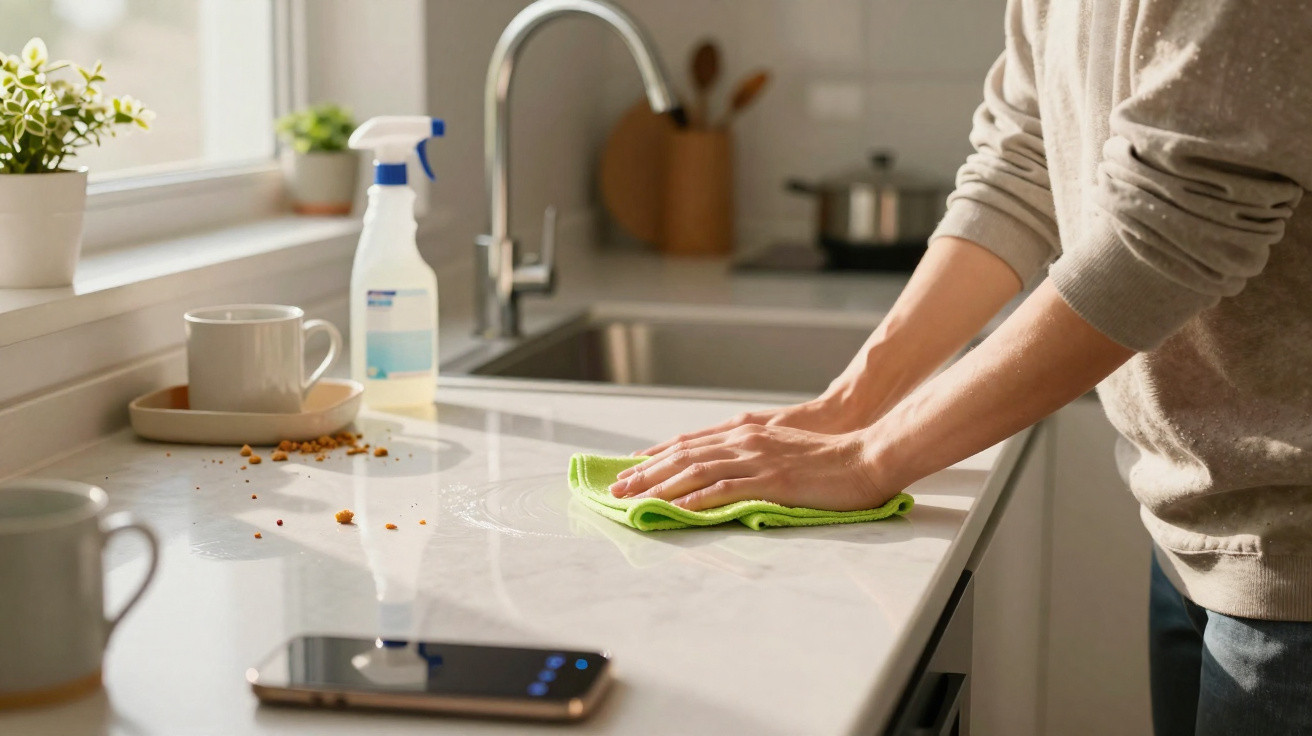
Put aside the colour-coded folders and 30-step lists. Begin with one small action you can repeat and that works in your real life rather than an imagined ideal version of it. Choose a daily trigger that already exists, then connect it to a tiny cleaning habit. When the coffee machine is on, wipe the worktop. Once the children’s bedtime story ends, spend two minutes gathering toys. When you close your laptop for the day, quickly reset your desk.
The key is not perfection but association. Each time the original habit occurs, add one small action, much like a passenger joining a journey that was already underway. After a fortnight, it is less likely to feel like “cleaning time” and more like “the way the day usually ends”.
The mistake many of us make is beginning with an overambitious plan. “From now on, every evening I will clean the whole kitchen, fold laundry, vacuum, and prep tomorrow’s outfits.” At best, that survives three days. Then real life intervenes: a late meeting, an ill child or a bad mood. The plan falls apart, leaving you feeling as though you have broken a promise that was never sustainable.
In truth, no one does all of that every day. Long-term success comes from small, slightly unexciting habits that still work through difficult weeks and low moods. Be kind to yourself if you miss a day. Predictable does not mean inflexible; it simply means that this is what normally happens.
Eventually, predictable cleaning becomes less about dust and more about the way your mind can breathe in your own home.
“People think they need motivation to clean,” says a professional organizer I interviewed. “They don’t. They need fewer choices. When the plan is always the same, you don’t wake up and renegotiate with yourself. You just do today’s tiny piece and move on with your life.”
- Give one room or task to each day, such as the bathroom on Monday or floors on Friday.
- Link a cleaning action lasting 2–5 minutes to a daily habit you already follow.
- Display a brief list on the fridge or inside a cupboard door.
- Recognise that “good enough, done regularly” is better than “perfect, done rarely”.
- Set a timer to keep each task short, making the routine easy to repeat and maintain.
Living in a home that does not constantly demand your attention
When cleaning becomes predictable, a subtle change takes place. Your house stops clamouring for attention. There may still be a pan in the sink or a toy hiding beneath the sofa, but the background anxiety eases because you know: “That has a place in my week.” Mess stops feeling like a personal failing and becomes Tuesday’s task or this evening’s five-minute reset.
Something relaxes when your surroundings do not surprise you every day. You are less likely to lose patience with your partner about dirty dishes if your mind already knows: “Dishes are my after-dinner thing, not a crisis.”
Predictable cleaning is not about becoming a minimalist monk or turning your home into a showroom. It is about choosing rhythm over drama. For some people, that rhythm is a strict rota on the fridge. For others, it consists of three anchored actions spread throughout the day. The exact form matters less than the repetition.
You may even find that, once the essentials run on autopilot, you have enough energy for one small additional job each week: a drawer, a shelf or that mysterious box in the hallway. If not, the basics are still being handled.
What might be different if cleaning stopped being a vague and overwhelming “I should” and instead became a few reliable beats within your day? That is the real issue. It is not about whether your skirting boards are spotless, but whether your home supports your life rather than continually seeming to need rescuing.
We have all had that moment of looking around and asking, “How did it get this bad?” Usually, the answer is simple: it did not become bad in a single day. So it can improve in small, predictable stages too.
| Key point | Detail | Value for the reader |
|---|---|---|
| Make cleaning a rhythm | Allocate straightforward tasks to particular days or daily triggers | Lowers decision fatigue and the sense that you are always falling behind |
| Begin more modestly than you expect | Concentrate on 2–5 minute habits linked to existing routines | Keeps the system achievable even on stressful or low-energy days |
| Embrace “good enough” maintenance | Favour regular essentials over infrequent deep cleans | Builds a calmer, more liveable home with less emotional pressure |
FAQ:
- How do I start a predictable cleaning routine if my home is already a disaster? Start with one area and one daily habit, such as resetting only the kitchen worktop each evening. Do not wait for everything to be perfect; allow the routine to gradually catch up with the mess.
- What if my schedule changes all the time? Rely on flexible “anchors” rather than set times: after breakfast, before bed or after work. The timing can shift while the habit remains connected to those moments.
- How long before a routine feels natural? Most people notice a change after two to three weeks of “usually doing it”. It may still require effort, but the resistance lessens and the actions become increasingly automatic.
- Should I involve my partner or kids in the predictable plan? Yes, but make it straightforward. One clear, age-appropriate task for each person at a regular point in the day or week is more effective than a lengthy chores chart that nobody uses.
- What if I miss a day or a whole week? Simply resume at the next scheduled opportunity rather than trying to make up for it. The benefit of a predictable system is being able to return to it without drama or a huge catch-up session.




Comments
No comments yet. Be the first to comment!
Leave a Comment