
French households are facing another costly winter, while an unusual plastic bag trick is suddenly appearing all over social media.
As radiators start humming again in homes across France, a basic cleaning tip from a home influencer is becoming a nationwide habit. Originally shared as an easy way to remove dust, it has quietly developed into a tool for tackling higher heating costs and is now reaching well beyond its first audience.
The hidden problem inside your radiators
For much of the year, radiators sit unused and collect dust, skin flakes and pet hair. This debris builds up deep between the fins and in slim metal channels that are difficult to reach with either a cloth or a duster. Once the heating is switched back on, the accumulated dirt warms up and is circulated through the room as fine particles.
The effects on health can easily be missed. At the start of winter, people with sensitivities may experience sore eyes, an irritated throat or unexplained fatigue. Children can see eczema flare-ups or asthma symptoms worsen just as radiators begin operating again. Older people may notice headaches and a stuffy, heavy atmosphere, particularly in bedrooms and compact sitting rooms.
Dirty radiators can also cost households money without them realising it. Dust forms an insulating layer over the metal, making it harder for warmth to spread into the room. As a result, a boiler or electric heating system must run for longer to achieve the same level of comfort. The additional operating time increases energy consumption and can reduce the equipment’s lifespan. During a cold snap, a system that is partly blocked can lead to an expensive failure at exactly the wrong time.
A dusty radiator doesn’t just look neglected; it can pollute your indoor air and add unexpected pounds or euros to your heating bill.
The plastic bag and hairdryer hack everyone is trying
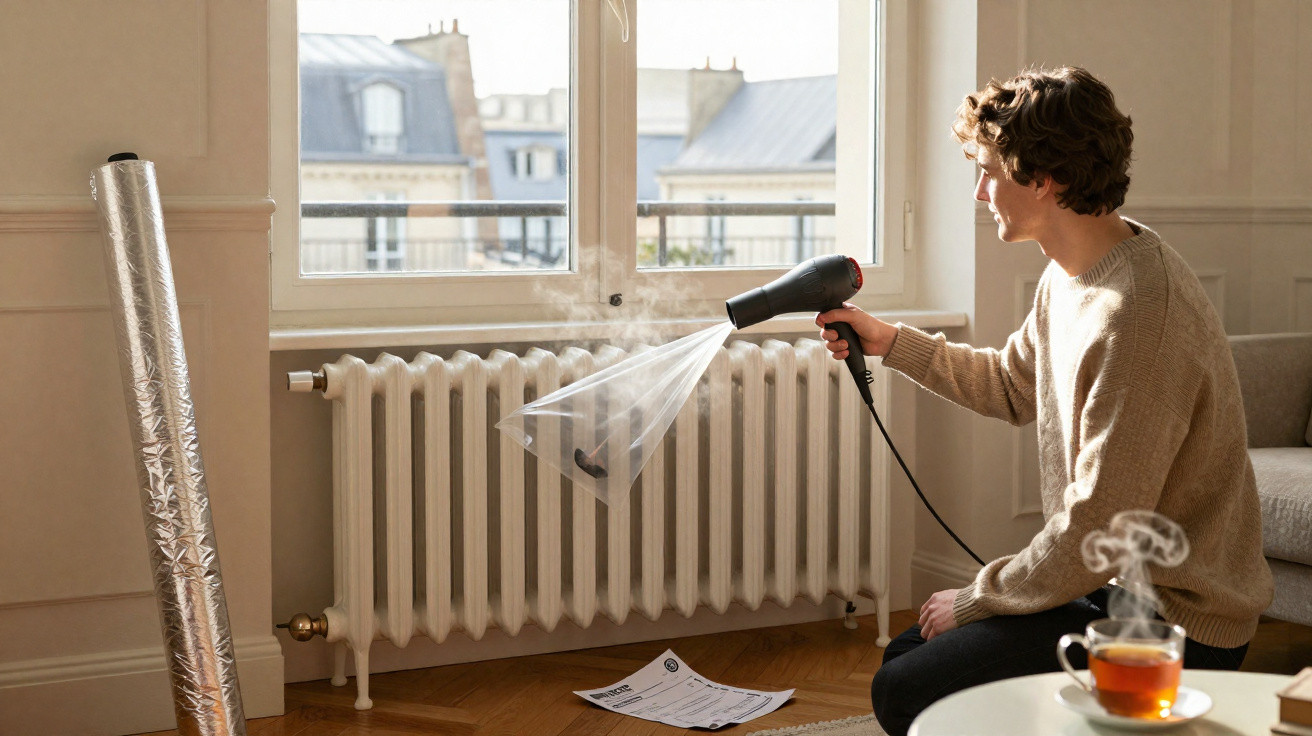
The technique attracting attention was shared by Polish-born creator Agnieszka Radzikowska, known online as @sprytna_radzikowska. Her video quickly travelled across languages and borders. The approach seems almost implausibly simple: use a plastic bag and a hairdryer to clear dust from a radiator without dismantling anything.
First, position a large bag beneath the radiator, covering as much of the floor below it as possible. Next, direct hot air down from the top of the radiator using a hairdryer. The airflow forces dust and fluff downwards, while gravity takes care of the rest. The debris drops straight into the bag. There is no need to take the radiator apart, buy specialist equipment or struggle with a vacuum cleaner hose.
| Step | Action | Typical time |
|---|---|---|
| Preparation | Turn off heating, place a large plastic bag or bin liner under the radiator | 30 seconds |
| Cleaning | Blow hot air from the top and along the fins with a hairdryer | 5–8 minutes |
| Finishing | Seal and throw away the bag, wipe nearby surfaces | 1 minute |
This is very different from the usual approach of brushing radiator fins, vacuuming blindly between panels and inhaling clouds of dust. With this method, the particles are collected in the bag rather than dispersed around the room. The only item needed is something found in almost every bathroom.
Instead of chasing dust around the room with a duster, the plastic bag method traps it in one controlled shot.
How a cleaner radiator can shrink your heating bill
When the fins and internal surfaces have been cleared of dust, heat can pass from the metal into the air more efficiently. Rooms heat up more quickly and with greater consistency. Chilly spots near windows or at the far end of a room may lessen as warm air circulates better. Saving ten minutes from every heating cycle, repeated hour after hour, can add up to worthwhile savings across a winter.
Energy specialists commonly estimate that maintaining heating systems correctly can reduce annual energy use by several per cent. That may appear limited, yet for a flat using electric radiators or a gas-heated house, a three-to-five per cent reduction over an entire season could pay for a month of bills, or at least offset part of the latest price rises.
To increase these benefits, technicians advise pairing the bag method with several straightforward routines:
- Bleed hot-water radiators before winter to remove trapped air that prevents proper circulation.
- Vacuum carpets and skirting boards around radiators to stop dust from finding its way back inside.
- Open windows fully for a few minutes each day to refresh stale air and reduce humidity, which can make rooms feel colder.
- Keep furniture, curtains and laundry at least a few inches away from the front and top of the radiator.
These modest actions complement one another. Clean fins support heat transfer, unobstructed water circuits improve circulation, and fresh, dry air feels warmer at an identical temperature. Together, they can help households lower their thermostat slightly while maintaining comfort.
Why this simple hack resonates in 2026
The viral rise of the plastic bag radiator trick closely reflects the pressures currently affecting households. Energy prices remain unpredictable across Europe, and many people are looking for measures that do not demand a major outlay. A solution requiring only a supermarket bag and a hairdryer feels widely accessible, almost democratic, when set against costly insulation work or new smart thermostats.
Social media has also been crucial to its spread. Short cleaning videos are ideal for vertical formats, while the visible result is highly satisfying: grey clumps of fluff tumble into the bag within seconds. Comments are filled with startled responses from viewers discovering how much hidden dust may be sitting in their own homes.
In an age of high-tech thermostats and connected boilers, one of the season’s most talked-about energy hacks comes down to a plastic bag and hot air.
There is a psychological dimension too. Many families feel they have little influence over global energy markets. A practical task that is simple to repeat each year restores some sense of control. You cannot negotiate wholesale gas prices, but you can ensure that every kilowatt of warmth leaves the radiator rather than the electricity meter.
A few precautions before you try it
Although the method appears harmless, basic safety measures still matter. Radiators and pipework should be fully cold before cleaning begins. Hot metal may melt thin plastic or harm a hairdryer if it is held too close. In older homes, people should take care not to obstruct safety vents or cover sensors during the process.
For electric convector heaters, panel heaters and storage heaters, the underlying idea is broadly similar, although the appliance design changes the way air moves through it. In some cases, a vacuum cleaner fitted with a narrow nozzle is more effective. The plastic bag trick is particularly suited to traditional wall-mounted radiators with open fins.
Households with people who have severe allergies may wish to use a mask and protective glasses while cleaning, even though most dust should fall into the bag. Wiping surrounding skirting boards afterwards with a damp cloth helps remove any particles left behind.
From French flats to global households: what this trend reveals
What appears to be a small household tip touches on wider issues: energy costs, indoor air quality and the ways ordinary people respond when bills rise faster than wages. French families may simply be early adopters of a practice that can spread to any country with cold winters and ageing radiators.
Heating professionals have discussed “thermal efficiency” for years using technical language. Viral videos now turn the idea into something people can see and understand. As dust is removed from a radiator, money is no longer leaving the bank account quite so quickly. That message is immediately relatable, which may be why the clip continues to circulate far beyond cleaning-focused communities.
For anyone wishing to take the approach further, the same principle can be applied to other appliances. Cleaning the coil at the back of a fridge, keeping a heat pump unit free from dust, or arranging regular boiler servicing can all improve the conversion of electricity or fuel into useful comfort. The plastic bag radiator trick is simply a quick, visible entry point to this wider way of thinking.
Waste is another issue worth considering. Some people replace disposable bags with reusable fabric sheets or large cardboard boxes lined with newspaper, then empty them outside. This cuts plastic consumption while retaining the dramatic visual result that made the method popular.
As winter progresses, more households are likely to test this five-minute hack before increasing the thermostat setting. The financial benefit may be limited for some but much more noticeable for others, depending on how neglected their radiators have been. What stays the same is the change in routine: the heating season no longer begins with a switch and a shrug, but with a quick clean connecting comfort, health and the household budget in one straightforward action.


Comments
No comments yet. Be the first to comment!
Leave a Comment