
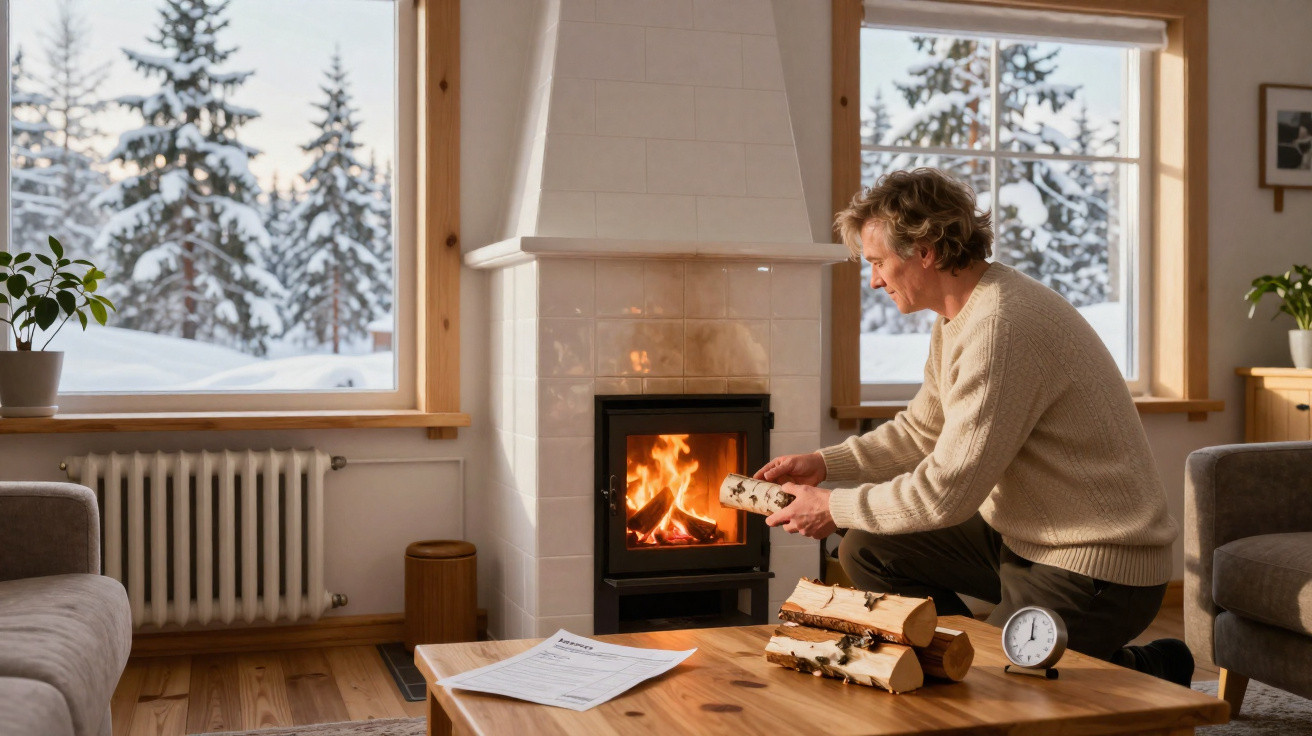
The cold is not what strikes you first. It is the quiet.
It is mid-January in a timber home outside Tampere, where the outdoor thermometer shows –18°C. Frost covers the windows and the sky is steel-grey, yet the indoor temperature is 22°C. Everyone is in socks, and there are no radiators visibly humming along the walls.
When asked where the radiators are, the retired engineer who owns the house laughs. Instead, he gestures towards a substantial white structure in the corner, positioned there like a familiar companion: a tiled masonry stove that steadily gives off heat.
His electricity bill is less than half that paid by his neighbours.
The longer you speak with Finnish heating specialists, the more an unusual thought emerges.
Perhaps radiators are already on borrowed time.
In the land of winter, radiators are falling behind
In almost any Finnish suburb developed before the 1980s, older homes reveal a familiar indoor feature. Rather than slim metal radiators, they often contain large, individually built stoves of brick or soapstone, commonly finished in off-white or pale-green tiles.
They may seem like relics from a grandparent's home, particularly beside smart thermostats and underfloor heating. But these “masonry heaters” are quietly changing the understanding of what efficient warmth can mean in a northern climate.
Finnish energy researchers have been examining the figures. A properly designed masonry stove, lit once or twice daily, can provide consistent radiant warmth for 12–24 hours while consuming remarkably little firewood.
In several case studies issued by Finnish building institutes, homes using modern masonry stoves reported heating costs 20–40% below those of high-end heat pump systems, particularly in older and more draughty properties. This comes without the ongoing concern over rising electricity prices or gas supply disruption, which made the past few winters a financial nightmare for many Europeans.
Why does this happen?
By their nature, radiators warm the air. Their operation depends on convection: heated air rises, cool air drops, and the process continues. Although this works, the resulting warmth can be inconsistent and uneven, and it is easily lost through poor windows or thin walls.
Masonry stoves instead warm thermal mass. Several tonnes of brick or stone take in the energy from a brief, intense fire, then gradually emit it as gentle, penetrating radiant heat.
Your body can feel warm while the air remains a few degrees cooler, and the home stays comfortable well after the fire has died out.
For Finnish specialists, that fundamental move-from heating air to heating mass-is the point at which radiators begin to seem outdated.
Why the masonry stove outperforms smart heating systems
Operating a masonry heater is almost remarkably straightforward. You load dry firewood once or twice a day, light it and allow it to burn fiercely and quickly for a couple of hours. There is no slow smouldering and no need for constant attention.
Ingenious internal passages direct the hot gases through the masonry, filling it with heat. Once the fire is out and the doors are shut, the large white structure simply remains in place, silently radiating comfort through the day and into the night.
Consider a young family in Jyväskylä who refurbished a detached house dating from the 1960s. They retained the original radiators “just in case”, while spending roughly the cost of a mid-range heat pump on a new certified masonry stove.
During their first winter following the work, they recorded every detail: outdoor temperatures, firewood consumption, electricity bills and room temperatures. On most days, one morning firing kept the living spaces warm until bedtime. When temperatures reached a bitter –25°C, they lit it again in the evening.
The radiators?
For most of the season, they remained switched off.
From an engineering perspective, the benefit is starkly simple. Depending on its size and how it is used, a substantial masonry heater can retain 500–1,500 kWh of warmth within its mass over a week. This stored heat provides a buffer against severe cold, energy-price surges and even short power outages.
Radiators supplied by electricity or district heating cannot provide that buffer. As soon as prices rise or electricity falters, comfort is affected too.
Let’s be honest: nobody really spends their evenings micromanaging their thermostat to chase the cheapest hour‑by‑hour tariff.
A large thermal mass means you do not have to. It smooths out those variations through a system designed, quite literally, for a country where winter occupies half the year.
How Finns are quietly reshaping home heating
For people considering the approach, Finnish experts consistently give the same initial advice: assess the house first and the stove second. The most efficient arrangement is not an enormous unit inside a small, draughty cottage, but a heater of the right size and position within a reasonably insulated home.
Many Finnish builders follow a simple rule: position the masonry stove as near to the centre of the house as possible. This allows radiant heat to reach several rooms, rather than turning one corner of the sitting room into a sauna while the hallway stays freezing.
A subtle cultural change is also taking place. For many decades, Finnish “modernisation” meant replacing wood-burning stoves with neat radiators connected to district heating, oil-fired systems or, later, electric boilers. This appeared clean, automatic and ready for the future.
Then energy prices became volatile, climate targets gained importance and a new generation began to realise that their grandparents’ heating systems were not merely nostalgic.
They were resilient.
Many Finns who once stopped using their old stoves now regret having removed them. Some attempt to make up for it with compact electric heaters or fan-powered devices that blow hot air at their legs. You probably know the result: one burning-hot part of the room, dry air and a bill that lands like a slap.
One Finnish energy consultant put it bluntly:
“Radiators are good at turning money into warm air. Mass heaters are good at turning one short fire into a whole day of comfort.”
When advising householders, experts regularly return to the same comparison checklist:
- Upfront vs. lifetime cost – With few repairs, a masonry stove may last 40–60 years, whereas many modern systems require substantial replacement work after 15–20 years.
- Fuel flexibility – Firewood, pellets and even future low-carbon fuels can be used without complete reliance on the grid.
- Comfort quality – Rather than only raising the thermostat's air-temperature reading, radiant heat warms people, walls and floors.
- Resilience – A well-constructed masonry heater continues to work through a blackout or gas shortage, provided there is wood available.
- Carbon footprint – If sustainably sourced, wood burned in efficient stoves can be far less carbon-intensive than fossil-based heating or peak-hour electricity.
What Finland’s quiet masonry stove revolution means elsewhere
After spending several days in Finnish homes still heated by large masonry heaters, a clear pattern emerges. The technology is not showy: there are no illuminated displays or app menus with three layers. Instead, there is a reliable routine, a mass of warm stone and rooms that feel gentle against the skin rather than dry or draughty.
It presents a different energy narrative from the one we usually hear, in which progress is always smaller, slimmer and more digital. In this case, the answer has become heavier, more tangible and closer to the warmth felt when late-afternoon sunshine reaches a stone wall.
For those living outside Finland, the message is not that everybody should immediately build identical stoves. Local regulations, air-quality requirements and housing types all matter.
What Finnish experts are actually challenging is the unquestioned belief that radiators supplied by remote systems represent the height of domestic comfort.
Their question is more fundamental.
What if the most suitable heating for the next 30 years is something that retains warmth as a thermos retains coffee, rather than something requiring a continuous, costly flow of energy for every cold minute outdoors?
The question does not disappear once winter is over. It remains, quietly, like the warmth of a wall beneath your hand.
| Key point | Detail | Value for the reader |
|---|---|---|
| Radiators vs. radiant mass | Masonry heaters retain heat in brick/stone before releasing it gradually | Helps you see why traditional systems can feel warmer while using less energy |
| Cost and resilience | Reduced running costs, a long service life and warmth during outages | Offers a route to more predictable bills and fewer surprises in cold weather |
| Comfort quality | Consistent radiant warmth rather than radiators’ changing hot-and-cold air | Helps you focus not only on “degrees” but on how your home truly feels |
FAQ:
Are Finnish experts really saying radiators are “doomed”?
Not immediately, nor in every location. The “doom” relates more to their long-term relevance: as energy prices fluctuate and resilience becomes more important, many Finnish specialists expect radiant mass systems to play a larger role than conventional radiator-based arrangements, particularly in colder areas.Isn’t burning wood bad for air quality and the climate?
Older, smoky fireplaces are. Modern certified masonry stoves burn rapidly at high temperatures and produce far lower particulate emissions. Where wood is sustainably sourced and efficiently burned, total lifecycle emissions may be considerably lower than those from fossil-based heating.Can I combine a masonry heater with a heat pump or radiators?
Yes. A hybrid arrangement is used in many Finnish homes: radiators or a heat pump supply background warmth and hot water, while the masonry stove takes over on the coldest days and provides deep, pleasant warmth in living spaces.What if I live in an apartment, not a detached house?
Complete masonry heaters weigh several tonnes and require structural support, which makes them unusual in standard flats. Even so, lighter “stove-like” mass heaters and enhanced radiant panels are appearing, based on the same principle: retain heat and release it gradually.Does this mean I should rip out my radiators right now?
No. Most Finnish experts would begin with insulation, draught-proofing and improved controls. If you are renovating or constructing a home, you can then properly compare a mass-based system with another 30 years of conventional radiators. The plain truth: the best moment to reconsider heating is when you are already preparing to make a major change.



Comments
No comments yet. Be the first to comment!
Leave a Comment