
The fitted sheet sprawls across the bed like a grumpy jellyfish, its elasticated corners folding back on themselves as though they know precisely how frustrating they are.
You lift it up and attempt to straighten one edge, only for the other to spring up in protest. Within two minutes, you are clutching a rumpled bundle destined for the cupboard under the label “good enough”. It is a small domestic loss, wrapped up in cotton.
One evening, I saw a friend fold a fitted sheet in 20 seconds while carrying on a casual conversation. The corners slotted into one another as if they had practised beforehand. There was no fuss and no exasperated sighing: just a sharp rectangle, piled up like hotel linen. It seemed almost like a conjuring trick.
That mundane little job suddenly appeared to offer a route to a more peaceful home – and, frankly, a calmer mind.
There is a technique for it. It is quick, and once you have watched it, you cannot forget it.
The fitted sheet problem we never quite solve
Most of us simply accept fitted-sheet chaos. Flat sheets get folded properly, while the elasticated one is pushed into the back of the cupboard and the door is shut a little too hastily. Its corners resist every attempt to bring order: they slip, shift and balloon out. In your hands, the fabric seems to have a life of its own, and not a particularly helpful one.
It is domestic Tetris, with the fitted sheet forever playing the part of the awkward leftover piece.
On a Sunday evening, when you are tired and half-looking at your phone, fighting with a misshapen sheet can turn the feeling from “reset for the week” into “why is everything always a mess?”. At that point, one straightforward technique can feel surprisingly effective.
A US survey into laundry habits found that folding fitted sheets is the most disliked laundry task of all. People said they would sooner clean the bathroom. They admitted to rolling sheets into “soft balls”, concealing them beneath more attractive linen, and avoiding visitors in case anyone glimpsed the airing cupboard. On social media, failed folding attempts are almost their own category: time-lapse clips show people trying, surrendering, then flinging the sheet across the room.
It is funny because it is both trivial and absurd, but it also strikes a chord. It is one of those reminders that adult life involves countless minor skills nobody ever formally explains, even though everyone seems to expect you to have mastered them.
When somebody eventually teaches you the method, it can feel as though you have joined a club you never knew existed. All at once, you are the person who can make elastic behave.
A fitted sheet does have its own logic. It is not simply a rectangle that has gone rogue: it still has four corners, however curved, elasticated and stitched they may be. The key is to stop viewing it as one unwieldy mass and instead treat the four corners as pieces of a puzzle. All you need to do is place each corner inside another, one at a time.
Once that clicks, the sheet no longer seems unpredictable. Rather than trying to smooth out chaos, you are creating a shape.
The under-30-second technique works because it follows the structure of the fabric. You are not forcing it into a form it resists. Instead, you work with the seam lines, conceal the elastic and layer the corners until the sheet recalls that it is, in fact, a rectangle. Once your hands learn the order, the speed follows naturally.
The under-30-second fitted sheet folding method, step by step
Begin by holding the sheet lengthways with the inside facing you. Put your hands into two neighbouring corners, as though you are wearing oversized, floppy oven gloves. The elasticated edge should sit along your fingers. Raise the sheet so that it hangs in front of you, allowing the lower half to fall towards the floor. Breathe once. This is the only tricky bit.
Bring the corner in your right hand over to the one in your left. Turn the right-hand corner inside out as you tuck it neatly into the left-hand one. You have now combined two corners into a single pocket.
Give the sheet a gentle shake to help it lie flatter, then locate the two remaining corners hanging at the bottom. Put your hands into them, repeat the same movement and place one inside the other. You should now have two “double corners”. Bring these together and tuck again. Think of stacking cups, only with cotton.
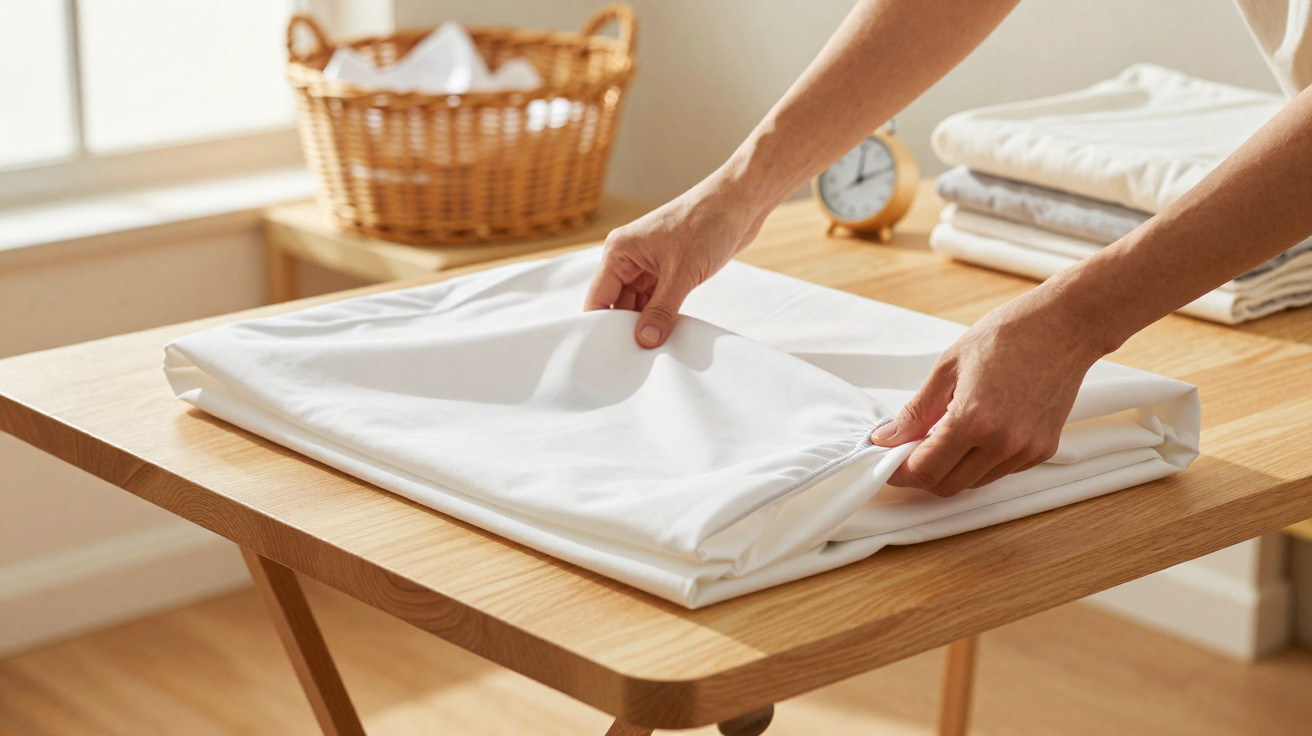
Place the sheet on a bed or table, with the elasticated edges forming an approximate rectangle. Fold in the curved elastic sides to make the edges straighter. It does not have to look artistic; you are simply aiming for a reasonably tidy rectangle. Fold it into thirds lengthways, then into thirds across the width, adjusting for the size of your shelf. That is it: once the movement feels familiar, this is the 30-second method.
To be realistic, your first attempt may take two minutes rather than 30 seconds. Your fingers may get muddled, the elastic may twist, and for a moment you may decide that everyone on TikTok is pretending. That is entirely normal. Nobody posts the failed attempts that never make the final edit.
Focus first on the opening movement alone: hands in the corners, then one corner tucked into the other. Try it several times with a dry sheet, without putting pressure on yourself to “get it right”. Muscle memory is built through repetition, not speed or perfection.
Let us be honest: nobody genuinely does this every day. On some days, you will still bundle the sheet into a ball and toss it into the cupboard, because life. The aim is not to become someone whose linen cupboard resembles a boutique hotel. It is to have an easy, fuss-free technique ready for those times when you want life to feel a little more orderly.
On a difficult day, a neat pile of sheets can be a quiet success. On a good day, it simply means less visual clutter in your home. Either way, it is worth the small amount of effort.
“I used to joke that my fitted sheets were like my life: fine from a distance, chaos up close,” laughs Emma, 34, who learned the folding hack from her aunt. “Once she showed me the corner trick, I went home and refolded every sheet I owned. It sounds ridiculous, but there was this weird, smug joy in it. Like, oh, I can do this grown-up thing now.”
That is the reality of small household skills: they are seldom only about the fabric. They are also about control, rhythm and the sense that your home is not always one step from disarray. Mentally, small accomplishments such as a properly folded sheet can provide an anchor during weeks that feel fragmented and noisy.
- Practise once with every sheet when it comes out of the tumble dryer. Warm fabric tends to cooperate more readily.
- Always begin with the inside of the sheet facing you, as this makes it easier to nest the corners.
- If time is limited, complete only the corner-tucking stage and leave out the final perfect folds.
- Put each fitted sheet inside its matching pillowcase to create an instant bundled bed set.
- Show one other person at home how to do it; shared techniques are more likely to become habits.
Why this tiny trick feels bigger than it looks
At first glance, this is merely a party trick for laundry enthusiasts. Yet after doing it a few times, it can alter the way you see your home. You start to notice how many everyday irritations result from poorly explained basics. Nobody sat you down at 14 and said, “Here is how to handle elastic corners so they don’t win.” You were expected to pick it up by osmosis.
We take that uncertainty into adult life, improvising quietly and hoping that nobody opens the wrong cupboard door.
Learning one precise skill, such as folding a fitted sheet in under 30 seconds, can prompt other small changes. You may be slightly more inclined to organise the towel shelf. Perhaps you will finally give away the spare duvet you dislike. You might demonstrate the technique to a teenager in your life, who will roll their eyes before conceding that it does, actually, help.
One tidy rectangle will not transform your life. However, the sense of “I know exactly what to do with this awkward thing” may last longer than you imagine. When everything feels untidy, that kind of muscle memory can be quietly reassuring.
| Key point | Detail | Why it matters to the reader |
|---|---|---|
| Corner inside corner | Nest each corner inside another to create two “super corners” | Turns an unmanageable shape into a simple rectangle |
| Inside facing you | Always begin with the reverse side of the sheet against your chest | Makes the seams and elastic easier to control |
| Quick routine | Repeat the method after every wash without aiming for perfection | Establishes an automatic habit with less mental load |
FAQ:
- How long does it really take to learn the 30-second method? Most people understand the basic sequence after three or four attempts. The “under 30 seconds” pace generally arrives after a couple of laundry cycles, once your hands no longer overthink every corner.
- Does this work for all sizes of fitted sheets? Yes, this approach works for single, double, king and super king sheets. With especially large sheets, you may need a larger surface on which to lay them flat before doing the final folds.
- What if my sheet has deep pockets or very strong elastic? Simply allow extra room when placing one corner inside another. If the elastic still protrudes, use your fingers to smooth it into the pocket before continuing.
- Can I fold a fitted sheet alone if I’m short or have a small wingspan? Absolutely. Keep the sheet nearer to your body, and do not worry if it briefly touches the floor. The important actions happen at the corners, not at the height you can raise the sheet.
- Is it worth refolding all my old sheets with this method? If your cupboard makes you feel stressed, yes. Refolding an entire stack at once can reset the space and make future laundry days feel easier. If not, begin with your next wash and allow the system to build gradually.


Comments
No comments yet. Be the first to comment!
Leave a Comment