
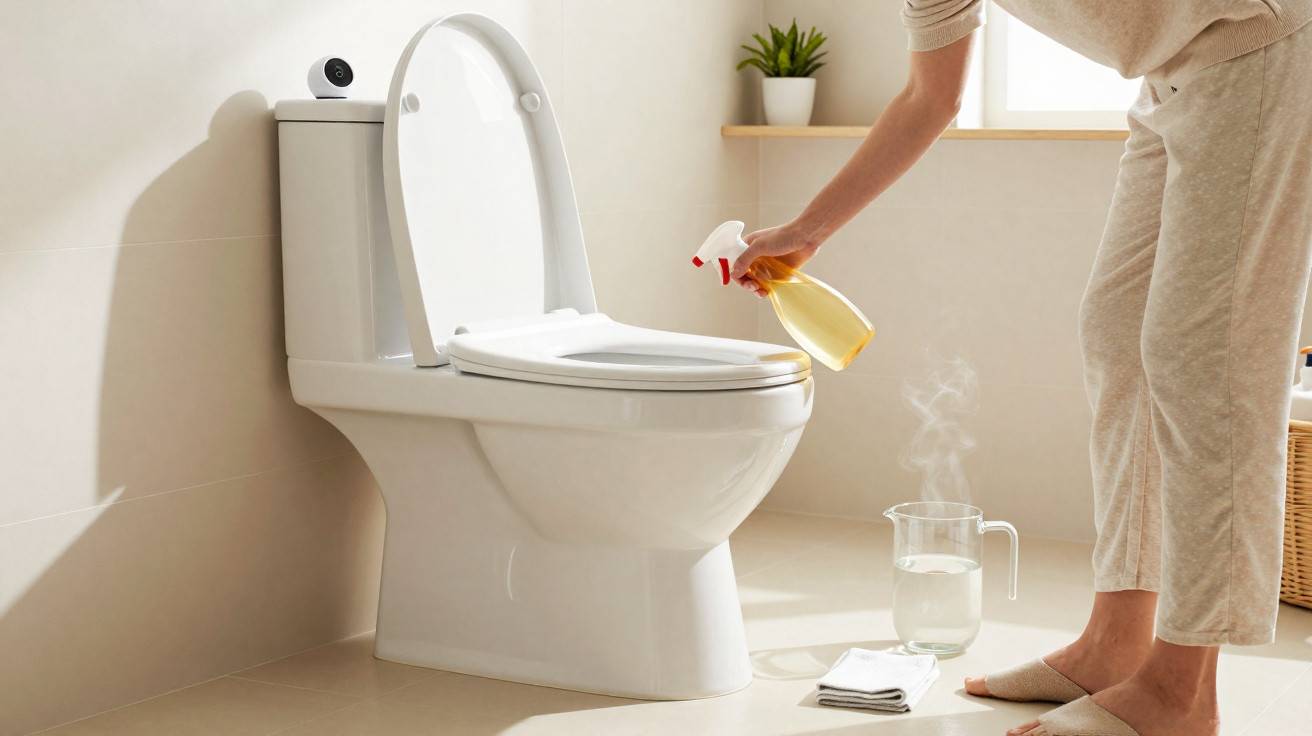
Urine odour in a toilet that returns despite cleaning is not a sign of poor hygiene; it is a chemical issue. Plenty of people rely on home remedies, wipe, spray, breathe a sigh of relief – only for the smell to return the following day. The good news is that there is a method with lasting results. No bicarbonate of soda, no lemon.
Cool air, a quiet hallway, yet that faint, acrid note catches in your nose. The previous evening, I had mopped thoroughly, scrubbed the bowl and hung up a fragranced freshener. An hour later, the smell was back, like an echo that cannot be switched off. We all know the feeling: visitors are due, and suddenly you cannot simply ‘breathe away’ the scent in your own bathroom. A building cleaner then showed me a straightforward method that does not start at the rim of the bowl, but in the place you would least expect.
Why urine odour persists – and where it hides
Odours travel and settle, especially wherever tiny splashes land. Common spots include the toilet seat, hinges, silicone seal at floor level and grout beside the toilet. Salt crystals and biofilm form in these porous areas, acting much like a sponge. You clean the top, while the odour remains underneath. You spray fragrance, but the crystals are still there. That is why it can seem as though ‘it always smells’. It is not your imagination; it is physics combined with patience.
A cleaner I met in Berlin has worked in schools for 15 years. Each evening, he uses a UV lamp to inspect hinges, grout and the rear edge of the bowl. Areas that appear clean in ordinary light suddenly show patchy under UV. Not disgusting – simply honest. “Half the problem is outside the bowl,” he says, pointing to the closed fixing cap. This is where unseen residue collects. Even the loveliest scented candle will not help there.
Urine breaks down into ammonia, uric acid and salts. When limescale is added, the result is a stubborn deposit that clings to surfaces and traps odours. Acidic or alkaline home remedies may loosen something at the surface, yet they often leave the biofilm untouched. The smell is not merely gas: it is embedded in the structure. Porous, rough materials in particular – old silicone seals and tiny cracks in a wooden seat – release it again once they become warm. Odour does not disappear with fragrance, but with understanding.
The effective urine odour trick: enzymes + warmth + time
The approach is simple: locate it first, then break it down. Take a small UV torch (blacklight), darken the bathroom and look for dull, irregular marks around the seat, hinges and silicone. Remove the seat and lift the caps. Next, get a bio-enzymatic urine odour remover; products from pet suppliers work extremely well. Lightly dampen the surfaces with lukewarm water, apply the enzyme cleaner generously and cover it with cling film. Leave it to work for 4 to 8 hours, or overnight where the odour is strong. Rinse with warm water afterwards and wipe dry. For an optional final oxidation step, apply 3% hydrogen peroxide thinly, leave for 10 minutes, then wipe it away.
Timing is where many people go wrong. They spray, wipe and consider it done. Enzymes need moisture and undisturbed time to genuinely ‘eat’ the uric acid crystals. Another common mistake is using perfumed sprays that only mask the odour, or chlorine, which deactivates enzymes and can damage materials. Choose a product specifically labelled for “urine, uric acid, organic odours”. Open the window, wear gloves and do not mix products. Honestly, nobody does this every day. One intensive clean every few weeks can make a remarkable difference.
Need a mental picture? Think of enzymes as tiny scissors, cutting odour molecules into harmless pieces.
“Odour is a symptom, not the enemy. You need to eliminate the source – not numb your nose.”
This quick checklist can help before you begin:
- Is the cleaner enzymatic and specifically intended for urine?
- Have I identified and marked the UV-highlighted areas?
- Has the toilet seat been removed and the hinges opened?
- Are the old silicone seals cracked – should replacement be planned?
- Is cling film ready to keep the surface damp?
Enzymes + time + warmth – that order is the real shortcut.
Lasting neutral freshness: small habits, major results
Keeping a bathroom odour-neutral is not a sprint but a routine. Once you have dealt with the problem thoroughly, a light weekly round using warm water and a microfibre cloth on the seat, hinges and silicone is often enough. Deal with limescale inside the bowl separately, using a modern sulphamic-acid-based descaler and a soft brush. Simply replace seals that smell musty. A night light reduces stray splashes, while a soft mat beside the toilet should go in a 60-degree wash. Remove the odour source, not create a cloud of fragrance – that is the approach that lasts.
| Key point | Detail | Benefit for the reader |
|---|---|---|
| Make the source visible | Use a UV lamp, remove the seat and inspect the seals | Directs cleaning to where the odour actually develops |
| Enzyme protocol | Damp with lukewarm water, spray generously, cover with film, leave for 4–8 hours | Reaches uric acid crystals rather than only the surface |
| Secure a long-term result | Keep a short weekly routine, treat limescale separately and renew seals | A permanently neutral bathroom without daily cleaning marathons |
FAQ:
- Does this work without a UV lamp? Yes. Darken the room, shine an ordinary torch low across the surfaces and trust your nose. UV reveals more, but it is not essential.
- Which enzyme cleaner should I choose? Use a bio-enzymatic product for urine/uric acid or pet odours. Select one with little fragrance and no chlorine. A spray bottle with a fine mist is practical.
- Is hydrogen peroxide safe to use in the bathroom? At 3%, it is easy to handle. Wear gloves, never mix it with chlorine or vinegar, test it on an inconspicuous area first and dry metal parts afterwards.
- What should I do about hard urine scale in the bowl? Apply a sulphamic-acid-based descaler, allow the contact time, then brush. For very thick layers, use a pumice stone intended for ceramic and work gently.
- The smell is coming from the cistern – will this help? Remove the lid: can you see biofilm? Empty and descale the cistern, then clean moving parts. If there is mould or porous seals, replace them or call a professional.
Comments
No comments yet. Be the first to comment!
Leave a Comment