
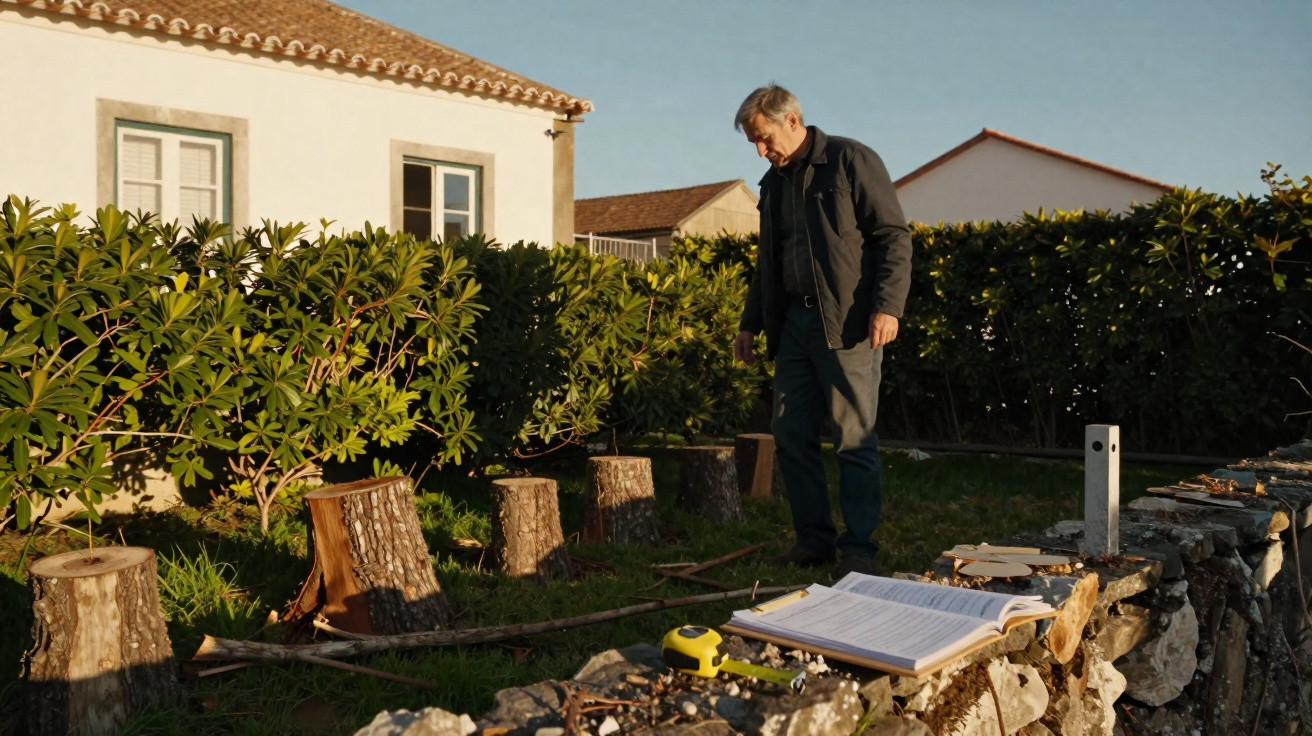
The sound of a chainsaw was what roused him. At first, he mistook it for a lorry reversing in the next road, a far-off growl blending into his sleep. Then he heard a branch snap sharply, leaves crashing down, and someone outside his bedroom window say, “That’s the last one.”
He leapt out of bed, drew back the curtain, and felt his stomach sink.
The line of mature trees bordering his rear fence for twenty years had disappeared. Their trunks were nothing more than stumps. Their branches lay heaped up like evidence at a crime scene. Wearing a hi-vis vest, his neighbour stood beside two contractors and gave a self-satisfied shrug: “Sorry, mate. I’ve got a right of light.”
The garden was suddenly bare. Unprotected.
And in an instant, this was no longer only a dispute about trees.
It was about control.
When a peaceful garden becomes a legal battlefield overnight
For plenty of homeowners, trees represent far more than foliage and shade. They provide privacy, muffle noise and form a green barrier that makes everything beyond the garden feel more distant. If those trees disappear overnight, the impact can be visceral. It is not merely the loss of branches; it is the loss of security.
The neighbour may see the situation entirely differently. Perhaps their kitchen window is obscured, their sitting room feels dim, or their garden never properly dries out. They search online, come across the notion of a “right of light”, and before long your maple or cypress hedge is cast as the enemy in their household story.
That is when the once-quiet boundary between two homes can begin to resemble a battle line.
Consider Tom, who owned a semi-detached home on a tightly packed suburban road. His back garden had been a leafy passageway, edged by four tall conifers on the boundary that he had planted twenty years before. Birds nested in them each spring. He drank coffee beneath the same thick green screen that had been there as his children grew up.
Sarah, his neighbour, saw it another way. The trees left her kitchen and upstairs study in shadow. After years of hinting at the issue – “Have you thought about trimming them a bit more?” – she reached breaking point when she began working from home full time. One Monday, Tom woke to the roar of machinery and saw hard hats topped with saws. After a brief call with a local solicitor, she had persuaded herself that a right of light entitled her to act.
By 9am, the trees had gone. So had the neighbourly relationship.
From a legal perspective, matters are much less straightforward than a chainsaw cutting through bark. In the UK, a “right of light” is not automatic. It is generally a particular legal easement acquired through long-term, uninterrupted access to light through a window or rooflight, often for 20 years or longer. Even if such a right exists, it will rarely entitle somebody to enter another person’s land and cut down property belonging to them.
Cutting trees that stand on your neighbour’s land may amount to trespass. It may constitute criminal damage. It can also result in costly claims for the trees’ value, loss of privacy and emotional distress. A right of light does not somehow override ownership of the land and everything growing on it.
But when emotions run high and sunlight becomes a symbol of something bigger, common sense is often the first casualty.
What to do when a “right of light” is used as a weapon
If you wake to find your fence line stripped bare while a neighbour brandishes their “rights” like a weapon, begin simply: stay calm and record everything. Photograph the stumps. Find photographs from previous summers that show the trees standing. Note dates and times, and retain any messages exchanged about them.
Without causing a scene, ask your neighbour who provided their legal advice. Did a solicitor actually tell them that they could cross the boundary and cut the trees? Did they obtain written consent from anyone? In many cases, the response will be a hazy mention of “something I read online” or “a friend in property”.
The difference between what they believe the law permits and what it truly permits is often where your position becomes stronger.
There is also a subtle trap into which many homeowners fall: guilt. They may worry that their trees genuinely made their neighbour’s life difficult. As a result, they absorb the shock, leave the damage unchallenged and attempt to “keep the peace”.
The emotional issue is genuine – no one wants to be viewed as the “selfish tree owner” depriving someone else of daylight. But that does not require you to accept unlawful conduct. You can understand the frustration of a dark kitchen while still making it clear that your boundary is not negotiable. This is the difficult middle path: being reasonable without becoming a doormat.
In truth, hardly anyone reads their local rules on trees or boundaries until something has already gone seriously wrong.
A London-based property lawyer put it bluntly when I asked: “People throw around ‘right of light’ like it’s a magic spell. In reality, it’s technical, limited, and almost never justifies cutting trees on someone else’s land without consent. When that happens, we’re usually talking claims, not rights.”
Check local tree and boundary rules early
Review guidance from your council, particularly where trees are tall or mature. Some trees may be protected, or require specific permission before they can be altered.Keep a simple photo record
Taking a few annual photographs of your garden and boundary can quietly protect you later, showing what was where and for how long.Talk before anyone reaches for a chainsaw
A brief, mildly uncomfortable conversation is preferable to a lengthy and extremely costly legal dispute. Consider suggesting pruning, crown lifting or thinning as a compromise.Put agreements in writing
Even a cordial email – “Thanks for agreeing to reduce the height by two metres” – may prevent a later “I never said that” dispute.Get neutral advice, not street-law
Citizens’ advice services, legal clinics or a short professional consultation can establish your actual position before anger takes over.
Right of light, trees and the difficult question of whose comfort matters most
Beneath the legal terminology lies a human problem that is not easily resolved. One homeowner wants sunlight streaming into their kitchen. The other wants a sheltered, private garden. Both pay a mortgage or rent. Both believe they have earned the ability to enjoy their own corner of the world in peace, without another person’s decisions literally casting a shadow over it.
Property law attempts to balance those competing needs, but it seldom feels equitable at the time. If your trees have suddenly vanished, it can feel deeply violating. If next door’s unmanaged hedge has kept your sitting room gloomy for years, it can feel like a slow suffocation.
These disputes are seldom solely about windows and branches. They involve respect, territory and the anxiety that your home – the one place meant to feel safe – may in fact depend on somebody else’s choices.
| Key point | Detail | Value for the reader |
|---|---|---|
| Right of light is limited | Often a specific legal easement, not a general weapon against trees | Helps you push back when neighbours overstate their “rights” |
| Unauthorised cutting can be unlawful | Crossing the boundary to cut trees may be trespass or criminal damage | Gives you grounds to claim compensation or demand repairs |
| Early, calm action protects you | Documenting, talking, and seeking advice before reacting in anger | Reduces stress, costs, and the risk of a feud that lasts for years |
FAQ:
Can my neighbour legally cut my trees because of a “right of light”?
In most circumstances, no. A right of light seldom gives someone permission to enter your land and cut down trees without consent. They may seek changes through legal channels, but taking action themselves will often be trespass or damage.What should I do first if my trees were cut without permission?
Photograph everything from every angle, record the date and time, and make a note of what was said. Speak calmly to your neighbour, then seek independent legal advice or contact a citizens’ advice service before agreeing to anything.Do I have to reduce tree height if my neighbour complains about light?
Not as a matter of course. Local rules, the species of tree, its height and its distance away can all be relevant. Negotiation and proportionate pruning may sometimes resolve the matter. If a formal “right of light” is claimed, it will usually require evidence and the correct legal process.Can I claim compensation for lost trees and privacy?
Frequently, yes, particularly where cutting was carried out without your permission on your side of the boundary. Compensation may cover the trees’ value, the costs of replanting and, in certain cases, the loss of privacy or amenity.How can I stop this kind of dispute before it starts?
Raise concerns early, keep trees maintained and be willing to make small adjustments if a neighbour identifies a genuine issue. Record any agreement in writing, and establish the true boundary before anything significant is cut.





Comments
No comments yet. Be the first to comment!
Leave a Comment