
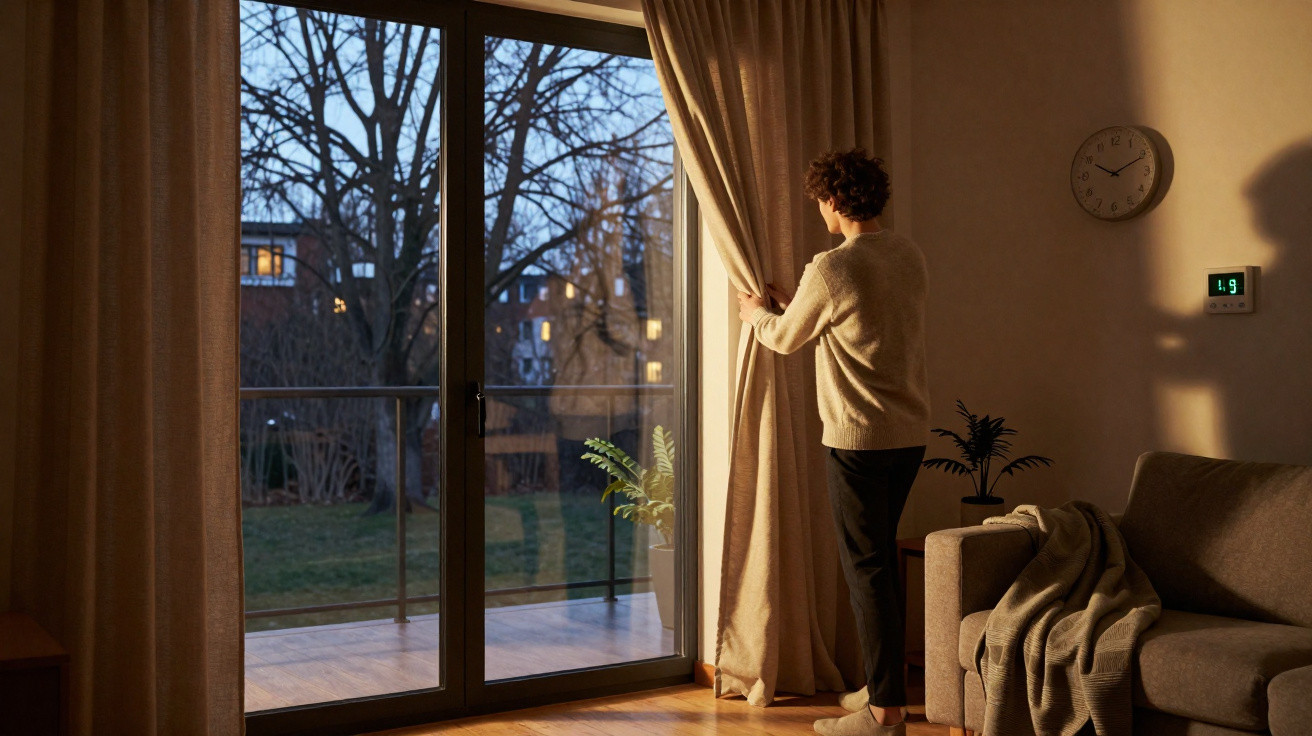
Between the afternoon spring sunshine and the cooler evening hours, many homes face an expensive gap: the property loses warmth faster than we would like, while energy prices remain high. A straightforward habit from around 19:45, recommended by energy experts in the UK, can also help households in German-speaking countries cut heating bills – without buying new technology, simply by drawing the curtains.
Why curtains should be closed from around 19:45
Around the middle of March, daily routines begin to change: daylight lasts noticeably longer and afternoon sun heats living rooms and bedrooms more effectively. That warmth is valuable from an energy perspective – provided it is not immediately lost through the windows.
“Anyone who consistently closes their curtains from about 19:45 keeps the heat stored during the day inside the home for longer, reducing the burden on the heating system.”
The reason is straightforward: even in modern buildings, windows are a weak point in the building envelope. Glass conducts heat more readily than an insulated wall, while panes become very cold overnight. Once the sun has set, the effect reverses, with the window transferring indoor heat to the cold outdoor air.
From mid-March, sunset in many areas falls at or shortly before 19:45. This makes the time a useful rule of thumb: until then, sunlight still provides a modest warming effect, but afterwards heat loss through the glass becomes dominant. Closing the curtains at this point slows that loss.
The physics: curtains as a “second pane of glass”
A curtain is no substitute for insulation, but it creates an additional thin layer between the room air and the windowpane. This forms a kind of air cushion that slows the transfer of heat.
“Dense fabric in front of a window reduces the outward flow of heat – a small change with a clearly noticeable effect on the indoor climate.”
The colder the night, the more obvious the difference becomes: rooms where curtains are drawn early in the evening stay warm for longer, while uncovered window areas become “cold traps”. Anyone who then turns up the thermostat pays for this effect directly through their energy bill.
Which curtains make a real difference
Not all fabrics perform equally well. Thin decorative net curtains are mainly intended for appearance. A noticeable effect requires more substantial material.
What to look for when choosing curtains
- Fabric thickness: Heavy, closely woven fabrics retain heat far more effectively than light, transparent materials.
- Thermal or blackout curtains: Multi-layer designs with a special coating or lining provide substantially better insulation.
- Length: Curtains should cover the full window area and reach just above the floor, without resting on a radiator.
- Width: Generous width ensures the fabric closes properly at the sides too, preventing cold areas around the edges.
- Colour and surface: Lighter fabrics with reflective inner surfaces can distribute solar warmth around the room during the day, then act as a barrier in the evening.
Many manufacturers sell what are described as “thermal” curtains. Studies indicate that indoor temperatures in rooms using these fabrics can be a few tenths of a degree to several degrees higher than in comparable rooms without curtains. That may sound minor, but during the heating season it can often mean the difference between “turning the heating up again” and “leaving the thermostat where it is”.
How much could realistically be saved on heating costs?
The potential saving depends greatly on the home: an older property with large single-glazed windows or a modern home with double or triple glazing, a north- or south-facing aspect, and a detached house or a flat within a larger building. The basic principle is that the poorer the window insulation, the greater the savings potential from curtains.
| Window type / situation | Potential effect of dense curtains |
|---|---|
| Older property, single glazing | Noticeably warmer room air, with heating demand in the evening considerably reduced |
| Older property, retrofitted insulated glazing | A noticeable increase in comfort, with a small saving across the whole heating season |
| New-build home with triple glazing | A smaller but still measurable effect, especially on very cold nights |
| Large glazed areas / floor-to-ceiling windows | Significant reduction in the feeling of cold in occupied areas, with less perceived “draught” |
Energy experts report that some households have been able to keep their average room temperature stable by up to one degree more, without heating for longer, through consistent curtain management. As every degree of reduced heating output saves roughly five to six per cent of energy, this is not merely about comfort but can also mean real financial savings.
Mid-March routine: making the most of the evening sun
The key is to combine open curtains during the day with reliably closing them in the evening. Anyone who spends the day in the office should not automatically shut everything in the morning simply because it is still cool outside.
A possible daily curtain routine
- Morning: Open curtains fully to allow as much daylight and solar warmth as possible into the home.
- Afternoon: In rooms receiving direct sun, make the most of the warmth and keep the window areas uncovered.
- Around 19:45 (from mid-March): Draw the curtains when the sun has disappeared behind buildings or below the horizon.
- Later in the evening: Air rooms only briefly and with windows fully open, then close the curtains again immediately.
People working from home can manage this even more precisely: just before dusk, walk through the property and close curtains wherever windows are large or cold air can be felt radiating inwards.
When energy prices are high: small actions with a major effect
In many countries, including Germany, Austria and Switzerland, households have faced pressure from rising electricity and gas prices for years. Many people already reduce room temperatures, take shorter showers or switch standby devices off more strictly. Drawing the curtains belongs in the same category: no loss of comfort, virtually no effort, but a genuine effect.
“Heating, airing and managing curtains – those who keep all three in mind often reduce their energy costs considerably without feeling cold.”
Users online share experiences similar to those reported on the British portal: people who draw their curtains diligently in the evening mention fewer draughts around the sofa, warmer bedrooms and radiators coming on less often. Tenants in poorly insulated older properties in particular find this a noticeable relief.
What to avoid
One common mistake is having curtains hang directly over radiators or even partially cover them. Warm air then builds up between the radiator and the fabric, with little circulation into the room.
- Fit curtains so their lower edge does not touch the radiator.
- Use wide curtain poles so that the fabric does not “stick” directly to the radiator.
- Where there are recessed radiator areas, make sure the curtain ends in front of the window reveal rather than in front of the radiator.
Moisture also deserves attention: in rooms with high humidity, such as bedrooms or poorly ventilated older properties, condensation can collect on the glass behind permanently closed, dense curtains. Regular brief ventilation and a quick check behind the fabric help prevent mould growth.
Practical examples for different homes
In a typical city flat with two large living-room windows, a simple test can be worthwhile: on two cool March evenings, keep the heating at the same setting, but close the curtains from 19:45 on only one of the days. Many people will notice while sitting on the sofa that the perceived temperature remains higher.
A similar experiment works in a detached home with large patio doors: place a thermometer in the living room, use the same heating setting on two comparable evenings, and record how far the temperature falls overnight – once with curtains or panel blinds closed, and once without them. Small measurements such as these make the effect tangible and encourage the habit.
Additional adjustments: combining curtains intelligently
Curtains can be paired with other low-effort measures. Many households create a kind of “cascade effect” by combining several small steps:
- Apply sealing strips to old window frames.
- Close roller blinds or Venetian blinds in addition during the evening.
- Place rugs in front of cold external walls to reduce the feeling of draughts.
- Bleed radiators regularly so they work efficiently.
Each measure alone has a moderate impact. Together, they stabilise the temperature level significantly – and curtains closed in the evening have a central role in that approach.
What terms such as “thermal curtains” really mean
The market for “thermal curtains” is expanding, often with bold claims. The term generally refers to multi-layer fabrics, often with an insulating lining or coated backing. The differences lie in their density, material and construction.
Anyone looking to upgrade does not necessarily need specialist products. Traditional heavy curtains made from densely woven fabric can also work well. What matters is that they close properly, are not too short and are hung securely, so they are genuinely used every day – especially from mid-March, when there may still be light in the evening but no meaningful warmth entering through the window.





Comments
No comments yet. Be the first to comment!
Leave a Comment