
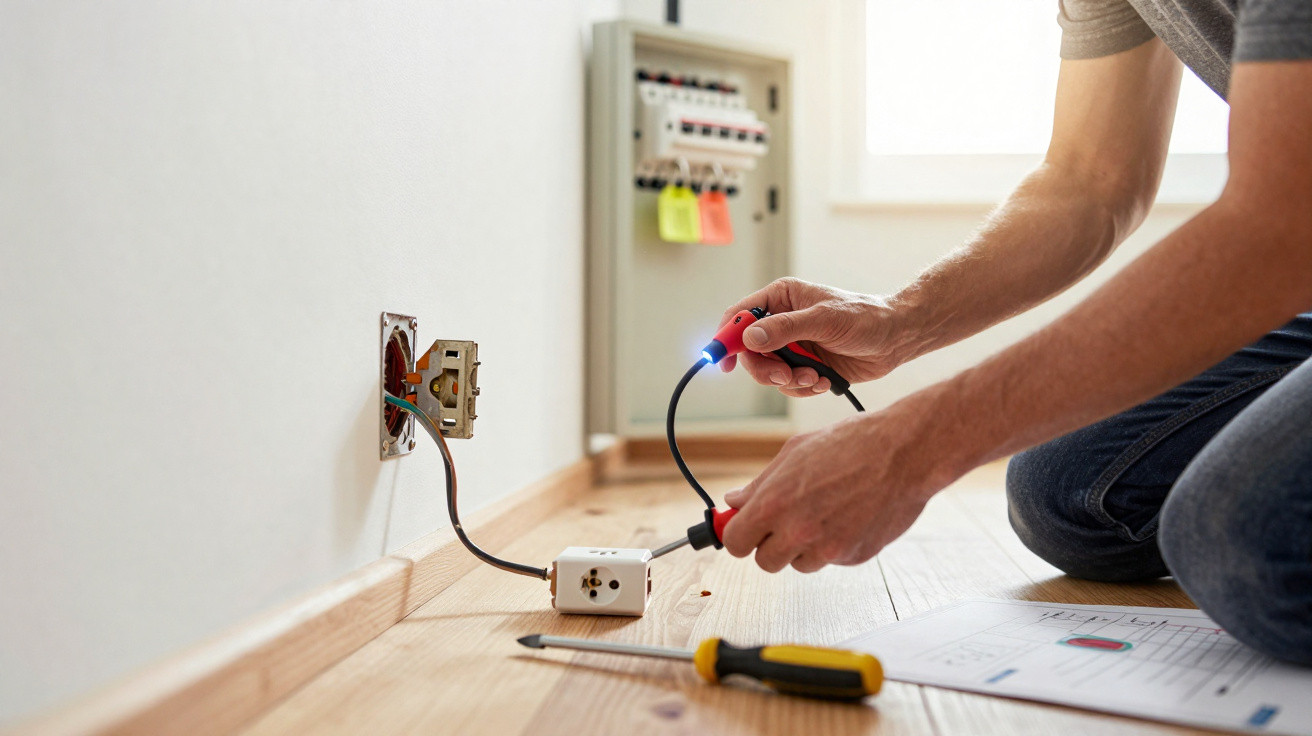
On a Sunday morning, the socket in the living room is starting to pull away from the wall. Nothing looks particularly dramatic: the faceplate has yellowed, a screw just spins, and there may be a black mark beside one aperture. It is easy to think the job simply involves switching off the power, disconnecting two wires and fitting a new unit. Plenty of people have done exactly that, often without any mishap. Yet this apparently routine task has a less reassuring side: an electrical socket carries enough energy to cause an electric shock, start a fire or trigger a wider fault in the home. The risk does not always stem from a major blunder. It can come down to one overlooked detail, an incorrectly identified circuit breaker or a poorly tightened wire. That single detail can change everything.
Switching off the power is not enough: you need to know what you have isolated
Most of us know the scene: leaning over the consumer unit, using a phone for light while looking for a label saying “living room” or “sockets”. The trouble is that such labels may be old, vague or simply wrong. One circuit can serve several rooms, particularly in a property that has been renovated over the years. Turning off a breaker at random creates a sense of safety, rather than certainty. The first rule is therefore to isolate the correct circuit and make sure nobody can accidentally restore the supply while you are working.
In a 1980s house, a DIYer believed that they had switched off the living-room sockets before replacing a cracked mechanism. The lamp in the corner had gone out, seemingly confirming that the right choice had been made. However, the wall socket was supplied by a different circuit at the consumer unit, shared with a neighbouring bedroom. On touching a conductor, they received a short but severe electric shock. According to figures regularly reported by safety organisations, domestic electricity accidents still injure thousands of people in France every year. One inaccurate label can therefore become a genuine trap.
The safest approach is to start with the relevant individual circuit breaker, or use the main switch if there is any uncertainty about the circuit. Tell everyone in the property what you are doing: someone else may instinctively switch the power back on to plug in a kettle or restore the Wi-Fi. If possible, put a visible notice on the consumer unit and keep it closed once the supply has been isolated. Never work on a live circuit, not even “just to see where the wire goes”. Let us be honest: nobody does this every day, and familiarity rarely protects anyone from electricity.
Electrical socket safety: the overlooked rule that prevents the worst
Once the circuit breaker is off, many people move straight to the screwdriver. This is exactly the point at which it is worth stopping briefly. Before handling any wires, confirm that there is genuinely no voltage using a suitable, undamaged voltage absence tester, commonly known as a VAT. A neon test screwdriver, still found in many toolboxes, is not an adequate substitute: it can give misleading results, particularly depending on hand position or, for some models, battery condition. A silent socket is not proof that it is harmless.
The correct habit is straightforward, although it takes two extra minutes: first test the device on a known live source, then check the terminals of the socket being replaced, and finally test the device again on the known source. This sequence confirms that the tester itself is actually working. Check between live and neutral, live and earth, then neutral and earth. If there is any remaining doubt, stop the work. A multimeter may be useful for an experienced user, but selecting the wrong setting is a common and sometimes dangerous mistake.
It is tempting to rely on the lack of a spark, an unlit bulb or the “feeling” that the electricity is off. These are clues, not assurances.
“With electricity, you never assume a circuit is dead: you prove it before touching it.”
Keep these practical checks in mind as well:
- use a compliant VAT that has been checked before and after use;
- remove rings, watches and metal jewellery before handling anything;
- work with dry hands, on a dry floor and in good lighting;
- never work alone if the installation appears old or damaged.
A new socket will not fix worn wiring
The third rule concerns what is found behind the faceplate: the wires, connections and condition of the back box. Replacing a socket front is one thing; reconnecting an installation correctly is another. Conductors must be identifiable, in sound condition and stripped by the right amount, with no exposed copper left once they are tightened. In newer installations, the green-and-yellow wire is earth and blue is neutral, while live is often red, brown, black or orange. In older properties, however, the colours may tell a very different story.
A frequent mistake is cutting back a wire that is already fragile because it appears too damaged or has been stripped badly. This can lead to overtightening, crushed copper or a terminal that only holds “more or less”. During normal use, a poor connection can slowly heat up behind the faceplate without any immediate noise or smell. It is one of the most insidious scenarios. A socket that blackens, moves, crackles or feels hot needs replacing, but the entire arrangement must be examined too. Signs of overheating are never merely cosmetic.
Before closing everything up, make sure the mechanism fits the back box, no wires are trapped and each terminal securely grips the intended conductor. Do not improvise with a connector block wedged behind the socket, insulating tape presented as a lasting repair, or a missing earth concealed by fitting a modern socket. Some faults clearly go beyond a home repair: brittle wires, melted insulation, damp, a burning smell, or an old consumer unit without suitable protection. In these circumstances, calling an electrician is not a luxury. It is a calm decision, and often less costly than dealing with damage afterwards.
| Essential point | Detail | Benefit for the reader |
|---|---|---|
| Identify and isolate the circuit | Switch off the matching circuit breaker, or the main switch if in doubt, and clearly notify the other occupants that work is under way. | Reduces the chance of someone restoring the power while wires are exposed. |
| Confirm the absence of voltage | Use a reliable VAT, test it on a known source before and after checking, and test the different terminals. | Prevents an unlit light or incorrect circuit identification from being mistaken for genuine isolation. |
| Inspect wires and connections | Look for overheating marks, damaged insulation, conductors that are too short, loose terminals and any damp. | Helps uncover a hidden issue before a new socket conceals a more serious fault. |
Replacing a socket can still be a satisfying small project: it can make a wall look tidier, a connection more reliable and a room a little more pleasant to live in. However, it is only a sensible task when you are prepared to slow down. Isolate, check, inspect: these three habits seem almost too simple, which is probably why they are forgotten. An electrical installation does not always provide a second warning. If you hesitate over an unusual wire, inconsistent colour coding or an overcrowded back box, take a photograph before touching anything and seek qualified advice. That caution may also help a neighbour, relative or friend who is about to reach for a screwdriver too quickly.






Comments
No comments yet. Be the first to comment!
Leave a Comment