
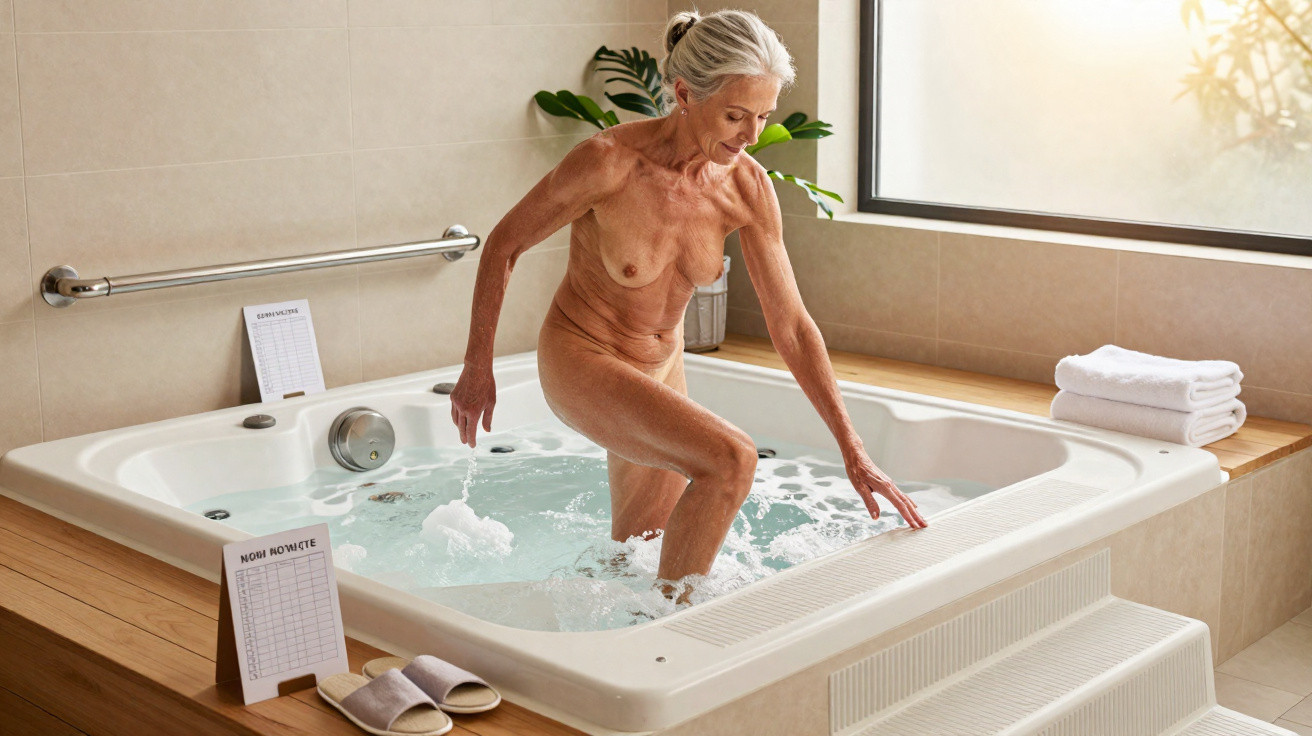
The first time you see a 78-year-old ease into a steaming jacuzzi, it can resemble a picture of graceful ageing. Soft light, churning bubbles and hands resting contentedly on the rim. But then the small details become impossible to miss: fingers holding on slightly too firmly, a cautious foot feeling for a secure surface beneath the foam, a split second of lost balance.
The water conceals the true hazard.
No one shares a photograph of the wet step sliding away, the knee giving way and the body pitching towards hard, cold tiles.
But that is often exactly where the story starts.
Why jacuzzis become difficult after 70
In theory, a jacuzzi seems an ideal companion after 70. The warm water can ease arthritis, the jets may relieve a stiff back, and it offers a gentle end-of-day routine. It is the sort of self-care doctors recommend and grandchildren happily record for social media.
In practice, though, two unseen factors enter the picture: ageing joints and wet plastic. The body takes a little longer to respond. Balance may no longer be as reliable as it once was, particularly when one leg is lifted while the other stands on a slippery edge.
That is how an otherwise calming soak can become a risky climb without much warning.
Speak to people in any retirement community and such accounts emerge quickly. An 82-year-old woman in Florida slipped while leaving her garden jacuzzi; she was left with a fractured wrist and a new anxiety about baths. A retired teacher in the UK struck his head on the side after his foot slid on a smooth fibreglass step.
People say things such as “I just lost my footing” or “my leg didn’t follow.” The issue is not usually clumsiness. It is equipment designed without people over 70 in mind: wet shells, shiny steps and narrow ledges.
Falls in and around water are greatly underreported. Few people want to say, “I fell getting out of the hot tub.”
There is straightforward physics at work. Water on a smooth surface creates low friction. Age can bring weaker muscles, diminished proprioception and slower reactions. Having to stand on one leg while getting in or out magnifies each of these limitations.
Take grip out of that equation and staying balanced becomes a matter of chance.
Non-slip steps alter the calculation. Their grit, texture and depth give feet something to “read”, even when bubbles prevent the person from seeing clearly. The brain becomes less tense because the sole feels secure. That affects the entire way the body moves around the tub.
How to make a risky jacuzzi a safe routine
For anyone over 70, the safest jacuzzi arrangement follows one basic principle: never place bare, unsupported feet on a shiny wet surface. Start by fitting a sturdy, broad, non-slip step at the access point. This should not be a flimsy plastic stool or a towel laid on the ground. Choose a firm, textured step with rubber feet or a fixed base.
Ideally, its surface should have a gritty texture that is noticeable beneath the toes, while its height should be low enough to avoid raising the knee too far. Add a grab bar or robust handrail exactly where the first foot touches down.
This is not about styling a spa. It is about creating a secure route for an older body.
A frequent error is thinking, “I’m still pretty agile, I don’t need all that yet.” Another is treating a partner’s arm as the primary support. The partner may move, hands can slip, and both people can end up struggling against gravity.
Then there is the familiar approach of simply holding the jacuzzi edge. That surface is damp, curved and not intended to take a person’s weight. We have all experienced the moment when pride speaks more loudly than caution.
A more realistic method is to plan for the worst day: weary legs, lower blood pressure after a hot soak, or slight dizziness on standing. If the arrangement remains safe in those circumstances, it is likely adequate.
“Once I added a non slip step and a rail, I stopped thinking about falling and went back to thinking about relaxing,” says Alain, 74, who uses his jacuzzi every evening for his back pain.
- Choose textured, wide non-slip steps
Select steps at least wide enough for both feet, with strong traction and dependable stability. - Add a fixed handhold at entry and exit
A wall-mounted grab bar or solid rail is much safer than using the tub edge. - Keep the area around the jacuzzi dry
A basic mat with non-slip backing can prevent that hazardous “one last” step. - Reduce soaking time and rise gradually
Hot water may lower blood pressure and leave a person unsteady on the first step. - Test the entire setup in daylight first
Practise each stage of entering and leaving before using the jacuzzi after dark.
Reconsidering pleasure and risk after 70
Age can bring a subtle conflict: wanting to continue enjoying what feels good while fearing the single fall that could alter everything. Jacuzzis sit squarely within that conflict. They can be therapeutic, but they can also be hazardous.
The important question is not “Should someone over 70 use a jacuzzi?” but “In which conditions does this remain enjoyable rather than dangerous?” The solutions are seldom glamorous: handrails that appear “medical”, substantial non-slip steps and a rule against bathing alone when balance is poor. Honestly, hardly anyone follows this perfectly every day.
Still, each small precaution creates another barrier between a pleasant evening and a lengthy night in hospital. Choosing those safeguards is not simply about fear; it is about preserving the freedom to keep saying yes to warm water, starlight and the modest luxury of sinking into bubbles without quietly preparing for a fall.
| Key point | Detail | Value for the reader |
|---|---|---|
| Non-slip steps are essential | They provide traction, surface area and stability when entering and leaving | Lowers the risk of falls while allowing jacuzzi use after 70 |
| Support should be planned rather than improvised | Handrails, grab bars and dry mats are more effective than arms and edges | Offers consistent, dependable support, including on tiring days |
| Routines can be adapted rather than given up | Shorter soaks, slower exits and safety checks before bathing | Maintains enjoyment and independence without overlooking genuine risks |
FAQ:
- Question 1: Are jacuzzis safe for people over 70?
- Answer 1: They can be, provided certain measures are in place: non-slip steps, stable support, supervised use when balance is poor, and limited time in hot water to prevent dizziness or falls in blood pressure.
- Question 2: What type of non-slip step should I buy?
- Answer 2: Pick a wide, weighty, textured step designed for wet areas, with rubber feet or a fixed base. Avoid lightweight, unstable stools and smooth plastic platforms that can move when wet.
- Question 3: Do I really need a handrail as well as a non-slip step?
- Answer 3: Yes, as most slips occur when weight transfers from one leg to the other. A rail gives the upper body a secure anchor while the feet move between different levels.
- Question 4: Can I use bath mats rather than proper non-slip steps?
- Answer 4: Mats help on the floor around the jacuzzi, but they cannot provide the stability or level transition offered by a proper step. Treat mats as an addition, not a replacement.
- Question 5: How long should someone over 70 stay in a hot tub?
- Answer 5: Most geriatric specialists suggest short sessions of 10–15 minutes at moderate temperature, followed by a slow, supported exit, particularly for people with heart conditions or low blood pressure.




Comments
No comments yet. Be the first to comment!
Leave a Comment