
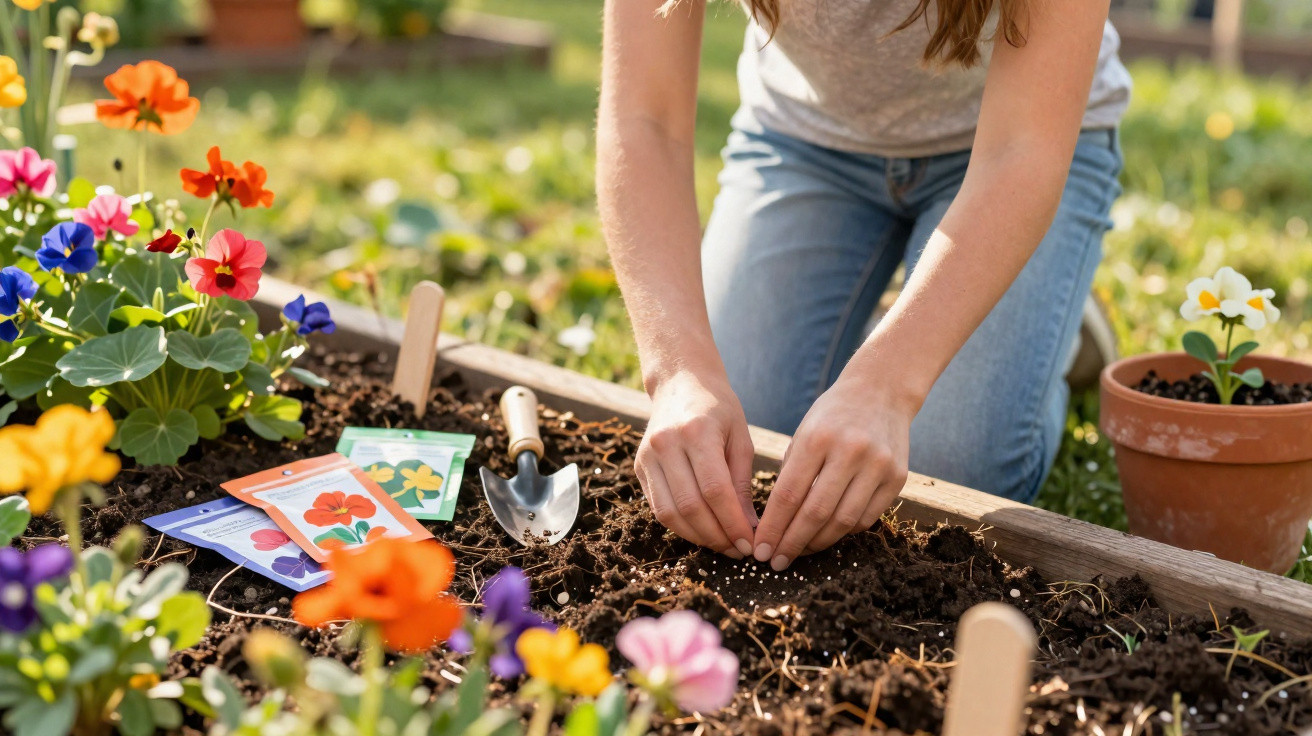
If, in March, you only gaze wistfully out of the window, you will miss the most important period for a summer garden. Behind glass, in a mini greenhouse or simply on a windowsill, the quiet stars of the season are getting under way now – the plants that will turn your flower bed into a sea of colour from June onwards. With suitable flower seeds and a little careful timing, an unremarkable patch of soil can become a garden that shines well into autumn.
Why March determines summer flowering
March weather can still be unpredictable: spring-like at midday, with frost on the lawn in the morning. In many areas, night frosts remain possible well into April. Sowing directly into the bed can therefore be risky, especially with sensitive flowers.
That is why many experienced home gardeners use a simple approach and sow under cover, for example:
- in a bright veranda or conservatory
- in an unheated greenhouse
- on a sunny windowsill
- in balcony planters or trays brought indoors overnight
This gives seedlings a head start. They can form strong roots and sturdy stems before being moved outside after the last frosts.
“Starting seeds indoors in March bridges the early-summer ‘gap’ and provides continuous flowering from June into autumn.”
Choosing good seeds avoids disappointment in the flower bed
Many people know the situation: you buy seed packets, prepare the soil and water attentively, only to end up with a few weak-looking plants. The cause is often the quality or type of seed rather than a lack of care.
For this reason, more and more garden enthusiasts are choosing open-pollinated varieties. These are flower varieties whose seeds can be collected and sown again, producing similar plants the following year. By contrast, certain hybrid varieties may flower very uniformly but are more difficult to propagate further.
Open-pollinated varieties offer several benefits:
- you can save your own seed from spent plants
- over the years, plants adapt to your soil and climate
- you help support plant diversity in the garden
Seed-swapping events in community gardens, libraries and neighbourhood projects are also popular. They often offer varieties that have already proved themselves in the local climate. Many gardeners say that seeds collected locally produce stronger plants the following year.
The 7 best flowers to sow in March
Anyone who does not want to spend hours weeding and maintaining plants should choose robust varieties that forgive the occasional missed watering day. The following seven flower varieties are considered reliable, long-flowering and relatively easy to grow.
Zinnias – vivid splashes of colour for beds and vases
Zinnias are classic summer flowers. Few species enjoy warmth and sunshine as much as they do. In March, they can be started in pots or seed trays.
- Germination temperature: ideally 18–20°C
- Later position: full sun and sheltered from wind
- Special feature: an excellent cut flower; the more you cut, the more blooms it produces
Important: do not plant zinnias outside too early, as they are sensitive to cold. Put them into the bed after the last frosts and they will reward you with colours ranging from soft pink to bright yellow.
Sweet peas – nostalgic climbing flowers
These annual climbers have the scent of “Grandma’s garden”. They climb fences, trellises and even simple strings, creating romantic clouds of pastel-coloured flowers.
For a strong start, soak the seeds in lukewarm water for several hours. This helps them germinate more quickly. When sown in March, they usually flower from early summer and can last until late summer if you remove faded blooms regularly.
Nasturtiums – versatile edible plants
Nasturtiums are particularly well suited to beginners. They germinate quickly, grow generously and tolerate occasional care mistakes. Their bright orange, yellow or red flowers decorate the bed and also make a welcome addition to salads.
The whole plant is edible; both leaves and flowers have a mildly peppery flavour, similar to garden cress. There is also a practical advantage: in the vegetable garden, nasturtiums often act as a “sacrificial plant” for aphids, which prefer to gather there rather than on more delicate crops.
Wallflowers – a classic scented choice for spring and summer gardens
Wallflowers, often sold in blends of warm yellow and rusty shades, are among the traditional cottage-garden plants. They are ideal beside paths, in front of walls or in containers on the patio.
Their strong fragrance is especially noticeable on warm days and during the evening. Paired with tulips or later-flowering perennials, they create a harmonious transition within the bed.
Coreopsis – undemanding sun lovers
Coreopsis, often sold as tickseed, produces light-looking, star-shaped flowers. Yellow and orange shades usually dominate, sometimes with a reddish centre.
They are well suited to naturalistic beds, gravel gardens and sunny front gardens. Cutting them back after the first major flush of flowers often encourages a second, slightly smaller wave of blooms in late summer.
Love-in-a-mist – delicate and airy
The dainty love-in-a-mist charms with finely feathered foliage and delicate, often blue flowers. Its seed pods, which form later, are decorative too and are widely used in dried arrangements.
Sown in March, it creates loose, natural drifts that fit neatly between taller perennials and roses. Some gardeners leave a few seed pods in place so that the plant can self-seed.
Poppies – a touch of wildflower meadow in your own garden
Poppies bring a piece of summer meadow to the flower bed with very little effort. Their fine petals appear almost translucent and, depending on the variety, glow in shades from white and pink to deep red.
Many poppy varieties tend to self-seed. If that appeals to you, allow some plants to ripen fully. The following year, fresh red touches will then appear in unexpected parts of the garden.
Start indoors or sow straight into the flower bed?
March conditions are not the same in every area. In milder, sheltered locations, some of the flowers listed can already be sown directly outdoors. Where late frosts are likely, seed trays and pots are worthwhile.
| Flower | Recommendation for March |
|---|---|
| Zinnias | better started indoors, then planted out later |
| Sweet peas | start indoors or sow outdoors in a sheltered spot |
| Nasturtiums | start in pots; direct sowing in the bed is also possible in mild areas |
| Wallflowers | sow in trays, then plant in groups later |
| Coreopsis | starting indoors is advisable, especially in cooler areas |
| Love-in-a-mist | direct sowing is possible in mild areas |
| Poppies | sow directly when the soil is frost-free |
Practical tips for successful March sowing
For a good start, ordinary seed compost is enough, provided it is loose and fairly low in nutrients. Heavy garden soil restricts fine root growth. Many flower seeds need light to germinate, so the rule of thumb is to sow too shallowly rather than too deeply. Often, it is sufficient to press the seeds lightly onto the surface or cover them with only a thin layer of compost.
Keep the compost evenly moist without allowing it to become waterlogged. A clear glass or plastic cover can help retain moisture, but it should be aired briefly every day to prevent mould from developing.
“The most critical stage is between germination and the first potting-on: at this point, light, air and water determine whether seedlings grow sturdy or become leggy.”
How to combine the seven flowers effectively
The real appeal comes when the individual varieties are combined thoughtfully. Tall zinnias and sweet peas work well at the back of the border, medium-height coreopsis and wallflowers fill the middle, while lower nasturtiums and love-in-a-mist soften the edges. Scatter poppies between them for seemingly spontaneous flashes of colour.
A similar arrangement works on a smaller scale in a container: climbing sweet peas on a trellis, zinnias in front, and trailing nasturtiums around the edge. This creates a “mini summer garden” on a balcony or patio while using very little space.
Benefits for the garden as a whole
These flowers do more than please the eye. Many attract bees, bumblebees and butterflies. Zinnias, coreopsis and love-in-a-mist in particular are regarded as real insect magnets. Anyone growing vegetables benefits from the extra pollination and the livelier garden environment.
If you enjoy sowing in March, you can begin saving your own seed in summer. Allow several strong plants to ripen completely, then collect the dry seed heads. Labelled paper packets stored somewhere cool and dry will provide the basis for the following spring – and make the garden more individual with every passing year.




Comments
No comments yet. Be the first to comment!
Leave a Comment