
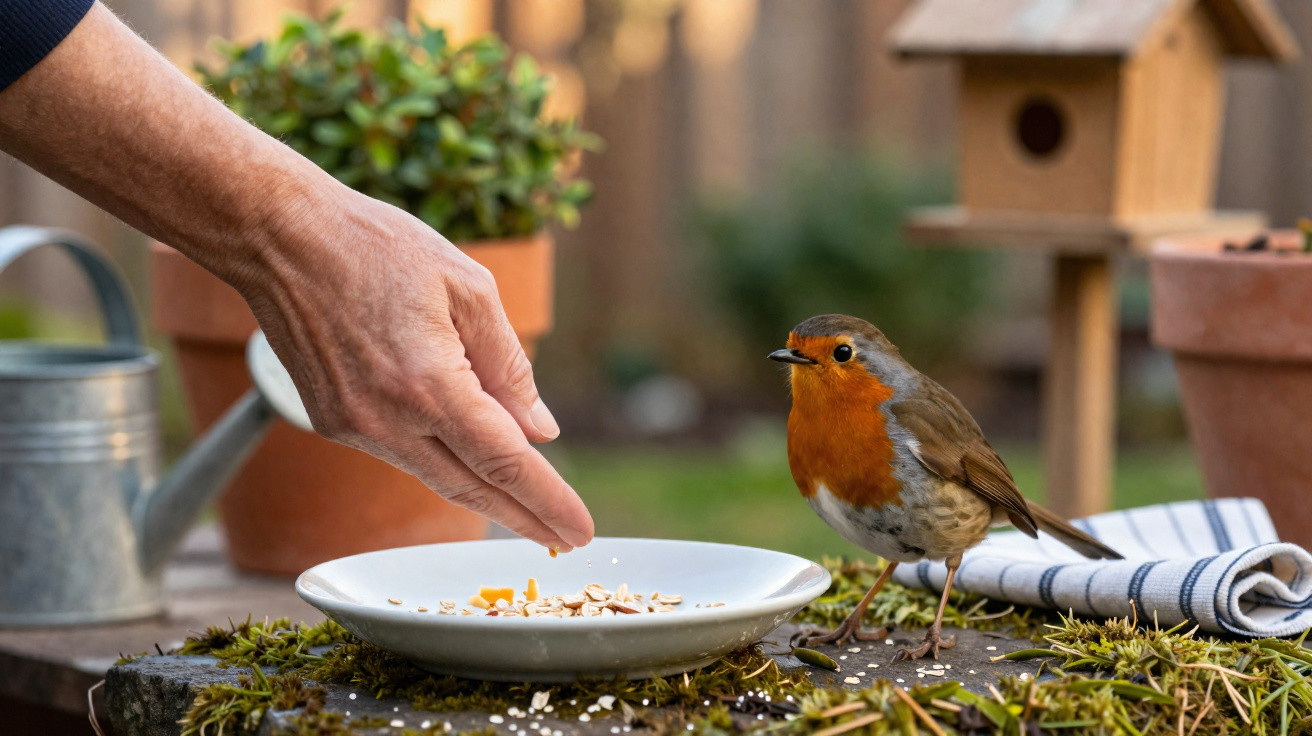
By four o’clock in the afternoon, shadows have already taken over the garden, while the birds’ movements become more precise, faster and almost frantic. At the lawn’s edge, a robin flutters down from a leafless branch, touching down with a muted thump on wet earth before cocking its head to detect the faintest sound. Its priorities seem almost visible: how much energy remains, how severe the coming night will be and where it might find the next effortless mouthful.
Gardeners are gently being encouraged to help at precisely this point. It does not require elaborate feeders or costly seed blends, only an everyday cupboard item that many of us already own. Scattering this simple kitchen staple this evening could help the robin inspecting your flowerbed face a warmer, safer night.
And it costs less than your morning coffee.
Why robins need our help right now
Pause beside a hedge in the late afternoon and it becomes clear: robins are plentiful, but curiously solitary. Highly territorial, the small bird confidently hopping near your shoes is likely guarding its area from first light until dusk. During winter, however, holding that territory is a risk. Brief daylight hours leave less time to feed, while long, chilly nights force them to use calories simply to survive.
Unlike certain songbirds, robins do not migrate; they remain here throughout the wet, grey season. That commitment has its drawbacks. Once soil freezes or prolonged rain pushes worms further underground, their preferred food is no longer within reach. They must then depend on whatever is available at the surface – and on the food we provide when natural supplies become scarce.
One low-cost cupboard staple makes helping them remarkably straightforward.
Experienced birdwatchers often describe the same scene. When the first hard frost arrives, robins can gather beneath kitchen windows and near back doors within hours, waiting for food. A British Trust for Ornithology survey found household foods such as grated cheese and oats at more winter feeding sites than many shop-bought mixes. It is not glamorous, but it works.
During one cold spell on a suburban Birmingham street, a community group monitored “their” robins. Residents on one side provided no food, whereas those opposite put out small amounts of softened oats and a little grated mild cheese on the ground at dusk. The fed side received regular evening visits from robins. On the other side of the road, birds appeared only briefly before leaving to search elsewhere.
Nobody can say with certainty how many birds survived because of those snacks. Still, the pattern was sufficiently obvious to volunteers observing from their misted-up kitchen windows. The robins remained where food was readily available.
The reason is simple. Robins are natural ground feeders. They are designed to make quick dashes over soil and low perches, rather than cling to tube feeders like acrobatic tits. As daylight fades, they cannot afford to waste energy negotiating complicated feeders. What they need is soft, energy-rich food near shelter, which they can collect in just a few hops.
This is where porridge oats are useful. They are plain, inexpensive and found in most cupboards throughout winter. Light and easy to peck at, oats provide slow-release energy to help a robin endure a lengthy night. Add a small pinch of grated mild cheese – never salty or mouldy – and they offer a modest but valuable lifeline.
Timing is every bit as important as the food itself.
The simple “tonight” trick: oats, cheese and timing
This winter, wildlife groups are making an almost disarmingly straightforward request: before darkness falls tonight, leave a small handful of plain porridge oats and a light sprinkling of finely grated mild cheese in a peaceful corner of the garden. Nothing more is needed. There is no specialist equipment and no complicated routine.
Scatter the oats in a thin layer over bare ground, a low patio or a flat stone, positioned close to a hedge or shrubs. Robins prefer to have a route to safety. They often fly in low, take a morsel and dart straight back into cover. Choose a spot visible from a window or back door, allowing your presence to become familiar within their routine.
Put the food out roughly an hour before sunset, as the light fades and the garden seems to pause. This is when robins are filling their “fuel tank” for the night ahead.
In practical terms, this cupboard-food approach suits everyday routines. You might boil the kettle, stir something on the hob or load the dishwasher, then step outside with a mug of oats on your way past. It is not meant to be a rigid daily task. Let’s be honest: nobody really does it every day. The goal is seasonal regularity rather than perfection.
We have all seen a garden that appears bare, dreary and nearly lifeless, only for a slight movement to catch the eye. Seeing a robin arrive because it has learnt that your patio offers food recreates that moment again and again. The bird will begin to match its visits to your schedule. If food usually appears at about 4.30 pm, it may start turning up around then, whether the weather is wet or clear.
Avoiding the main mistakes is straightforward. Do not leave a large heap of cheese: it is too fatty, may be too salty if the wrong type is chosen and becomes a problem when it spoils. Use only one or two teaspoons of a mild, low-salt cheese, grated as finely as snow. Oats should be plain, with no sugar or flavoured instant sachets. Never put out large pieces of bread either; they swell, have little nutritional value and may attract rats.
“We tell people to think ‘espresso shot’, not ‘buffet’,” explains a volunteer from a local bird rescue. “A small, high‑energy hit just before dusk can be the difference between a robin shivering all night and a robin waking up ready to sing.”
- Best staple to use tonight: Plain, uncooked porridge oats spread thinly on the ground.
- Optional boost: Mix a teaspoon of finely grated, low-salt mild cheese into the oats.
- Where to place it: Set it on open ground within a metre or two of a thick shrub, wall or hedge.
- When to put it out: About an hour before sunset, particularly on frosty, rainy or very windy days.
- How often: Offer it a few evenings each week during the coldest months, with more frequent feeding in cold snaps.
What this tiny habit changes in your garden
When you begin offering robins kitchen staples, this small act subtly reshapes the way the garden feels. Patterns that previously went unnoticed start to stand out: the branch used as a take-off point, the way a bird pauses with an oat in its beak to watch for competitors, and the quiet sharp clicks or fragments of song used to declare that the feeding place belongs to it.
Over several days and weeks, the passing thought of “oh, a robin” can become something resembling a relationship. Children may ask whether “their” robin has visited that day. Neighbours might see it on the fence and mention it while putting out the bins. Before long, you may find yourself looking outside at feeding time without consciously deciding to do so. A bird that was once part of the background becomes central to your winter routine.
More broadly, regular small offerings to many garden robins may slightly improve local survival rates during severe weather. Each additional adult surviving until spring means another defended territory, another nest raised and another generation hearing that distinctive song at dawn. It all starts with a packet of oats that is probably already in your cupboard.
It can also alter your experience of winter. Gardens at this time of year can feel like places in limbo – no longer fully alive, but not yet in bloom. A robin arriving at almost exactly the same time each evening, and becoming bolder as it learns your habits, turns that quiet period into a gentle appointment. It offers five minutes away from screens and scrolling, focused on something real, living and fragile.
There is nothing grand or difficult about it. You do not need an acre of land, a wildlife pond or expensive feed. All that is required is a doorway, a small patch of ground, a bag of oats and three spare minutes before switching on the kitchen light. That is the extent of the request. In return, tomorrow evening, as daylight drains away and the air grows colder, a robin may already be waiting, its bright breast catching the final light and trusting that you remembered.
If you do not, there is always tomorrow night.
| Key point | Details | Why it matters to readers |
|---|---|---|
| Best food to put out tonight | Use plain, uncooked porridge oats with a teaspoon of finely grated, low-salt mild cheese. Spread a small handful over bare ground or a flat stone close to a hedge. | It is inexpensive, takes only seconds and relies on ingredients already found in many homes, enabling you to help robins immediately without purchasing specialist bird food. |
| Ideal timing for feeding | Put food out around an hour before sunset, particularly on frosty or wet evenings. Robins commonly feed until the final usable daylight. | Providing food then allows robins to “tank up” before the day’s longest and coldest period, increasing their chance of getting through the night. |
| Common mistakes to avoid | Do not use salty, strong or mouldy cheese, flavoured instant oats, large amounts of bread or excessive quantities left overnight that may attract rats. | Small, fresh portions support bird health, limit pests and ensure well-meaning feeding does not unintentionally create further problems. |
FAQ
- Can I feed robins every day with oats and cheese? You can, provided portions remain small and the cheese is mild and low in salt. For many people, putting out this mixture three or four evenings a week is more manageable and still gives birds a dependable feeding pattern.
- Are porridge oats safe for other garden birds too? Yes, when supplied in modest quantities. Blackbirds, dunnocks and even sparrows may join them, collecting oats dropped on the ground. Keep the oats dry and unflavoured, and combine them with natural foods such as fruit or seeds where possible.
- What if I only have quick-cook or flavoured sachet oats? Avoid flavoured varieties, as added sugar and artificial flavourings are unsuitable for wildlife. Plain quick-cook oats are generally acceptable dry and in small portions, although switching to basic traditional porridge oats on your next shop is preferable.
- Will feeding robins like this make them too dependent on me? This is unlikely if you offer modest portions. Robins remain capable foragers that will continue hunting insects and worms; oats and cheese simply act as a top-up, particularly during cold snaps when naturally available food is harder to find.
- Is it okay to put the food on a bird table instead of the ground? It is, although many robins favour low, open places and may feed with greater confidence from a patio slab or low wall. Where a table is your only option, use its flattest section and spread food out so birds do not have to compete in a confined area.






Comments
No comments yet. Be the first to comment!
Leave a Comment