
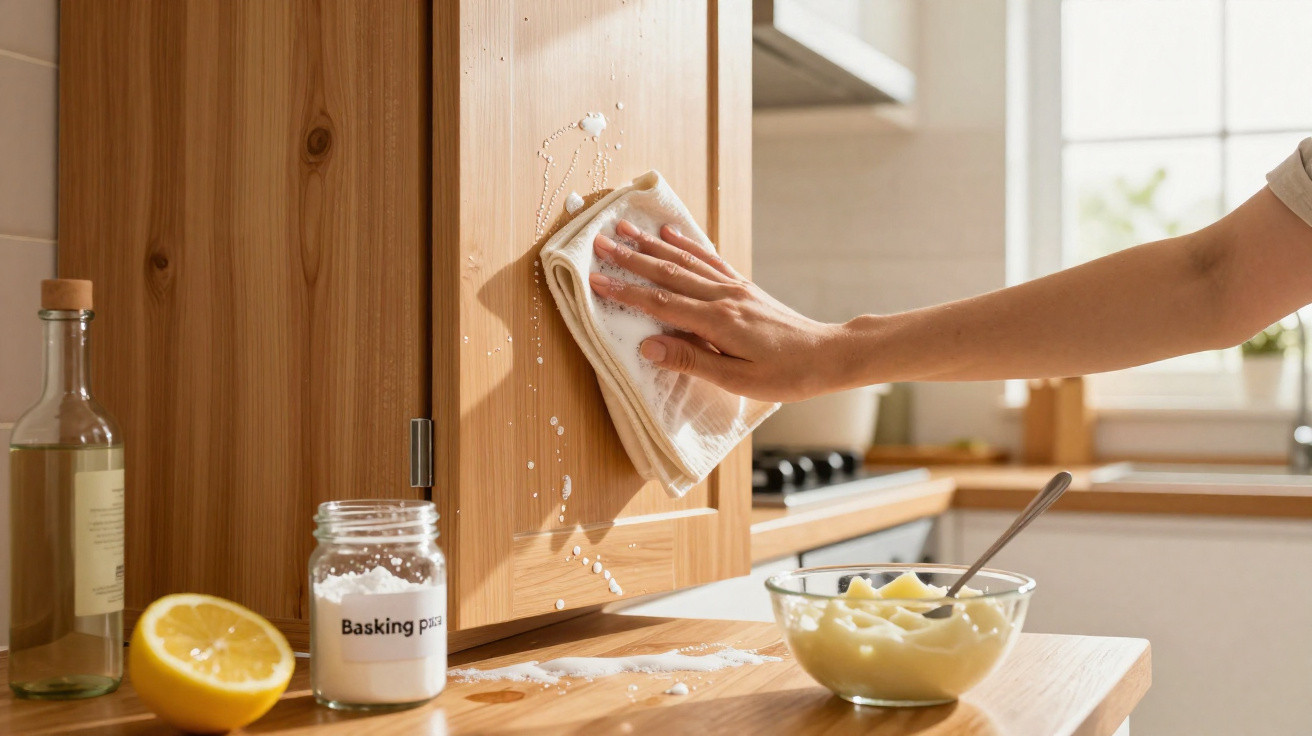
Many people know the feeling: you quickly wipe across the wall cabinets, only to find a sticky layer rather than a smooth surface. Especially around the cooker, a stubborn combination of grease, steam and dust builds up over the months. Yet you often do not need a specialist product from the supermarket cleaning aisle – an unassuming powder from the kitchen cupboard can do the job.
Why kitchen cupboards become greasy so quickly
When frying, boiling or deep-frying, tiny droplets of fat rise with the steam. This vapour then spreads throughout the room. Kitchen cupboards, particularly wall units and their handles, seem to attract these particles.
- Greasy vapour from pans and saucepans settles on surfaces.
- Airborne dust combines with it, forming a tough coating.
- If it is not cleaned away regularly, the mixture hardens and becomes difficult to remove.
An extractor hood lessens the issue but cannot eliminate it entirely. Even kitchens with effective ventilation will gradually develop a coating that leaves cupboards looking dull and grubby.
The sticky film on kitchen cupboards is not a sign of “poor hygiene”, but an entirely normal part of daily life – it only becomes a problem when it is left for too long.
Clean kitchen cupboards with bicarbonate of soda
Bicarbonate of soda, often sold as baking soda or food-grade soda, is one of the most overlooked all-purpose household products. As the powder is mildly alkaline, it breaks down grease without being harsh. Many people already use it for baking or to neutralise fridge odours – and those same qualities can be put to use when cleaning.
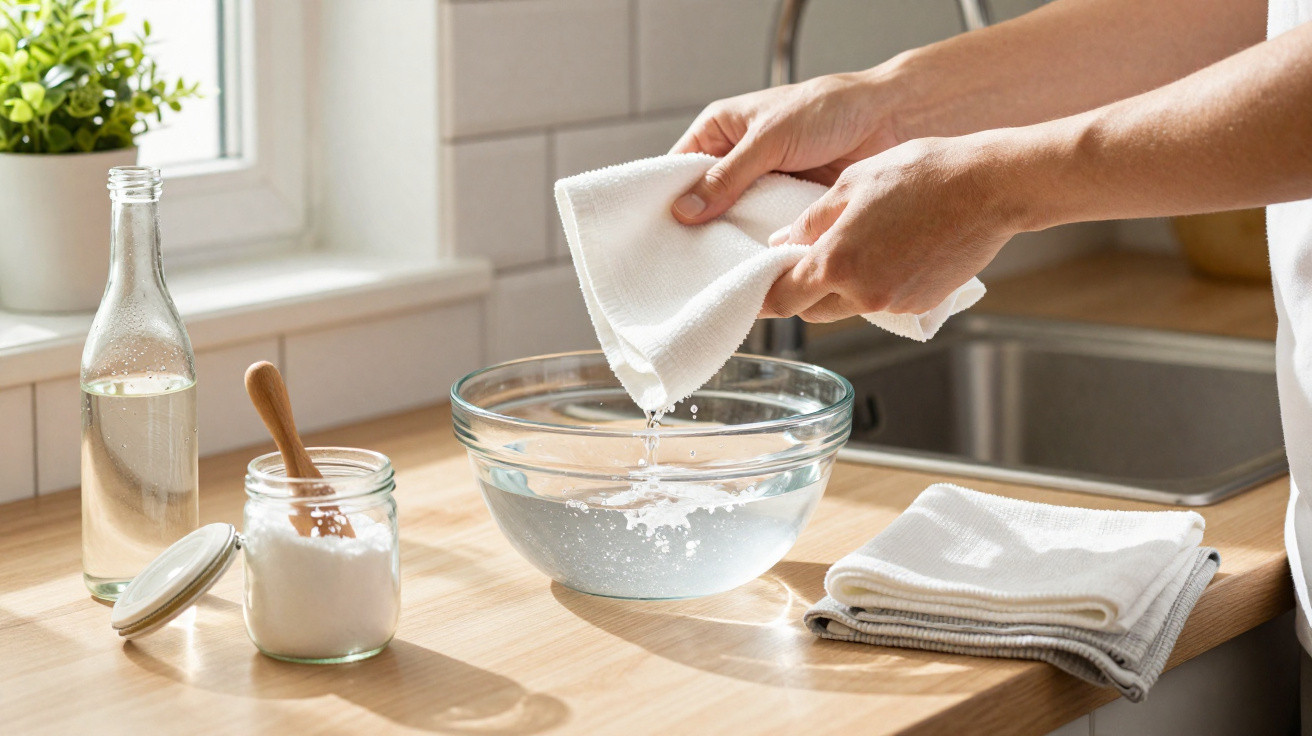
How to mix the bicarbonate of soda solution
For dirty kitchen cupboards, this straightforward basic mixture has proved effective:
- 1 to 2 tablespoons of bicarbonate of soda
- approximately 250 ml of warm water
- optional: a squirt of mild washing-up liquid for heavy grease deposits
Stir the bicarbonate of soda thoroughly into the water so that as much as possible dissolves. A small amount of residue does no harm; it increases the gentle abrasive action.
Step-by-step method for greasy cupboards
Work methodically to keep the cleaning both effective and gentle:
- Remove loose dust with a dry cloth.
- Apply the bicarbonate of soda solution using a soft sponge or microfibre cloth.
- Clean the surfaces using circular movements, without rubbing too vigorously.
- Leave the solution to work for around 2 to 5 minutes.
- Wipe over with a clean, damp cloth until no residue remains visible.
- Finally, buff with a dry cloth to prevent water marks.
Its combination of mild alkalinity and fine particles makes bicarbonate of soda a particularly gentle grease remover for materials – ideal for frequently used kitchen fronts.
Where not to apply bicarbonate of soda directly
Although bicarbonate of soda is fairly mild, it is worth carrying out a quick test in an inconspicuous spot. Take particular care with:
- High-gloss fronts with delicate lacquer
- Fronts with specialist coatings or very soft plastics
- Solid wood with an open-pored finish or specialist oils
In most cases, it is enough to dissolve the bicarbonate of soda very thoroughly in water rather than applying it directly as a paste. If you are unsure, use a soft cloth instead of the abrasive side of a sponge.
Vinegar, lemon and more: other home remedies for clean kitchen cupboards
Alongside bicarbonate of soda, vinegar and lemon are classic household cleaning options. Both contain acids that cut through grease and have an antibacterial effect.
| Home remedy | Effect | Suitable uses |
|---|---|---|
| Bicarbonate of soda | Degreasing, mildly abrasive, odour-neutralising | Greasy film, odours, slightly yellowed surfaces |
| Vinegar | Degreasing, antibacterial, limescale-removing | Handles, hard-wearing fronts, tiles, worktops (depending on material) |
| Lemon juice | Mildly degreasing, deodorising, slightly bleaching | A fresh scent, light soiling, stainless-steel handles |
When vinegar is a good idea – and when it is not
A solution of warm water and a little household vinegar removes grease while also providing an antibacterial effect. It is often sufficient for durable surfaces such as coated chipboard or robust plastic fronts.
Use caution with:
- Delicate wooden surfaces
- Certain lacquers and high-gloss fronts
- Natural-stone worktops nearby, such as marble or limestone
The acid can damage these materials or make them appear dull. If you use vinegar, always wipe the surface afterwards with water and dry it thoroughly.
Lemon for a fresh kitchen scent
Diluted lemon juice loosens light grease deposits and leaves behind a pleasant smell. It is particularly suitable for a quick clean between deeper cleans, or for cupboard interiors and handles where odours can accumulate.
The same rule applies here: always test it first on delicate fronts and avoid using it too concentrated.
How to prevent new greasy films effectively
Even the best clean is of limited use if everything feels sticky again after a few weeks. A handful of habits can significantly reduce the work involved.
Regular quick cleans instead of a major cleaning marathon
- After cooking, briefly wipe fronts near the cooker with a damp microfibre cloth.
- Once a week, clean all wall cupboards with plain water or a mild bicarbonate of soda solution.
- Do not overlook handles and edges – grease builds up particularly heavily there.
Making these small steps part of everyday life prevents a thick layer from forming in the first place.
Cooking oil as a protective layer – useful or not?
Here is a rather surprising tip used in many homes: applying an extremely thin layer of neutral cooking oil to clean fronts can stop fresh dirt from sticking as firmly. The oil acts rather like a separating film.
Use it very sparingly:
- Put a few drops of oil onto a soft cloth.
- Rub it over the surfaces in a barely perceptible layer; do not leave them visibly oily.
- Buff with a second, dry cloth until nothing feels greasy.
This may work well on matt or textured surfaces. High-gloss fronts may develop streaks, however. In those cases, regular cleaning with a lightly dampened microfibre cloth is usually the better option.
Choosing the right product for the surface
Not every kitchen front can tolerate the same treatment. Checking the material briefly can prevent problems.
- Foil or plastic fronts: usually straightforward; bicarbonate of soda solution and mild vinegar are often suitable, but avoid harsh scrubbing.
- Lacquered high-gloss fronts: use a very soft cloth and heavily diluted products, always test first, and never rub dry.
- Solid wood, oiled or waxed: use very little water and only very mild cleaners, then re-oil if necessary.
If you are uncertain, the kitchen documentation may contain guidance from the manufacturer. It often gives clear recommendations about which cleaning products are appropriate.
Common mistakes when cleaning kitchen cupboards
Many issues are caused not by the home remedy itself, but by how it is used.
- Water that is too hot can affect certain adhesives or coatings.
- Scouring sponges create micro-scratches, allowing dirt to become embedded even more quickly.
- Strongly perfumed all-purpose cleaners mask smells, but do not remove greasy film any better than bicarbonate of soda or vinegar.
Gentle products, lukewarm water and a little patience are often more effective in the long term than aggressive specialist spray cleaners.
Practical example: how long a bicarbonate of soda clean really takes
Anyone who assumes a thorough clean automatically takes up half a Saturday may underestimate what home remedies can achieve. In an average kitchen with two to three rows of wall cupboards, a complete clean with bicarbonate of soda solution often takes no more than 30 to 45 minutes:
- 5 minutes to mix the solution and prepare the cloths
- 20 to 30 minutes to clean every front
- 10 minutes to wipe down and dry
Repeating this routine every few weeks keeps cupboards looking fresh and clean for noticeably longer. The annual deep clean then becomes less demanding.
What bicarbonate of soda does chemically
Bicarbonate of soda consists of sodium hydrogen carbonate. The substance is mildly alkaline, or basic. Chemically, fats are known as esters. Alkaline solutions split these compounds more easily, which releases grease films from surfaces.
Unlike many strongly alkaline cleaning products, bicarbonate of soda remains relatively mild and is considerably less irritating to the skin. Even so, wearing gloves is worthwhile, especially if you have sensitive skin. They protect your hands and nails, particularly during longer cleaning sessions.
When a specialist cleaner does make sense
There are situations where bicarbonate of soda, vinegar and lemon reach their limits – for example, in kitchens neglected for years or with extremely yellowed fronts. In that case, a targeted degreaser from a specialist retailer can help. It is particularly worthwhile when:
- the grease layer has become almost rubbery,
- burnt splatters of oil and sauces are stuck to the cupboards,
- the kitchen needs to be brought into top condition quickly for a move or sale.
If you do turn to stronger products, follow the material guidance and do not mix several cleaners indiscriminately. Often, a single application is enough, after which bicarbonate of soda can once again provide the basic everyday clean.


Comments
Предлагаем лучшие цены https://profildoors-center.ru/zerkalnye-dveri
Представительство обеспечивает бесперебойную поставку продукции предприятия всем партнерам в Центральном Федеральном Округе России https://profildoors-center.ru/magic
В структуру предприятия входят три крупные площадки в разных районах Ленинградской области и производственная площадка в Новосибирске https://profildoors-center.ru/povorotnaya
Для хранения и распределения готовой продукции в Ленобласти построен Логистический центр https://profildoors-center.ru/about
МДФ https://profildoors-center.ru/glyanczevye-dveri
Это легкая древесноволокнистая плита будет оказывать на петли минимальное давление https://profildoors-center.ru/sotrudnichestvo
А правильно выбранное покрытие защитит ее от воздействия влаги, грибка и плесени https://profildoors-center.ru/compack
Массив https://profildoors-center.ru/magic-uniq
В производстве дверей используются деревянные плиты из дуба, сосны, ольхи и других древесных пород https://profildoors-center.ru/sotrudnichestvo
Экологичность, яркость фактуры и натуральность окраски делает такую дверь незаменимой для любых интерьеров https://profildoors-center.ru/sotrudnichestvo
Шпон https://profildoors-center.ru/sertifikaty
В основе изделия лежит ДСП, которая покрывается шпоном https://profildoors-center.ru/kupe
Внешне шпонированная дверь не отличается от изделий из массива https://profildoors-center.ru/wave
Но ее цена вполне доступна https://profildoors-center.ru/magic
Витрина Piega https://profildoors-center.ru/garmoshka
Межкомнатные двери — это не только функциональный элемент для зонирования пространства, но и важная часть дизайна интерьера https://profildoors-center.ru/contacts
Правильно подобранные двери способны подчеркнуть стиль помещения и повыси..
• Металлокерамика — сочетание металла и керамики: металл используется в качестве каркаса, а сверху придаёт форму и цвет коронке — керамика https://adentalab.ru/
1 https://adentalab.ru/
Снятие слепков и подготовка https://adentalab.ru/
После первичного осмотра стоматолог снимает слепки с обеих челюстей пациента https://adentalab.ru/
В лаборатории по этим слепкам создаётся гипсовая модель челюстей пациента https://adentalab.ru/
• Диоксид циркония — отличается прочностью, используется для изготовления коронок, которые в дальнейшем устанавливаются вместо жевательных зубов https://adentalab.ru/
• Акрил — лёгкий пластик, сохраняет форму конструкций https://adentalab.ru/
4 https://adentalab.ru/
Финальная обработка и установка протеза https://adentalab.ru/
Когда восковая модель удовлетворяет требованиям, начинается изготовление окончательной версии протеза из выбранного материала https://adentalab.ru/
После окончательной полировки протез готов к установке https://adentalab.ru/
Врач-стоматолог устанавливает съёмный зубной протез в полость рта пациента, давая рекомендации по уходу и корректировке https://adentalab.ru/
Выбор протезов и материалов, из которых они будут изготавливаться, осуществляет врач, сочетая своё решение с мнением пациента https://adentalab.ru/
Leave a Comment