
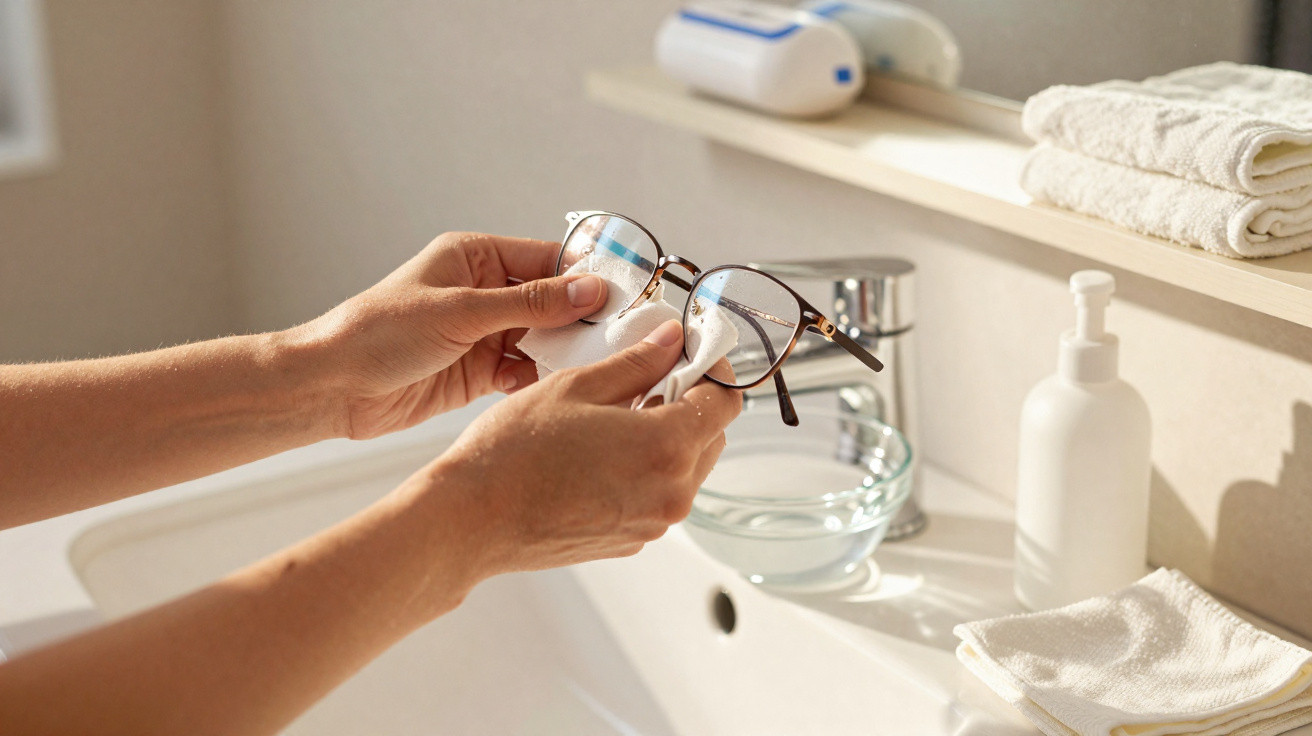
Glasses slip down, a mark becomes irritating, and the sleeve comes to the rescue for a quick wipe. Yet this kind of ‘quick clean’ can dull the lenses, damage their coatings and reduce clarity. Following a few straightforward rules will keep your glasses clear for longer and help you avoid costly replacements.
Why your glasses can suffer sooner than you expect
Modern glasses are compact high-tech products. Anti-reflective coatings, blue-light filters, hard coatings and UV protection can all react sensitively to unsuitable care. On top of that, dust, sand, make-up residue and skin oils act like fine sandpaper when dragged across a lens during wiping.
Cleaning your glasses incorrectly makes your vision a little worse each time – often without you noticing straight away.
The issue is that many seemingly handy options do more harm than good. Disposable paper products in particular, along with a quick wipe on a jumper, are real scratch traps.
What to avoid when cleaning your glasses
Before looking at the best methods, it is worth knowing the common mistakes behind dull lenses:
- Do not use hot water – high temperatures can damage coatings.
- Do not use tissues or kitchen roll – paper fibres can contain hard particles.
- Do not wipe lenses with clothing such as a T-shirt, jumper or scarf – many fabrics are mildly abrasive.
- Do not use glass cleaner, all-purpose cleaner or nail-varnish remover – their chemicals are too harsh.
- Do not rub lenses dry when dust is on them – always moisten them first.
These practices damage the delicate lens layers, create micro-scratches and make glasses look greasy and cause glare more quickly.
Tip 1: Water and mild washing-up liquid – the professional method at home
One of the most effective solutions is also the simplest: lukewarm water and a mild degreasing cleaner. Many opticians recommend precisely this, rather than expensive specialist bottles from the shop shelf.
Step-by-step method for cleaning glasses
- Wash your hands thoroughly with soap, then rinse them well.
- Hold the glasses under cool or lukewarm water, never hot water.
- Put a tiny drop of mild washing-up liquid or gentle soap onto your fingertips.
- Gently rub the lenses and frame with your fingertips, paying particular attention to the bridge and temples.
- Rinse everything thoroughly with water.
- Carefully pat the glasses dry using a clean, soft cloth or microfibre cloth.
This approach reliably removes grease, dust and fingerprints, including from anti-reflective, blue-light-filter and sun-protection lenses. Many glasses wearers report that it can also noticeably reduce the tendency for lenses to mist up for several days.
Tip 2: Microfibre cloth – a handy option when you are out and about
For a quick clean, a microfibre cloth is sufficient in most cases. The material captures dust and dirt instead of grinding it over the lens surface. This is why a cloth of this kind is included with almost every new pair of glasses.
Use it correctly as follows:
- Briefly breathe on the glasses or, where possible, lightly moisten them with a drop of water.
- Move the microfibre cloth over the lenses in small circular motions, using gentle pressure.
- Finish by wiping the bridge and temples too, as sweat collects there.
Compared with a microfibre cloth, kitchen roll and paper tissues act like sandpaper – especially when they already contain dirt particles.
If you do not have a microfibre cloth to hand, a smooth cotton cloth that does not shed fibres can be used in an emergency, such as a freshly washed fabric handkerchief. Even so, microfibre remains the better choice.
Tip 3: Clean your microfibre cloth regularly – otherwise it becomes a source of dirt
Something many people overlook is that even the best cleaning cloth eventually becomes dirty. Grease, dust and particles build up in its fibres, then end up back on your glasses during the next clean. This can lead to scratches, which is exactly what you are trying to avoid.
How to care for your glasses cloth properly
- Wash the microfibre cloth in the washing machine every few weeks.
- Do not use fabric conditioner, as it coats the fibres and reduces their cleaning performance.
- Ideally, wash it in a laundry bag so that it does not get lost.
- Replace the cloth completely with a new one at least once a year.
Anyone who uses an unwashed cleaning cloth for years repeatedly drags invisible, slightly sharp dirt across their lenses. The result is fine abrasion marks that can no longer be removed.
Tip 4: White household vinegar for extra shine
White household vinegar is an inexpensive all-round household product, and it can work on spectacle lenses too when used in the right quantity. It dissolves greasy residue, removes limescale streaks and leaves a clear shine.
To use vinegar safely:
- Mix equal parts vinegar and water.
- Pour the mixture into a small spray bottle.
- Apply one or two sprays to the lenses, or lightly dampen a microfibre cloth with it.
- Wipe the lenses gently, then dry them with a second clean cloth.
Keep your hands off glass cleaner, all-purpose spray and aggressive solvents – they attack the coatings on modern spectacle lenses.
If you wear sensitive premium lenses or lenses with specialist coatings, ask your optician whether vinegar is suitable for that particular model. In most cases, the diluted solution is not a problem when used sparingly.
Tip 5: Ultrasonic cleaner – deep cleaning like an optician
Many opticians have a small device behind the counter: an ultrasonic cleaner. The technology is now available for home use at a reasonable price too. It suits anyone wanting to clean their glasses particularly thoroughly without rubbing or scrubbing.
How an ultrasonic cleaner for glasses works
A typical set-up includes:
| Component | Function |
|---|---|
| Tank | Filled with water and a little cleaning agent |
| Basket insert | Keeps the glasses in place without scratching them |
| Ultrasonic module | Produces high-frequency vibrations in the water bath |
| Timer | Controls the cleaning time, usually under one minute |
The vibrations loosen dirt even from difficult-to-reach areas, including hinges, nose pads and the edges between lenses and the frame. Many devices can also be used for jewellery or metal watches without leather straps.
Important: only use one for glasses approved for this type of cleaning. For very old models, fragile frames or specialist coatings, it is worth checking with an optician first.
How often should you clean your glasses?
Anyone who wears glasses every day needs some form of routine. The following offers a rough guide:
- a brief clean with a microfibre cloth: once or several times a day, depending on how dirty the glasses are;
- a thorough wash with water and washing-up liquid: every few days;
- cleaning in an ultrasonic device: every one to two weeks, or when deposits are visible.
The same principle applies to non-prescription sunglasses. Scratches also create stray light in these lenses and can tire the eyes more quickly.
Risks of neglected glasses – an underestimated everyday trap
Smeared or scratched lenses are not merely annoying. They have immediately noticeable effects:
- Your eyes have to work harder to distinguish contrasts.
- Concentration declines faster, especially when using a screen.
- Glare can become more dangerous while driving.
- Small irregularities in the lens can contribute to headaches.
People who wear glasses with clean lenses often find that they blink less and their eyes feel more relaxed – an effect many only notice when they can make a direct comparison.
Practical habits that help your glasses last longer
Day-to-day handling matters just as much as cleaning itself. A few routines can significantly extend their lifespan:
- Always put your glasses in a case overnight rather than leaving them loose on the bedside table.
- Never place them on a table with the lenses facing downwards.
- Take glasses off with both hands so that the frame does not become misshapen.
- Do not store them in the bathroom directly beside hairspray or perfume, as fine droplets can settle on them.
These small measures prevent many issues that are later classed as ‘normal wear and tear’ at the optician’s – and which can then be felt in your wallet.



Comments
No comments yet. Be the first to comment!
Leave a Comment