
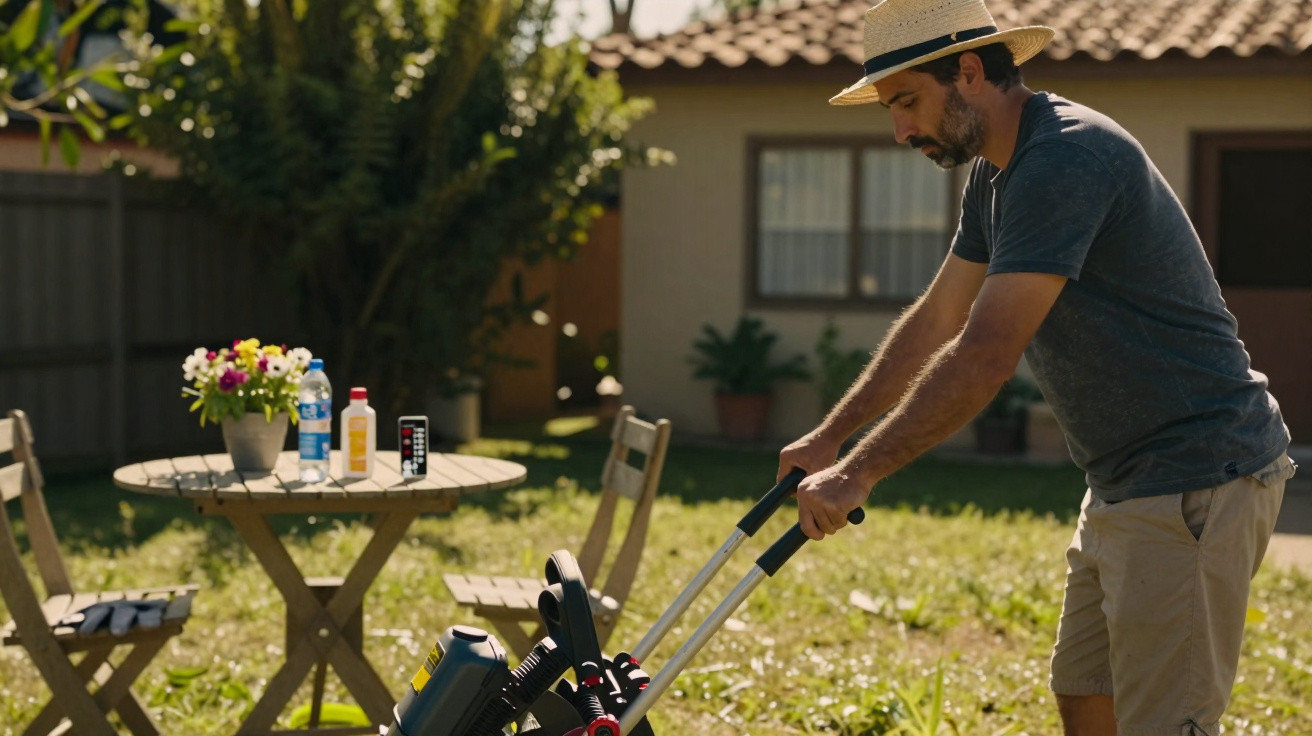
The mower starts at 1 p.m., exactly as expected. Its roar cuts through the shutters, overpowering the cicadas and the rattle of cutlery from a late lunch. Through the heat haze, he can be seen guiding the machine back and forth, cap low over his face, keen to finish before returning to work.
From 15 December 2025, that familiar scene will discreetly become unlawful in 26 French departments. Mowing during the middle of the day will no longer be permitted, regardless of how quickly the lawn is growing or how packed the diary is. The principle is straightforward: mowers must remain in the shed between noon and 4 p.m. The argument surrounding it, however, is far more complicated.
Why the noon-to-4 p.m. mowing ban is being introduced – and why it hurts
The proposed restriction appears severe: from 15 December 2025, 26 departments will ban lawn mowing from 12:00 to 4:00 p.m. on most days. For plenty of residents, that is the one period when they are both at home and awake.
This measure has not emerged from a bureaucratic whim. Local authorities associate it with heatwaves, air and noise pollution, and even energy consumption. Midday is when ozone levels, pressure on electricity grids and health risks for professional and amateur gardeners are at their highest. The state's position is plain: the grass can wait, but lungs and nerves cannot.
In a quiet suburban road on the edge of Lyon, neighbours are already debating the change across their hedges. Thierry, 42, works in logistics and normally mows during his lunch break when he is on an early shift. “By the time I get home at night, it’s dark,” he says with a shrug, brushing grass from his shoes.
His retired, deeply tanned neighbour takes another view. “When you mow at 1 p.m., the whole house vibrates,” she says. “You close the windows, you still hear everything.” Local town halls have started displaying draft timetables on notice boards. Some people worry about penalties, while others fear losing their only period of “me time” in the garden. There is little agreement, except on one point: weekends are about to change.
Several pressures sit behind the rule. Heatwaves are lasting longer, and gardening at 2 p.m. is no longer merely hot and uncomfortable; it can be hazardous. Emergency services regularly report dehydration and faintness connected with outdoor work during the hottest part of the day.
Noise is another issue. Lawn mowers, brush cutters and blowers are classed as neighbourhood noise, and complaints to prefectures have risen sharply over the past five years. The midday period is a particular flashpoint: babies are asleep, night-shift workers are resting, and residents want a few peaceful minutes. Environmental agencies also highlight fuel emissions and micro-particles that peak at these times. The noon-to-4 p.m. ban is presented as a modest measure capable of delivering several benefits.
Living with the mowing ban: fresh routines and a different weekend pace
The immediate response will probably be to move mowing to early morning or late afternoon. For many households, Saturday between 8 and 10 a.m. is likely to become the new peak period for garden noise.
Gardeners who dislike working against the clock are already trying a different approach: mowing less frequently, but more intelligently. Leaving grass slightly longer helps it retain moisture and slows its growth, particularly during hot weather. Many professionals now advise increasing the cutting height and following a regular mowing day rather than randomly “chasing the jungle”. Paradoxically, the rule may create more routine rather than less.
The key is to organise garden tasks as you would plan meals for the week. Trim the hedge one evening, give the lawn a quick cut the following day, and collect leaves at sunrise on Sunday if local rules permit it. In this way, the prohibited noon-to-4 p.m. period becomes a compulsory pause.
Some households are even making it a ritual: lunch in the shade, a nap, children reading indoors and parents catching up with emails. On a compact terrace in Montpellier, a young couple have decided that the four-hour period will be “screen-free garden time”, with no machinery or work. The restriction frustrates them, yet it also gives them a shared reason to slow down. Let’s be honest: nobody really does that every day.
Local landscaping firms are feeling the impact more sharply. The middle of the day forms part of their normal working hours, and the ban across 26 departments requires them to reorganise entire rounds. One small business in the Gironde now begins at 6:30 a.m. in summer and moves heavier mowing work to cooler evenings when it is permitted.
To adjust, some businesses are buying quieter electric mowers and robotic models that can operate at times when they might previously have irritated everyone nearby. Others are broadening their offer by installing drought-resistant lawns, redesigning gardens to be “low-mow”, or replacing turf with mixed wildflower meadows. The ban is pushing an entire sector away from the perfectly close-cut lawn and towards something more adaptable. Beyond the irritation, many experts see a broader change in the way private outdoor spaces are viewed.
Tips, pitfalls and simple ways to cope with the new rule
The most practical step is to divide mowing into brief, focused sessions. Instead of attempting the entire garden in one draining effort, many homeowners will benefit from working in 15–20-minute “zones” outside the restricted hours.
Cutting the front strip before work, the rear corner after dinner and the awkward edges on Sunday morning can make the task feel more manageable. A basic calendar on the fridge or phone, with two or three slots each week, can keep the lawn in check without turning the weekend into a marathon. It also reduces the likelihood of rushing to mow in blazing sunshine simply because “it has to be done”.
Once the ban begins, certain mistakes will be tempting. The first is attempting to beat the restriction by finishing “quickly” at 12:15 p.m. or 3:45 p.m., assuming nobody will notice. In reality, those are the times when neighbours are most alert to noise and most likely to make a complaint.
The second pitfall is allowing maintenance to lapse before tackling an overgrown lawn with a small domestic mower. That is when equipment overheats, blades become clogged and tempers rise. There is also a psychological trap: feeling “punished” by the rule and making gardening a conflict rather than a routine. On a human level, resentment can build quickly when an ordinary habit begins to resemble an obstacle course.
The gardeners who adapt most successfully are generally those who speak to neighbours and family early. Letting people know that you will mow later in summer evenings, or that Sunday mornings may be slightly noisier in spring, can reduce tension before it escalates.
“Noise rules are rarely about the machine itself,” notes a municipal mediator from the Var. “They’re about how people feel listened to, or ignored, in their own homes.”
- Speak with your neighbours before altering your routine.
- Check the precise local by-laws, as permitted times may differ by commune.
- Increase the mowing height to reduce both frequency and strain.
- Think about quieter electric or robotic equipment.
- Leave one “buffer slot” in the week for urgent mowing.
A mower rule that reaches beyond the garden
On paper, this new restriction on mowing between noon and 4 p.m. seems small, almost trivial. Yet it affects a very personal place: gardens, weekends and the short period when people feel at home in their own patch of land.
Across many of the 26 affected departments, the garden is not a luxury; it is an extension of the sitting room, a play area for children and a summer dining space. Being told when a mower may or may not be started creates a quiet collision between public-health objectives and private routines. On some patio, someone is already saying: “It’s my garden, I’ll mow when I want.”
Most people have experienced an engine starting just as they settle down with a book or coffee. This rule aims to restore several protected hours of quiet, while reducing “freedom” during the rest of the day. Some will welcome the reason to slow down, while others will be angry at one more restriction.
The real outcome may become clear in the years after 2025. If lawns become smaller, more people choose clover or wildflowers, and robotic mowers hum quietly at dawn, the ban may come to seem like the beginning of a transition rather than an inconvenience. For now, though, the contest between lawn height, thermometers and neighbourly harmony is far from settled.
| Key point | Detail | Benefit for the reader |
|---|---|---|
| New noon–4 p.m. ban | From 15 December 2025, mowing is prohibited during this time slot in 26 departments | Know when using a mower could expose you to fines or complaints |
| Why it exists | A combination of heatwave risks, noise complaints and pollution concerns | Understand the reasoning so you can adapt rather than simply feel punished |
| How to adapt | Shorter, planned mowing sessions, a higher cut and quieter tools | Keep your lawn manageable without giving up your weekends |
FAQ:
- Which 26 departments are concerned by the noon–4 p.m. mowing ban? They are mainly departments heavily exposed to summer heatwaves and high levels of noise complaints. Exact lists are issued by each prefecture; check your prefecture or town hall website for the latest map.
- Does the ban apply every day, including Sundays and public holidays? Most draft rules cover all days during specified periods, often from spring until early autumn, although exemptions may be possible. Local by-laws may be stricter or slightly adjusted, so local rules always take precedence.
- Are electric or robotic mowers also affected by the ban? Yes. The restriction concerns mowing itself and the noise linked to it, rather than petrol engines alone. Quieter equipment can improve relations with neighbours, but it does not remove the time restriction.
- What are the risks if I keep mowing between noon and 4 p.m.? You could receive a verbal warning followed by fines under local noise and nuisance rules. Repeat offences can escalate rapidly, particularly where neighbours make formal complaints.
- How can I prepare before 15 December 2025? Try new mowing times this season, raise your cutting height, discuss future schedules with neighbours and consider low-maintenance planting. A modest change now will make the legal transition far less severe later.






Comments
No comments yet. Be the first to comment!
Leave a Comment