
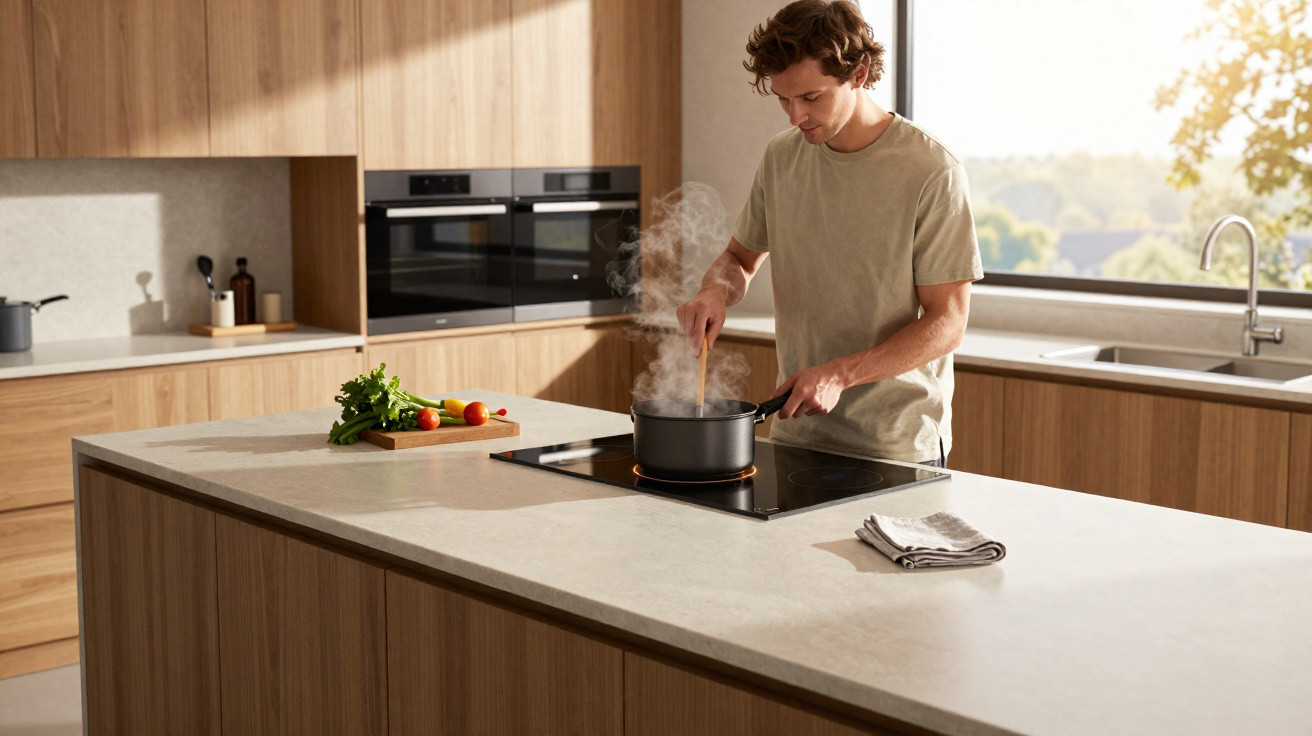
What previously shouted “appliance” can now sit unseen, transforming the atmosphere of the home.
Enter a recently refurbished kitchen in early 2026 and you may notice a change that is hard to identify. The space is more restful, closer to a living area than a functional workshop, while the familiar glossy black rectangle once centred on the worktop has… disappeared.
The quiet disappearance of the black glass hob
Induction hobs long represented modern progress: streamlined, level and futuristic. Yet they remained visually dominant, placing a large dark panel across stone, timber or concrete worktops and readily showing dust, smears and fingerprints.
According to designers, this kind of visual “noise” no longer suits the way people want to inhabit their homes. Kitchens are now open, sociable rooms that merge with living areas rather than isolated laboratories. Homeowners increasingly request quieter lines, fewer visible items and materials that continue uninterrupted across the room.
The new ambition is simple: keep the cooking power, erase the appliance.
The result is that the worktop can once again function as one continuous plane. Marble-effect composite, textured ceramic, engineered stone and dense quartz can run across islands and peninsulas without a black glass insert interrupting the design. This can make a room seem larger and more luxurious, even when its physical dimensions remain unchanged.
Cooking on stone: how invisible induction works
There is no magic behind the technology, although it can seem magical at first glance. Instead of a conventional glass hob, there are induction modules concealed directly below the worktop.
Manufacturers install slim induction coils beneath an ultra-compact ceramic or sintered-stone slab. Visually, the counter simply appears to be a worktop. There may only be discreet positioning guides, such as a tiny cross, a muted circle or fine engraved marks showing where cookware should sit.
The controls have moved too. Certain brands build flush touch sliders into the surface, while others conceal them on the worktop’s front edge. Some systems use a separate removable control puck, which can be put away in a drawer for cleaning or when laying the table.
You place the pan directly on the stone, switch on the zone, and heat passes through the material to the cookware.
Fundamentally, this remains induction cooking. A coil produces a magnetic field that reacts with the ferromagnetic base of a pan, generating heat within the metal itself. The stone heats only a little as a consequence, much less than a gas pan support or conventional electric hob.
The significant difference is the surface material. While standard glass-ceramic may crack or become scratched, these systems use dense engineered slabs designed to manage sharp temperature shifts, the local weight of heavy cookware and everyday knocks.
Why 2026 is the tipping point for invisible induction
Invisible induction has existed as a specialist idea for several years, but in 2026 it is becoming the main discussion point in kitchen showrooms. A number of developments are coinciding:
- the expansion of open-plan homes and combined kitchen–living spaces
- established manufacturing of sintered stone and ultra-compact ceramic
- tighter energy-efficiency requirements across Europe and North America
- growing weariness of visible appliances and aesthetics centred on “tech on display”
For households preparing a refurbishment, the choice is increasingly not “gas or induction?”, but “traditional glass induction or concealed under-stone induction?”
A worktop that behaves like a proper table
Turning a dead zone into multi-purpose space
Conventional hobs create a space people tend not to use. Even once cool, they may be reluctant to place a laptop on them or pile up plates. Steam, spills and the possibility of dropping something make the area an obstacle rather than a usable surface.
When an invisible system is switched off, the hob area becomes fully usable worktop again. A kitchen island can accommodate home working in the morning, bread making later in the day and evening drinks, without a visible divide between its “cooking side” and “living side”.
In compact urban flats, where every square foot matters, the effect is particularly practical. The same 90-centimetre section of counter can serve multiple purposes during one day without looking cluttered or overly technical.
Simpler cleaning, fewer products and less hassle
Anyone who has attempted to keep a black induction hob free from streaks will recognise the process: specialist scraper, glass cleaner, microfibre cloth, followed by the lingering faint ring of marks. Grease droplets also tend to bake onto heated glass and stick stubbornly.
With concealed induction worktops, the surface does not reach such high temperatures. Splashes dry rather than burning on, and the absence of raised rims or joins means crumbs and liquids have no crevices in which to collect.
Most owners report that a quick wipe with a damp cloth handles daily mess, without chemicals or long scrubbing sessions.
This supports the wider shift towards calmer, more considered home routines. Particularly in open-plan rooms, where the sink and island are visible from the sofa, people want kitchens that remain tidy-looking without demanding much upkeep.
A longer-lasting expensive investment
A fractured glass hob can suddenly become an expensive problem. Dropping one heavy saucepan can mean replacing the entire surface. Concealed induction removes the most vulnerable visible component.
Manufacturers select high-density ceramic or engineered-stone surfaces capable of handling delivery, fitting, hot pans and the occasional dropped jar. Such slabs are already used to clad building façades and cover airport floors, environments that endure much tougher treatment than a domestic kitchen.
This resilience is important because a contemporary kitchen often takes up a substantial portion of a refurbishment budget. A solution that maintains its appearance for 15 or 20 years encourages a more gradual, less disposable approach to interiors.
Safety, energy and the goodbye-gas moment
Is it safe to cook on an invisible surface?
For parents, safety is the immediate question: when the hob cannot be seen, how can you tell where it is or whether it remains hot? Brands respond with distinct layers of protection.
| Feature | What it does |
|---|---|
| Pan detection | Turns on heat only when an appropriate pan is placed on the marked zone. |
| Residual heat icons | Displays a warning light until the surface has cooled to a safe temperature. |
| Automatic shut-off | Cuts power after a set period or when no pan is sensed. |
| Child lock | Prevents unintentional operation of the zones and controls. |
The stone over the coil becomes warm around the pan, but not to a dangerous extent. Since heat is created directly in the cookware’s metal, accidentally touching the surrounding surface is less hazardous than contacting a hot gas pan support or radiant electric ring.
Energy performance in the post-gas landscape
As cities stop permitting new gas connections and homeowners pay closer attention to utility costs, induction has become the clear replacement for open flames. Invisible systems retain the same efficiency benefits: rapid response, accurate temperature control and less heat wasted into the room.
Electrical capacity can, however, present an obstacle for some early adopters. Older properties, particularly in Europe, may need upgraded circuits or greater supply capacity for a high-powered induction installation. Before approving an under-stone system, installers now commonly carry out pre-checks of consumer units and cabling.
Costs, compromises and the buyers it suits
Still not a budget choice
Despite the attention it receives, invisible induction costs more than a typical glass hob. The price covers several elements simultaneously:
- the induction modules
- a compatible, high-density worktop, often made from a premium material
- accurate cutting, strengthening and fitting
- calibration and testing of zones, sensors and controls
In many markets, the cooking area can cost twice as much as mid-range exposed induction. For complete refurbishments with larger budgets, this premium can be acceptable. It may not yet be worthwhile for smaller projects in which the homeowner only wants to replace an appliance.
Practical limitations to consider
The technology has real restrictions too. Not every stone can be used. Natural marble, for instance, may be vulnerable to thermal shock; timber cannot cope with the heat; and concrete requires careful reinforcement. Most installations rely on certified slabs with specified thicknesses and performance information.
Heat and power distribution may vary as well. Some invisible induction systems perform best with medium-sized pans rather than a single very large stockpot. Others need a minimum ventilation gap beneath the worktop. A hurried installation or badly ventilated cabinet may reduce performance or cause electronic components to wear prematurely.
What invisible induction means for future kitchen design
The growth of hidden induction forms part of a broader movement in which technology retreats from view. Designers anticipate that future projects will conceal additional functions-charging, extraction and lighting controls-within furniture that appears uncomplicated.
For homeowners, this creates fresh planning considerations. Selecting a worktop in 2026 can mean discussing thickness tolerances, thermal conductivity and coil mapping, rather than simply choosing a colour and edge profile. A stone that appears ideal may not perform effectively with future cooking modules.
One approach is to plan in layers. The visible layer-the stone surface-should match personal taste and everyday use. The hidden layer-induction, wiring and ventilation-should remain sufficiently accessible for future upgrades. Some brands already offer “cartridges” that can be removed from beneath the worktop when cooking habits change or a household moves.
The change also alters the kitchen’s social use. When the hob blends into the island, guests can sit nearer while cooking takes place, rather than feeling confined to the far side of a technical area. Shared pots, platters and boards can spread across the surface. The room becomes less of a machine room and more of a communal table with concealed power underneath.
At the beginning of 2026, invisible induction remains novel enough to start conversations at dinner parties. In a few years, however, the lack of a visible hob may be the feature that denotes a modern, carefully considered kitchen-a discreet indication that its appliances are working hard, despite being almost impossible to see.





Comments
No comments yet. Be the first to comment!
Leave a Comment