
The corridor of a budget hotel somehow smells… expensive. Not luxurious in the way perfume does, and not synthetic like a bargain air freshener. It is simply the clean, mildly soapy aroma of a floor that has just been mopped – the sort of scent that makes you trust the white bedding and even the television remote. As you wheel your suitcase across the tiles, you may briefly wonder why your own home never holds that smell for longer than ten minutes after you have scrubbed the floor.
At home, lemon and vinegar solutions can leave the kitchen smelling more like a failed salad than a clean room. Their fragrance vanishes quickly, or hangs around with an oddly sour edge.
Some people have quietly abandoned that approach.
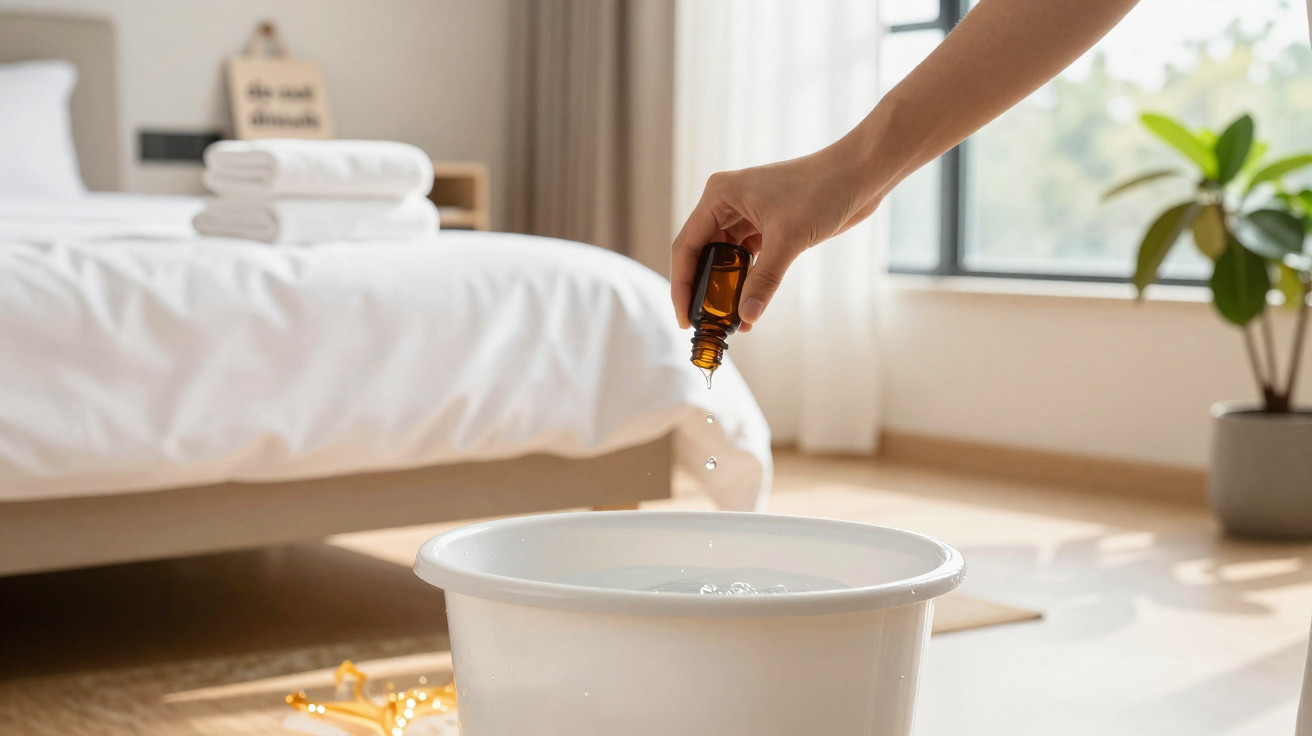
They put just two drops into the mop bucket.
The hotel-clean smell without a salad-like scent
Step into a carefully maintained hotel lobby just after the housekeeping team has finished, and there is an instantly recognisable rush of freshness. It is neither the aggressive hit of bleach nor the sugary, artificial smell of a plug-in diffuser. Instead, it is a lightly powdery clean note that you sense rather than consciously notice.
That aroma does not come from rubbing half a lemon along the skirting boards. Neither does it come from another white-vinegar formula that makes your eyes sting. More often, it comes from something subtle and compact that is incorporated into the cleaning routine.
Speak with professional cleaners and a familiar practice emerges. Many discreetly put two or three drops of concentrated fragrance oil or laundry scent booster into their mop water. Not a capful and not even a splash: genuinely just two drops.
One housekeeper at a mid-range hotel chain admitted that she carries a small bottle of “fresh linen” concentrate in her apron. She dips in a toothpick, taps it into the bucket and swirls the water. Almost immediately, the entire corridor smells of crisp sheets. Guests pass through, take one breath and mentally register that the space is clean. Few would suspect such a tiny amount is responsible.
The reasoning behind the method is straightforward. Clean floors do not merely look hygienic; their smell communicates cleanliness too. We naturally link subtly soapy, laundry-style scents with order and hygiene. A delicate fragrance released from warm mop water adheres to tiles and skirting boards much more effectively than the sharp notes of lemon or vinegar, which disappear quickly.
Vinegar is an excellent degreaser, but it suggests a “kitchen experiment” rather than a “hotel lobby”. The hotel-style technique gives cleaning and scenting separate roles. Clean first, then add fragrance.
Two drops in the mop bucket: the method in practice
The core method is almost ridiculously easy. Fill a bucket with warm water and add your normal floor cleaner or a gentle soap. Next, use no more than two drops of a concentrated scent product: an essential-oil blend, floor fragrance oil or a liquid laundry perfume intended for dilution.
Move the mop through the water to distribute the fragrance evenly. There is no need for a powerful perfume cloud or sticky marks on the tiles. You are left with a gentle background aroma that remains for several hours and quietly implies that somebody has properly cleaned the room.
Those who rely on this trick often discover it after spending a weekend at a friend’s house that smelled improbably good. They see the friend mop using an ordinary bucket and the same murky water – apart from a little brown glass bottle retrieved from the back of a cupboard.
Once home, they try it on a small area of flooring. On the first attempt, they often add too much, turning the living room into a perfume counter. By the second try, they limit it to two drops and the house suddenly has that relaxed, hotel-like feeling of cleanliness. Realistically, hardly anyone does this every day. Yet using it once or twice a week, before visitors arrive or following a deep clean, can alter the atmosphere of an entire room.
The effectiveness of the “two drops” approach comes down to concentration and surface contact. Fragrance molecules disperse more effectively in warm water before settling lightly on the floor as the moisture evaporates. The bucket itself does not need to smell strongly; all that matters is the faint scent trail it leaves behind.
Use too much and the result can become stifling, particularly in compact bathrooms or narrow hallways. Keep the amount restrained and the brain interprets it as authentic cleanliness rather than an attempt to mask something. Our noses are surprisingly good at spotting when we’re being lied to by fragrance.
What to add to the mop bucket – and what to avoid
The most straightforward option is a laundry fragrance or “scent booster” liquid formulated specifically for dilution. Add two drops to the mop water, stir briefly and start cleaning. These products are made to smell of fresh sheets, cotton, or soap, aromas already associated with clean beds and soft towels.
Essential oils offer another option. A traditional hotel-style combination is one drop of lavender with one drop of eucalyptus or tea tree, mixed into a neutral cleaner. Lavender rounds off the sharper notes, while eucalyptus brings a “spa corridor” character. Bear in mind, though, that essential oils do not magically disinfect floors; their main contribution is fragrance.
The product people most often regret tipping directly into a bucket is undiluted fabric softener. It may look clever on TikTok, but it can leave floors slightly sticky or streaky. Low-cost perfume oils intended for burners can cause similar problems: they may create an oily coating and could mark porous tiles.
People who have tried a few options generally settle on one dependable bottle, using it for months. It is a scent that does not clash with other cleaning products, trigger a headache or make the kitchen feel too much like a “hotel lobby at 6 am” when they are simply tidying up after supper.
“I used to drown the house in those plug-in things,” admits Sara, 34, who works night shifts and cleans in the late morning. “Now I just put two drops of a cotton-scented laundry perfume in the mop water. The smell is lighter, it feels like real cleanliness, not like I’m hiding something.”
Smart scents to try in the bucket
- “Fresh linen” or “cotton” laundry fragrance: the closest option to a hotel-sheet smell.
- Lavender + eucalyptus essential oils: a calm, clean combination, particularly suitable for bathrooms.
- Neutral floor fragrance concentrate: formulated not to stain surfaces or leave residue.
Things people often regret using
- Undiluted fabric softener: may create streaks and a waxy, slippery finish.
- Excessive essential oil: can be overpowering and may irritate children and pets.
- Strong food-like scents (vanilla, cinnamon): pleasant in candles but strange on floors.
Small habits that make it work
- Keep a window open for ten minutes as you mop, allowing the scent to settle gently.
- If you have delicate timber or stone flooring, test the fragrance in an inconspicuous corner first.
- If product interactions concern you, use the fragrance only in the final rinse water.
Beyond the mop bucket: the understated pleasure of a home that “smells clean”
The appeal of the “hotel-clean smell” reflects something about modern life. We clean between meetings, once children are asleep or just before the delivery driver knocks at the door. Making floors genuinely shine is one task; giving the home a quietly fresh aroma without filling it with harsh chemical perfume is another.
People who use the two-drop method tend to speak less about impressing visitors and more about themselves. It is the subtle line of fragrance in the hallway as you return with the shopping, or the quiet sense of “ah, yes, I did something for this place today”.
For some, it becomes a modest ritual: fill the bucket, add the standard cleaner, pause and then tap in two drops as a final touch. The point is not to make a home pretend to be a hotel. It is to borrow that feeling of calm and order for a few hours.
You may develop your own version: rosemary for a kitchen that always carries the scent of Sunday lunch, a cotton note in the bedroom or almost no fragrance at all – simply the soft neutrality of genuinely clean air. The trick lies in the balance: floors that look clean, a scent that is nearly invisible and the quiet satisfaction of walking barefoot on a surface that both looks and smells cared for.
| Key point | Detail | Value for the reader |
|---|---|---|
| Two drops are enough | Add a very small quantity of concentrated fragrance to warm mop water | A simple way to create a hotel-style clean smell without overwhelming perfume |
| Separate cleaning from scenting | Clean first with your usual product, then lightly fragrance the rinse water | Improved hygiene and longer-lasting freshness without harsh odours |
| Choose suitable products | Opt for laundry-type fragrances or diluted essential oils rather than fabric softener | Helps prevent residue, streaks and heavy, artificial smells at home |
FAQ:
- Question 1 What type of fragrance can I safely put in my mop bucket?
- Question 2 Can essential oils damage flooring or make it slippery?
- Question 3 Is it possible to mix vinegar, floor cleaner and fragrance together?
- Question 4 How long does the “hotel-clean” smell normally remain on the floor?
- Question 5 Is this method safe in a home with pets or young children?

Comments
No comments yet. Be the first to comment!
Leave a Comment