
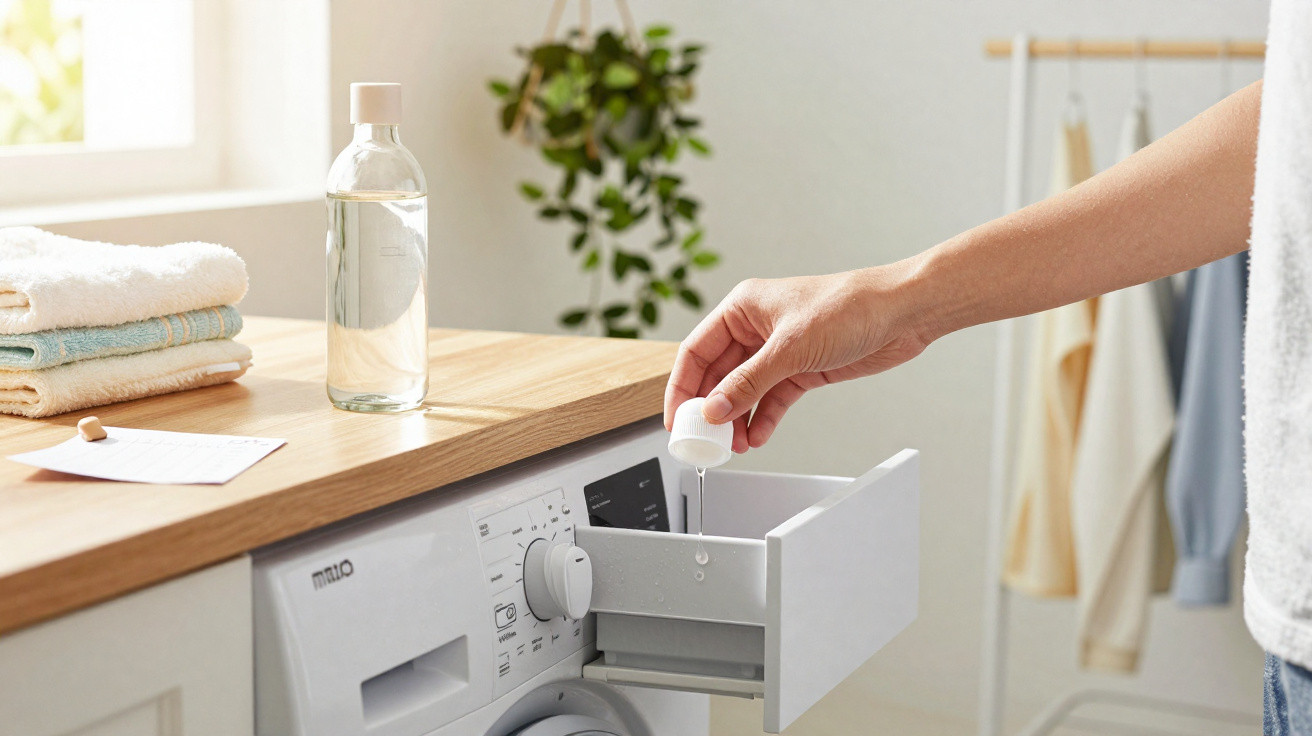
Everyone wants laundry that comes out fresh and neutral, rather than smelling like a damp gym bag. But today’s washing machines operate at lower temperatures, use less water and hold on to residue that can quickly turn sour. The answer is not tablets, novelty products or spending an entire Saturday scrubbing. Instead, it is a small routine using an unassuming bottle that is probably already in your kitchen cupboard: the one you use on chips, not clothes. And it can help with every wash.
Steam warms the hallway as the drum whirs and a pile of school shirts waits nearby. When the programme finishes, you lift a T-shirt to your face and notice it: that slight swampy smell suggesting the machine needs attention. Pull back the rubber seal and there is the familiar grey layer of grime, returning even after repeated hot washes.
I discovered the solution in an unglamorous setting: at a neighbour’s kitchen table, where she poured a capful from a litre bottle of plain white vinegar. There was no fuss and no expensive product. She added it to the fabric softener drawer and said, “Every wash. Done.” It seemed far too simple to make a difference.
It did. The chemistry behind it is remarkably satisfying, too.
One capful of white distilled vinegar, major results
Modern washing machines are excellent at conserving water, yet they can also retain residue. Detergent leaves behind a fine, sticky coating that supports odour-causing microbes and sticks to the drum, pipes and door seal. Adding one capful of white distilled vinegar during the rinse tackles that process at the root. It counteracts remaining alkalinity, helps release the film and washes it away.
Take Jenna from Leeds, who feared her washing machine was on its last legs. Her towels smelled “like a cupboard in November,” while paying for a repair visit was not possible that month. For one week, she used the capful method across six loads without changing anything else. The smell began to disappear by the third load. By the sixth, the open machine door smelled like… nothing at all. Her towels also dried more quickly. It was a small amount with a noticeable effect.
The explanation comes down to straightforward chemistry. Laundry detergents are generally alkaline, whereas the acetic acid in vinegar shifts the rinse water closer to neutral. That change affects the residue, encouraging it to release from metal and rubber surfaces. A capful diluted in a full drum of rinse water creates only a mild trace of acidity, but it works steadily and unobtrusively. Stainless steel is unaffected. So are plastics. Odours have less opportunity to take hold.
Using white distilled vinegar with no hassle
Use one capful, roughly 10–15 ml, of plain white distilled vinegar. Before every wash, pour it into the fabric softener compartment so that it is dispensed during the rinse alone. If your machine has no dispenser, pause the programme just before rinsing and pour it straight into the drum. The approach and small quantity are the same for top-loaders, front-loaders and high-efficiency machines. If the washer already has a musty odour, begin with one hot maintenance cycle: add a cup of vinegar to the empty drum, then move on to the capful-per-wash routine.
The key is to use a modest amount consistently. Never mix vinegar with chlorine bleach, not in the drawer, not in the same cycle. When using separate fabric softener, switch between them: use vinegar for one wash and softener for the next. Alternatively, leave out softener altogether, as many people find that towels are fluffier without it. Wipe the door seal weekly, keep the door slightly open between loads and clean the drawer each month. Realistically, nobody gives their washing machine a deep clean every day.
Rubber seals concern some readers. However, this is a very small dose delivered during the rinse instead of the main wash. An appliance technician described it like this:
“I see more damage from detergent overdosing than from a teaspoon of vinegar. Keep it small and keep it in the rinse-that’s the sweet spot.”
- Choose plain white distilled vinegar only, never malt or balsamic vinegar.
- Limit the amount to 10–15 ml for each wash; extra vinegar is not more effective.
- Do not use it in a bleach load; use vinegar in the following cycle instead.
- Check the manual if your washing machine remains under warranty.
- Leave the door and drawer open to air, because airflow is half the battle.
The benefits you notice over time
There is a subtle pleasure in a washing machine that smells of nothing at all. The hallway no longer has that damp scent. Towels dry faster because residue is not weighing them down. Socks feel cleaner around the toes. During a hectic week, those unseen improvements count. You buy fewer “washing machine cleaner” tablets and no longer search “why does my washing machine smell like eggs” at 11 p.m.
Most of us know the frustration of washing the same load twice in the hope that the smell will disappear. Making a capful part of your routine breaks that cycle with something you can pour in before pressing Start. It is kind to clothing, gentler on the drum and well suited to the untidy reality of family laundry. For additional protection, do a hot maintenance wash once a month; treat it as an insurance policy rather than a reminder of a dreaded chore.
Perhaps that is why this tip travels between neighbours instead of appearing in advertising. It is simply too ordinary to market. A bottle beneath your sink can keep the washing machine fresh, week after week. If other methods have failed, it may be the smallest experiment you make all year.
| Key point | Detail | Why it matters to the reader |
|---|---|---|
| Ideal dose | 1 capful (10–15 ml) in the rinse every wash | A straightforward habit with no measuring jug or uncertainty |
| Where to add it | Fabric softener drawer; it is released during the rinse | Looks after fabrics and tackles residue at the crucial stage |
| Precautions | Do not mix with bleach; use plain white vinegar only | Keeps the machine safe and avoids laundry-related drama |
FAQ:
- Will my clothes smell like vinegar? The smell disappears during spinning and evaporates as the laundry dries. If there is any scent left afterwards, too much was used; reduce it to one capful.
- Is this safe for rubber seals and hoses? Yes, at 10–15 ml in the rinse. The mixture is highly diluted when it reaches the seals. Most wear problems result from excessive detergent residue, rather than a small acidic rinse.
- Can I use it on every load, even delicates? Yes, for most materials. If you prefer to be cautious, do not use it on silk or acetate, and never use it in any load containing chlorine bleach. It is suitable for cotton, synthetics and sportswear.
- Does vinegar replace fabric softener? It can do. Vinegar cuts down residue and helps fibres feel smoother without the coating that can make towels less fluffy. If you prefer scented softener, alternate it with vinegar.
- What if I don’t have white vinegar? Only use distilled white vinegar. Malt vinegar and apple cider vinegar may stain fabrics or leave smells behind. If you have run out, citric acid is a useful alternative: dissolve ½ teaspoon in water and add it to the softener drawer.






Comments
No comments yet. Be the first to comment!
Leave a Comment