
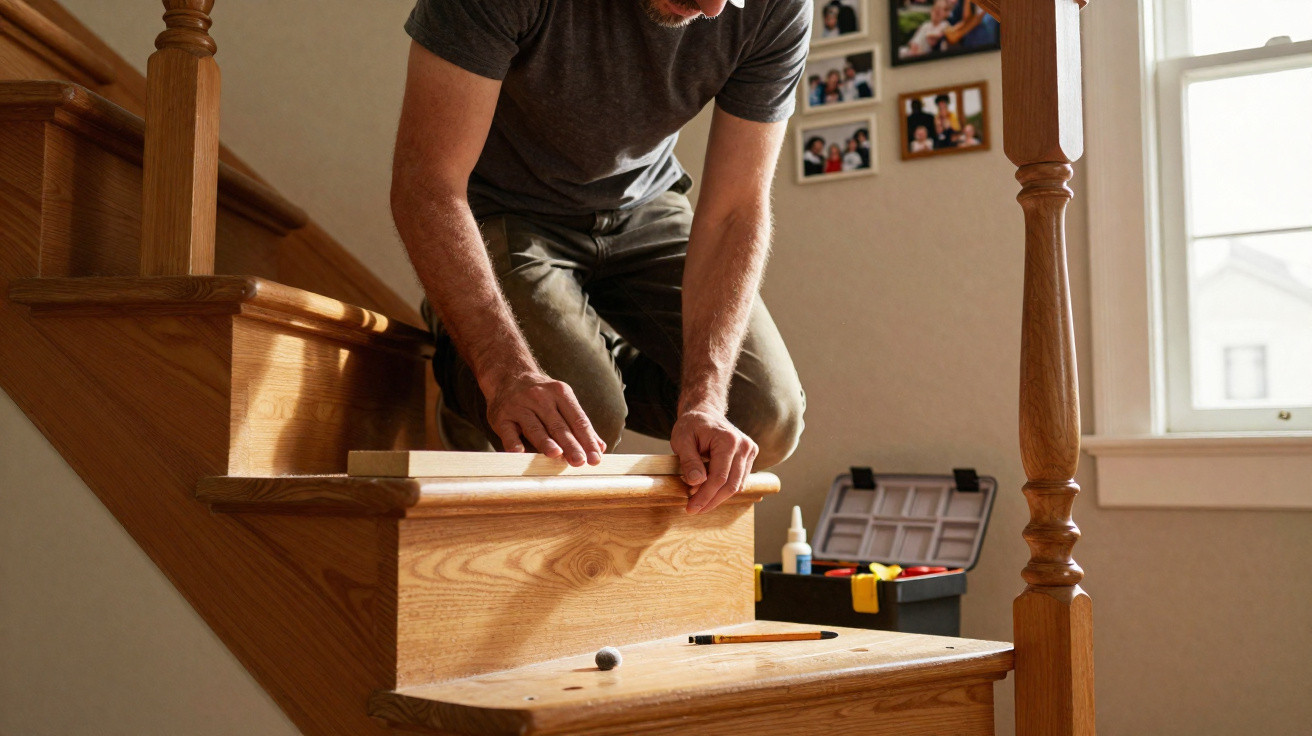
It is 6.42 am, the house is still asleep, and the first step on the third tread brings out that familiar creak. It is not loud enough to wake everyone, yet it makes the staircase seem to object to every trip upstairs. In many homes, the sound eventually becomes part of the daily backdrop: children returning late, morning coffee, laundry being taken upstairs. You almost get used to it, until one day you start wondering whether the creaking signals a genuine problem. The good news is that a creaking wooden staircase does not necessarily require a dusty building project or removing the treads. One simple, carefully targeted action can sometimes transform the atmosphere throughout the house. Most surprisingly, it is often the exact place that needs attention.
Why a wooden staircase suddenly starts to creak
We all know the moment when a tread that has been quiet for years suddenly makes itself heard. Wood moves: it responds to central heating, humidity, dry spells and the structure's repeated minor movements. Two parts rubbing ever so slightly against one another are enough to produce this sharp noise, sometimes similar to an old wooden floor.
In a renovated house near Rennes, a homeowner thought the staircase needed replacing after hearing creaks every time it was used. The joiner identified just one troublesome area: the joint between the tread nosing and the riser on four heavily used steps. In under an hour, the noise had reduced noticeably, without a single tread being removed.
The issue rarely comes from the wood alone. Nails, old screws, a dried-out packing piece or a joint that has developed a little play often all contribute to the chorus. When a foot presses down, the tread bends by a few millimetres; this tiny movement produces friction. It is too small to spot easily, but impossible for your ears to overlook.
The joiners' discreet method: stop the movement, not the staircase
The first step is to pinpoint the noisy tread accurately. Walk up slowly, then come back down, placing your foot in the centre, near the wall and along the outer edge: the sound will often vary according to where pressure is applied. Once the area has been found, joiners commonly use talcum powder or a dry lubricant suitable for wood, worked into the narrow accessible gaps between the components.
Where joints are slightly more open, a thin wooden wedge coated with flexible wood glue can be gently inserted from beneath the staircase or from the side. The aim is not to force anything. It is to eliminate the movement causing the friction. Let us be honest: nobody really does this every day, but this small repair can prevent months of living with a creak.
The most common instinct is to pour oil, penetrating fluid or another greasy product onto the tread. It may sound sensible, particularly when the noise resembles a hinge, but it can stain the wood, attract dust and make the surface slippery. It is better to keep a few straightforward principles in mind.
“A creaking staircase is not necessarily worn out: it often simply needs a joint that barely moves to be stabilised,” explains a joiner specialising in interior renovation.
- Identify the precise tread before treating the whole flight.
- Choose talcum powder, dry wax or a non-greasy dry lubricant.
- Insert a thin wedge only where a gap is visible and accessible.
- Avoid randomly placing screws in the visible face of the treads.
- Have the staircase inspected if a tread sinks or the stringer moves.
A small creak can also tell the story of a home
There is something almost reassuring about the sound of an old staircase: it is a reminder that a house is not a fixed set. A tread that sings beneath residents' feet may carry decades of comings and goings, house moves, children racing about and late-night returns. Silencing it does not mean removing its character, provided the cause is addressed without treating the material harshly.
A no-dismantling solution works very well when the creak remains localised and the structure appears sound. By contrast, a visible crack, an unstable handrail, treads that move noticeably or a noise accompanied by sagging requires professional advice. Safety comes before silence, especially on a staircase used every day.
This kind of repair also offers a practical benefit: it prevents major work being started too quickly for what may be a minor defect. A little observation, a suitable product and a patient touch are often enough to make trips upstairs quieter again. And if the staircase still gives a soft whisper underfoot, some people may choose to let it live that way.
| Key point | Detail | Benefit for the reader |
|---|---|---|
| Identify the noisy area | Test the tread with your foot in different places | Avoids unnecessarily treating the entire staircase |
| Use a dry product | Talcum powder, dry wax or a wood-compatible lubricant | Reduces friction without staining or making the tread slippery |
| Watch for warning signs | Significant movement, a crack, sagging or an unstable handrail | Helps distinguish a simple creak from a structural issue |



Comments
No comments yet. Be the first to comment!
Leave a Comment