
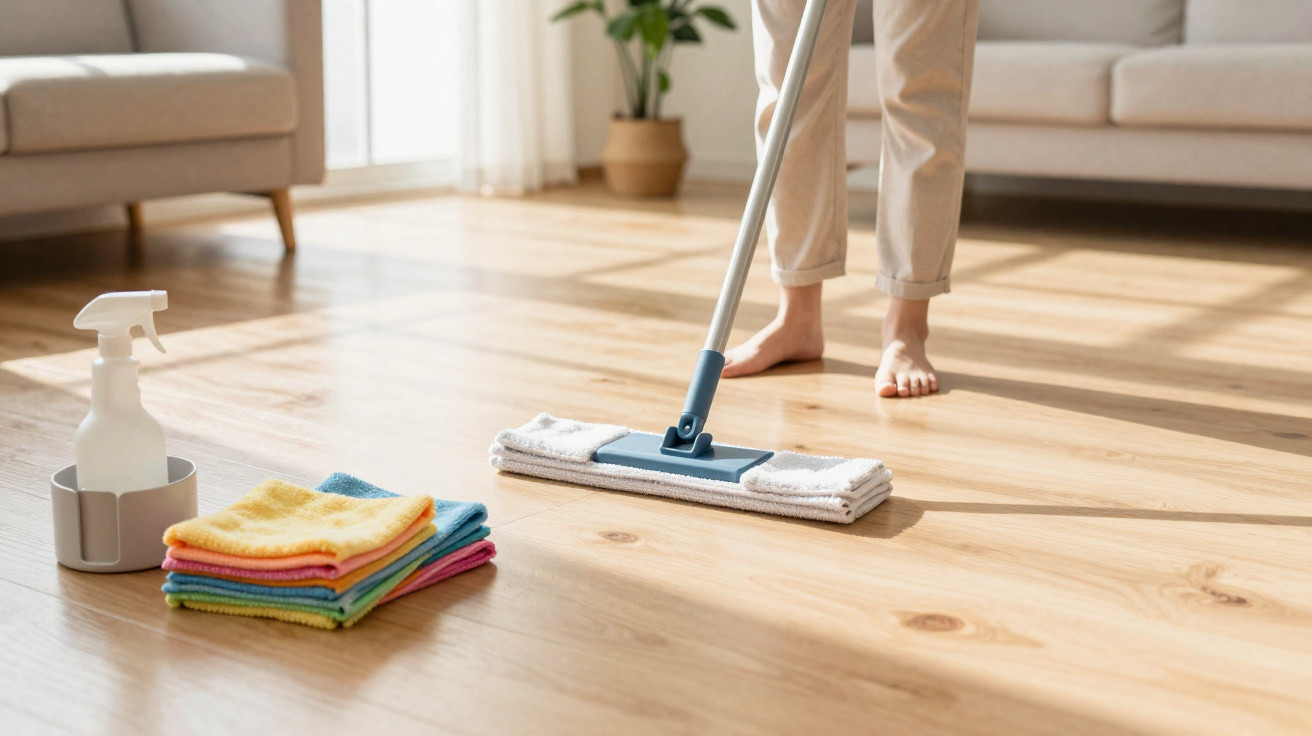
At 6.30 am, in the still-quiet corridor of an office building, the familiar rattle of a wheeled bucket has almost vanished. In its place, a cleaner guides a flat mop, sweeps a microfibre pad across the floor and keeps moving without stopping every few metres to rinse their equipment. The tiles dry quickly and without rings, as the first employees arrive holding their coffees. We all know that moment when a freshly washed floor somehow shows streaks in the light. Here, they do not reappear.
The bucket of water: an old habit that slows down cleaning
In many premises, a large bucket of grey water is still closely linked with the idea of a clean floor. Yet cleaning teams responsible for large areas have gradually altered their routines: they now favour flat damp sweeping, using microfibre pads prepared in advance. The process can seem almost too straightforward, but it prevents splashing, reduces unnecessary trips and leaves far less moisture behind. The difference is immediately visible, particularly on dark flooring or laminate.
A microfibre pad lightly treated with cleaning solution can cover an entire room before it needs changing. In a small 80 m² open-plan office, for example, a cleaner can wash the floor without carrying several litres of water or looking for a sink to empty a bucket. Some cleaning companies believe they save between 20 and 30% of the time spent on daily rounds, depending on the layout of the premises. It may not look dramatic on paper, but over a full day the difference is very real.
There is a rarely noticed drawback to the conventional bucket: repeatedly dipping a mop into the same water can spread some of the dirt around rather than remove it. Microfibre, by contrast, captures dust, hair and particles with its exceptionally fine fibres, before going straight into the wash. The floor is not flooded; it is genuinely wiped clean. That distinction matters in busy corridors, shops and kitchens, where a damp surface can quickly become a slipping hazard.
The prepared microfibre pad method: quick, clean and surprisingly accessible
The approach relies on a very simple system: place several clean pads in a sealed container, with only enough water and detergent to dampen them without soaking them. Once fitted to the flat mop, a pad should leave the floor with a slight sheen, never wet. Work in wide S-shaped movements, rather than repeatedly passing over the same spot. When the area is finished, put the used pad into a separate bag or container. It must not go back into the clean water.
A common mistake is to use a large amount of product, believing that a strong fragrance means better cleaning. Let us be honest: hardly anyone measures it precisely every day. Excess detergent leaves a sticky film that attracts dust and causes those well-known marks that show up in backlighting. It is better to follow the recommended dosage, use warm water where the manufacturer permits it, and replace the pad as soon as it appears loaded with dirt. That is not perfectionism; it is simply common sense.
For delicate floors, suitable equipment makes a noticeable difference: a microfibre pad designed for the surface, an articulated handle and a supply of clean pads are often all that is needed. Professional cleaning is not based on a magic technique, but on keeping clean and dirty items clearly separate.
“A clean pad for a clean area: it is a simple rule, but it prevents a large proportion of streaks and repeat cleaning.”
- Choose washable microfibre pads that are sufficiently thick;
- Allow one clean pad per room or heavily used area;
- Never put a dirty pad back into the container holding prepared pads;
- Wash microfibres without fabric conditioner, as it reduces their absorbency.
A small change that transforms the chore of cleaning floors
This method does not mean that the water bucket must disappear from every home. It remains useful for a very dirty patio, a muddy entrance or a substantial spill. For routine cleaning, however, a flat mop with a barely damp pad is better suited to what people actually want: to work quickly, avoid straining their back and not find streaks once the floor has dried. Comfort can sometimes begin with very ordinary details.
The real turning point often comes when you notice the time spent emptying, filling, wringing out, moving and then cleaning the bucket itself. Keeping a small supply of clean pads cuts down these tasks and makes housework feel less discouraging, even in a family flat. Cleaners have understood this for a long time, because their working day consists of repeated actions. Why continue with a cumbersome method when a lighter alternative is already available on shop shelves?
One interesting question remains: do our cleaning habits come from what genuinely works, or from what we have always seen people do? A bucket full of water feels reassuring, almost homely, whereas a pre-dampened pad can sometimes seem too dry to work effectively. Yet it is precisely this controlled moisture that prevents streaks. Trying the method in just one room may be enough to change your mind, especially when the morning light finally reveals a spotless floor.
| Key point | Detail | Added value for the reader |
|---|---|---|
| Damp microfibre pad | It cleans without soaking the surface | Fewer streaks and faster drying |
| Pads prepared in advance | A clean pad is used for each area | Prevents dirt being deposited back onto the floor |
| Reduced product dosage | Cleaner is used according to the instructions | Limits sticky films and water marks |
Comments
No comments yet. Be the first to comment!
Leave a Comment