
A sewer-like smell, laundry that comes out questionable even after several cycles: one hidden, often overlooked part of your washing machine can make all the difference.
Many households in France and elsewhere in Europe complain that their washing machine smells unpleasant despite frequent washes and well-known detergent brands. A Spanish home-care website, cited by the online press, highlights one specific and rarely cleaned part of the appliance where much of the problem builds up. It is neither the drum nor the detergent drawer.
Why your washing machine smells despite washing all the time
A washing machine combines water, heat, detergents and textile fibres. Along with lingering moisture, this creates ideal conditions for bacteria and mould. Repeated short programmes and low-temperature washes mean that these micro-organisms are never completely removed.
Maintenance specialists interviewed by the Spanish outlet say unpleasant odours rarely originate from one place alone. A dirty detergent drawer, a blackened door seal and an ignored filter can all play their part. However, one particular compartment often holds the largest share of the residue.
The drainage compartment, especially the outlet hose and filter, is among the most neglected parts, even though it collects dirt, lint and stagnant water.
This largely unseen area catches everything the machine is attempting to flush away: undissolved detergent, microfibres, hair, and small metal or plastic items. Over time, these deposits ferment, producing an odour that travels back through the drum and permeates the laundry.
The washing machine area almost nobody cleans: the drainage system
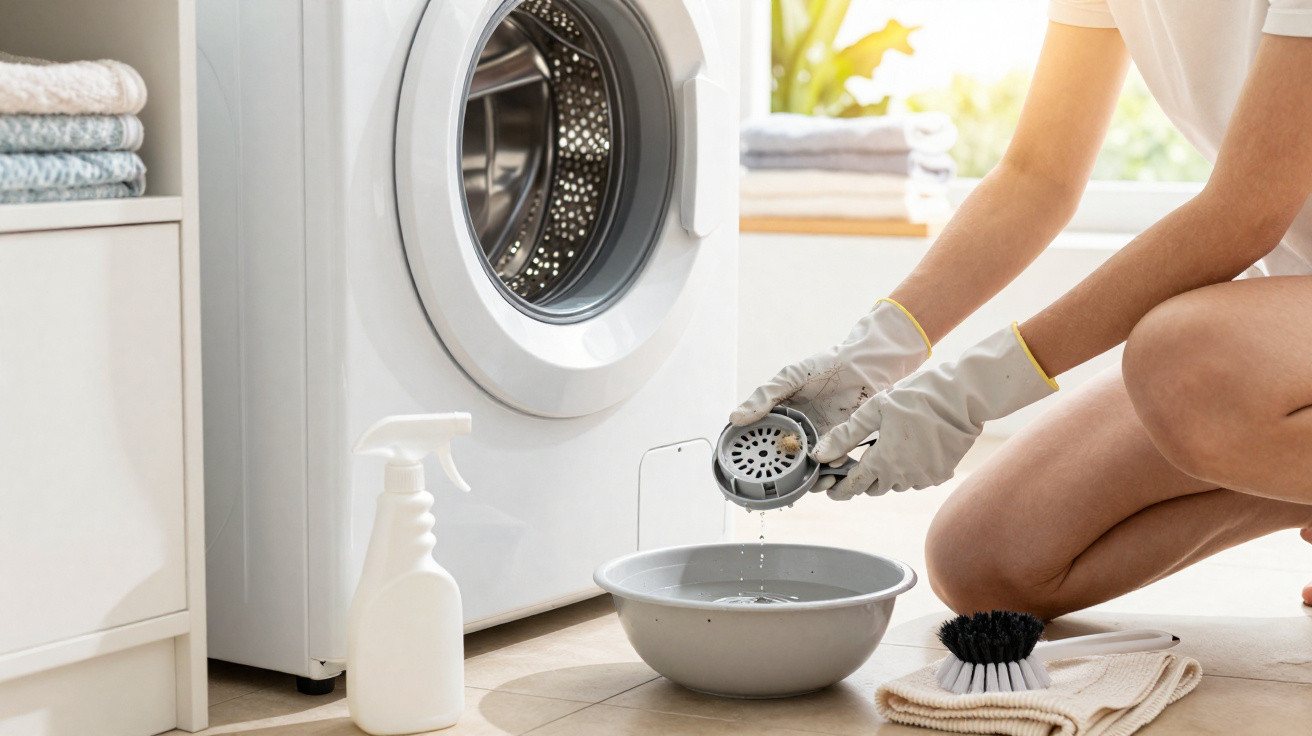
On most appliances, this part sits behind a small flap at the bottom of the front panel, usually on the right-hand side. It is seldom accessed unless there is a fault or an error message. Yet, according to the technicians quoted by the Spanish publication, regularly maintaining this compartment can drastically reduce bad smells.
The drain filter: a real trap for odours
The drain filter holds back anything that should not enter the wastewater system. It gradually becomes blocked and can sometimes retain a small amount of stagnant water permanently. This water, loaded with organic debris and detergent, develops a very strong smell, similar to that of a dirty sink trap.
- Textile waste: lint, fibres and dust from clothing.
- Forgotten objects: coins, screws, buttons and hair grips.
- Poorly dissolved detergent and fabric-softener residue.
- Greasy deposits from certain technical fabrics or heavily soiled items.
In the source article, maintenance experts advise opening this compartment at least a few times each year, even if the machine appears to be operating normally. They point out that the procedure is included in the manufacturer's instructions, although few users take the time to read or follow them.
How specialists say to clean it in practice
The technicians consulted set out a straightforward method that requires very little equipment:
- Disconnect the washing machine from the electricity supply.
- Have a bowl or some cloths ready, as water will run out.
- Open the front flap, normally located at the bottom of the appliance.
- Slowly unscrew the filter cap and allow the water to drain away.
- Remove the filter and take out visible waste by hand or while wearing gloves.
- Rinse the filter under hot water, brushing it if necessary.
- Clean the inside of the filter housing with a sponge or damp cloth.
- Refit the filter, screw it back securely and close the flap.
A clogged drain filter works like a “pocket cesspit” inside the machine: as long as it remains dirty, the smell returns, whatever product is used.
The Spanish outlet stresses that this should be done carefully and in line with the manufacturer's guidance. Some models also have a small manual drain hose beside the filter, which must be emptied before the component is removed.
Other risk areas not to overlook
While the drain filter is the part most commonly forgotten, other areas of the appliance can also contribute significantly to unpleasant odours. The specialists interviewed emphasise the cumulative effect of all these trouble spots.
Door seal, detergent drawer and drum: three parts to monitor
The rubber seal around the door holds water and grime. Its folds quickly fill with black, slimy residue: a mixture of mould and detergent. This greasy layer can be removed with a damp cloth and a small amount of household cleaning product.
The detergent drawer, meanwhile, attracts dry, sticky deposits. Technicians recommend that you:
- remove the drawer completely;
- rinse it under hot water;
- brush the corners and crevices where clumps of powder build up;
- wipe the compartment where the drawer sits in the machine.
The drum can be descaled and disinfected by running an empty high-temperature programme with a product designed for washing-machine maintenance, or with simple options suggested by industry experts, such as white vinegar and bicarbonate of soda, provided the manufacturer's instructions are followed.
How to stop bad smells from returning
Professionals cited in Spain's specialist press highlight several practical habits. They also apply to French households, even though brands and models vary.
| Task | Recommended frequency | Main benefit |
|---|---|---|
| Cleaning the drain filter | Every 3 to 6 months | Limits stagnant water and strong odours |
| Wiping the door seal | At least once a month | Reduces mould and black marks |
| Rinsing the detergent drawer | Once a month | Prevents detergent crusts and blockages |
| Empty high-temperature cycle | Once every 1 to 2 months | Cleans the drum and internal pipes |
| Leaving the door open after washing | After every wash | Allows the drum to dry and limits moisture |
Experts also note that routinely using short, low-temperature programmes encourages deposits to form. An occasional wash at 60 °C or 90 °C, chosen to suit the laundry, helps sanitise the inside of the appliance.
How washing machines are maintained in France
In France, guidance from domestic-appliance manufacturers and consumer organisations broadly matches the advice outlined by the Spanish press. Instructions from brands sold on the French market likewise emphasise:
- periodically cleaning the drain filter;
- descaling the machine regularly;
- checking the drainage hose;
- leaving the door slightly open after a wash.
French consumer associations also point out that persistent smells may indicate a problem with the drainage connection, such as a missing or faulty trap. In this situation, a plumber or domestic-appliance technician can inspect the installation to prevent sewer odours from rising through the drain hose.
Electrical retailers and supermarkets in France sell a range of dedicated products, including washing-machine cleaners, descaling tablets and anti-odour liquids. Manufacturers advise following the frequency stated on the packaging and avoiding excessive doses, which could damage seals or internal components.
How good maintenance also affects the machine's lifespan
Beyond unpleasant odours, a blocked drain filter can lead to faults: the machine may stop spinning, show an error code at the end of a programme, or stop during a wash. Regular maintenance reduces these risks and postpones repairs that can sometimes be expensive.
A clean filter, a descaled drum and a clear drainage hose reduce the strain on the motor and pump, which can extend the washing machine's lifespan.
For a French household, these maintenance steps cost little: some time and a few straightforward products, sometimes already found in the kitchen, such as white vinegar or bicarbonate of soda, if their use is compatible with the machine's instructions. By contrast, poor maintenance can result in higher energy and water use, repeated cycles to tackle smells or stains, and ultimately earlier replacement of the appliance.
Finally, domestic-appliance specialists remind users that a washing machine is not a “self-cleaning” appliance. It washes laundry, but it does not fully clean itself. The drainage system, with its filter and sometimes its small drain hose, remains the crucial link that is often ignored. Checking it a few times a year is often enough to identify – and resolve – much of the unpleasant smell that disrupts everyday life.



Comments
No comments yet. Be the first to comment!
Leave a Comment