
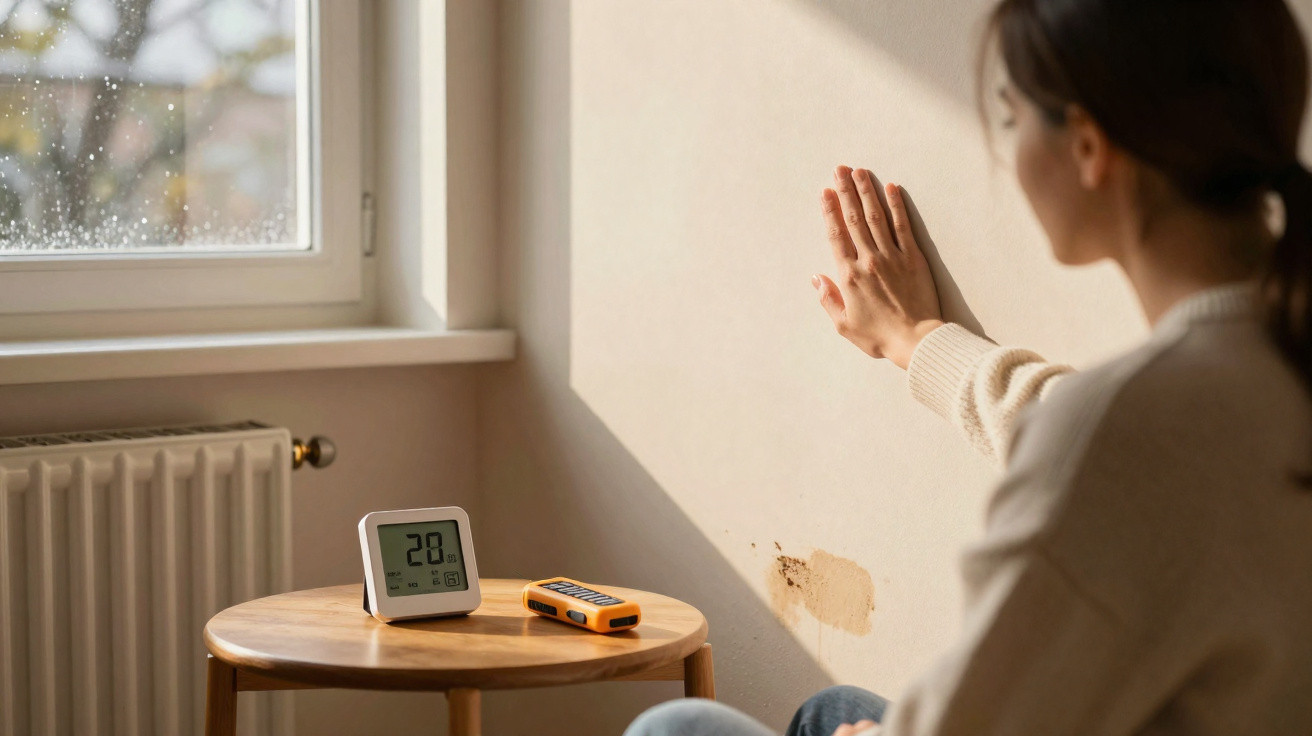
In Belgium, a wall that turns cold and damp as soon as autumn arrives may be concealing a genuine issue. A few straightforward checks can prevent needless expense.
The Belgian home-advice website behind this article sets out a practical approach to finding out why a wall becomes cold and damp from November onwards. Before contacting a contractor or committing to costly work, the online publication points out that any occupier can carry out several checks themselves, provided they take a methodical approach.
A cold and damp wall in November: a symptom that should not be ignored
If an internal wall becomes noticeably colder than the rest of the room from November and then starts to look damp, it is more than a comfort issue. According to the Belgian publication, it is a warning sign that calls for a careful inspection of the home. Such symptoms may result from ordinary condensation caused by how the room is used, but they can also indicate inadequate insulation, poor ventilation or the early stages of water ingress.
“A cold wall draws moisture from the surrounding air: the cooler the surface is compared with the room, the more water settles on it.”
In this situation, the specialist website advises against immediately opting for the most obvious answer, such as renewing the insulation. Instead, it recommends first establishing the wider context: the type of wall, its exposure, the building’s history, whether water pipes are nearby, and how the room is used, whether it is a bedroom, bathroom or kitchen.
First step: tell condensation, water ingress and rising damp apart
The Belgian outlet stresses that damp walls can have several causes, each requiring a different response. Before seeking professional help, an occupier can try to determine which type of issue they are facing.
Condensation: too much moisture in indoor air
Condensation is still the most common cause in homes heated during winter. It occurs when warm, moisture-laden room air meets a cold surface. At first, the water settles as invisible droplets, before developing into clearer marks.
- Marks mainly concentrated in corners or behind furniture.
- Frequent condensation on windows.
- A stale smell and dark patches that may suggest mould.
- A wall that feels colder to the touch than the room’s other surfaces.
In accounts collected by websites of this kind, many occupiers say that they dry clothes indoors, ventilate very little and keep the heating at a moderate level. Together, these three habits create ideal conditions for condensation.
Water ingress: water coming from outside
Where dampness is concentrated on an external wall, particularly after heavy rainfall, the Belgian publication suggests investigating water ingress. This can happen when the façade is no longer watertight because of cracks, deteriorated masonry joints, damaged window sills, missing flashings or a problem with the roof.
“A stain that appears or worsens after a spell of rain often points to a defect in the façade or roof.”
Unlike condensation, its timing is the key difference: dampness follows weather events rather than the way the room is used.
Rising damp: moisture coming up from the ground
Some older properties in Belgium, as in France, do not have an effective damp-proof course between their foundations and walls. Water in the ground can therefore slowly rise through the masonry.
The specialist publication identifies several warning signs:
- Damage starts at floor level and rises over several tens of centimetres.
- Skirting boards warp, paint blisters and plaster crumbles.
- There may be no direct connection with rainfall, as the problem tends to remain fairly constant over time.
A reliable diagnosis of rising damp will generally require a professional, but these visible signs can already help direct the investigation.
Simple checks to carry out before making any call
The Belgian website highlights a set of actions that are within everyone’s reach. They can clarify the source of the problem and may sometimes resolve it without major building work.
Examine the wall closely
The occupier can start by making a record of what they can see and feel:
- Check where the dampness occurs: at the bottom or top of the wall, around a window, behind furniture or in a cold corner.
- Feel the wall in several places to identify areas that are distinctly colder.
- Note when the wall seems dampest: after showering, cooking, rainfall or early in the morning.
- Inspect the condition of window seals, sills and frames.
“A simple record kept over a few days, including observations and dated photographs, helps reveal a recurring pattern.”
This record will be particularly valuable if the occupier eventually brings in a professional. It makes it possible to present factual evidence rather than a general impression.
Measure room temperature and humidity
The specialist site recommends using a small thermometer-hygrometer, an inexpensive device that measures air temperature and relative humidity. In Belgium and France alike, these tools are readily available from DIY shops and online.
The publication outlines the following key points:
- Relative humidity consistently above 65% in a heated room strongly encourages condensation.
- Air that is too cold, even where moisture levels are low, makes surfaces colder and brings them closer to the dew point.
- A substantial temperature difference between the wall and the surrounding air indicates a thermal bridge or a localised lack of insulation.
By comparing these readings with how the wall feels, the occupier can more clearly assess how much is due to indoor conditions and how much may be linked to the building itself.
Check ventilation and household habits
The Belgian publication underlines the importance of everyday habits. In many cases, the issue worsens because indoor air contains too much water vapour and is not renewed sufficiently.
- Airing: open windows for several minutes each day, including in winter.
- Mechanical ventilation: keep extract vents free of dust and do not block air inlets.
- Steam production: drying laundry, frequent showers and cooking without lids all add moisture.
- Furniture: large items placed flush against a wall prevent air from circulating.
“A wall that is already slightly cold quickly becomes a condensation point when indoor air remains saturated with moisture, especially in a poorly ventilated room.”
Even before getting in touch with a professional, the website advises testing a period of several weeks with more regular airing, steadier heating and a gap of a few centimetres behind furniture placed against the wall.
When should you contact a building professional in Belgium?
Once these basic checks have been completed, certain signs should prompt further action. The Belgian outlet mentions, for instance, persistent visible deterioration, a strong mould smell, or stains that continue spreading despite improved ventilation.
| Observed situation | Likely cause | Recommended contact |
|---|---|---|
| Stains after heavy rain on an external wall | Water ingress through the façade or roof | Roofing contractor or façade specialist |
| Deterioration rising from floor level | Rising damp | Damp specialist / building surveyor |
| Widespread condensation on windows, poorly aired rooms | Condensation linked to daily living | Ventilation installer / heating engineer |
The website also notes that, in Belgium, it can be worthwhile to appoint an independent building surveyor when the diagnosis appears complex or several companies recommend different solutions. This kind of expert, comparable to a building-defects specialist in France, can assess the situation without having a direct commercial interest in the proposed work.
What an occupier in France can do in a similar situation
For a French reader facing a cold and damp wall from November, the method described by the Belgian publication remains relevant. The organisations and terminology may differ, but the underlying process is unchanged.
In France, possible first points of contact include:
- A qualified energy-renovation tradesperson to assess thermal bridges and insulation.
- A façade specialist or roofer to inspect the façade and roof where water ingress is suspected.
- A building-defects specialist in the event of a dispute or a persistent problem.
In some cases, local housing agencies or France Rénov’ advice centres can direct homeowners free of charge towards suitable professionals, or explain ventilation and heating principles that help reduce condensation.
“In France as in Belgium, no miracle product can replace a sound diagnosis that combines observation, measurements and an analysis of the building.”
The overall principle is therefore the same: before considering resin injection, insulating panels or extensive façade work, carrying out a basic investigation yourself can prevent expensive and sometimes ineffective mistakes.
Understanding technical terms to make better decisions
The Belgian outlet emphasises one point: an occupier who understands a few technical terms can speak with contractors more confidently. Two concepts are especially common in damp-related cases.
The dew point
The dew point is the temperature at which air can no longer retain all the water vapour it contains. Below that temperature, water condenses on cold surfaces. A poorly insulated wall exposed to outside conditions can remain close to the dew point throughout winter.
When the air is very humid, the dew point rises, meaning condensation forms sooner. This explains the emphasis on airing and ventilation to reduce relative humidity in the room.
The thermal bridge
A thermal bridge is an area of a building where insulation performs less effectively than elsewhere, such as a wall-to-floor junction, the area around a window or the connection between a balcony and façade. These zones become colder, attract condensation and can sometimes create the impression of having “an icy wall” in one specific spot only.
Addressing a thermal bridge often requires targeted work, either internally or externally. However, an informed occupier can already identify these areas and describe them accurately to a professional, rather than referring vaguely to “general dampness”.
Whatever the country, this gradual approach - observation, simple measurements, changes to daily habits, followed by professional support where needed - remains the best way to regain control when a wall becomes cold and damp from November, without being driven solely by fear or ready-made solutions.





Comments
No comments yet. Be the first to comment!
Leave a Comment