
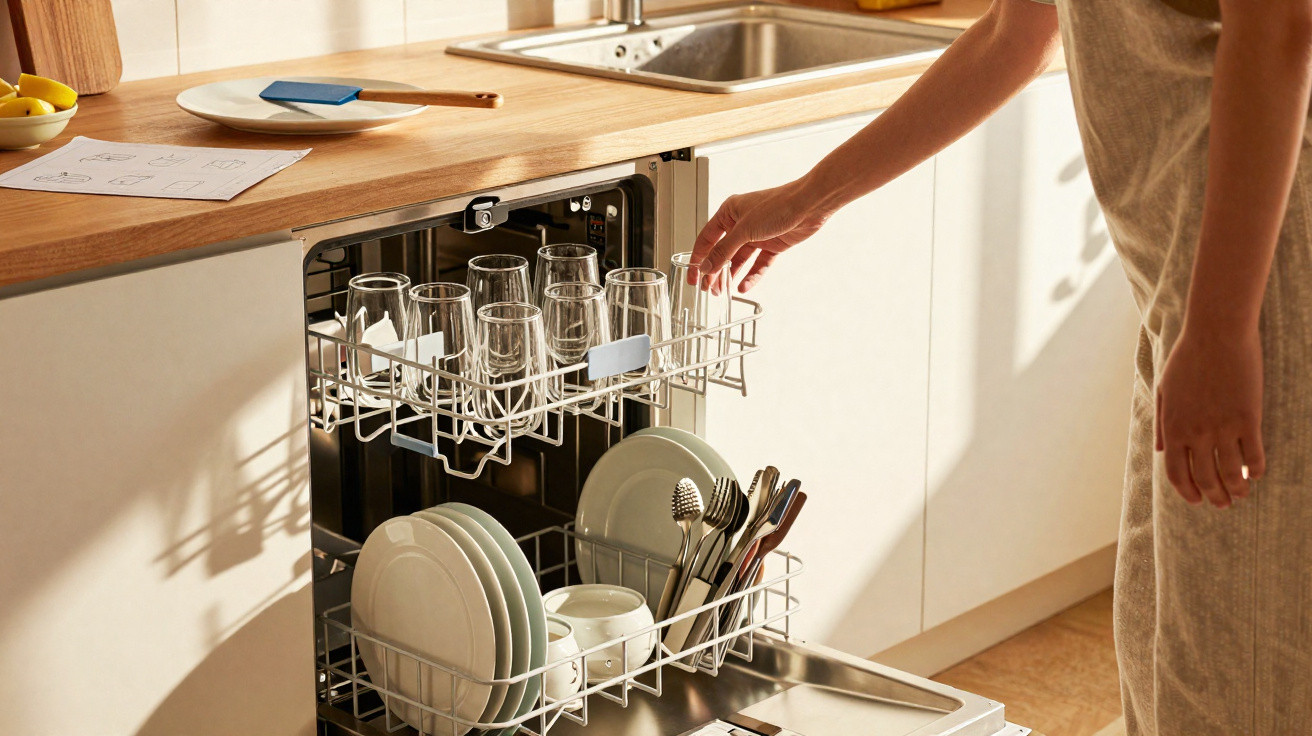
Dinner is over, the kitchen finally looks presentable, and then comes that familiar ritual we perform almost automatically: stacking plates, wedging glasses into any spare gap and sliding the saucepan in sideways. The next day, though, a greasy spoon, a bowl of cloudy water or a mug stained with lipstick is waiting for you. We all know that mildly irritating moment. The dishwasher is not necessarily to blame: in many homes, it has simply been loaded the wrong way for years. Manufacturers, however, have a far more precise layout in mind than most people realise.
The layout that makes all the difference: every level has a purpose
When you open a new dishwasher, the small diagram in the manual seems almost self-explanatory. A few weeks later, old habits return and loading becomes a race against time. Yet manufacturers are quite clear: the lower basket is intended for heavy, heavily soiled items, while the upper basket is for more delicate crockery, glasses and small bowls. This division is not just fussy detail. It follows the actual path of the water, which is sprayed more forcefully by the lower spray arm.
The recommended arrangement often resembles a well-organised kitchen: large dinner plates in the lower-basket slots, facing the centre; serving dishes and pans at the sides, without preventing the arm from turning; glasses upside down in the upper basket, with a little space between them. A study by the British consumer association Which? has already shown that poor positioning can leave residue on a significant proportion of the load, even when a good detergent is used. It is not a lack of water; its route is being blocked.
The logic is simple enough: water needs to hit the dirty surfaces, then drain away freely. A plate positioned with its back to the spray becomes a small barrier, while a bowl that is too deep holds a puddle that will still be there during drying. Manufacturers also advise against nesting items inside one another, however tempting that may be after a family meal. Let us be honest: hardly anyone manages this every day. Still, two minutes spent loading more thoughtfully can often prevent a second cycle, which uses far more water and electricity.
The exact dishwasher loading layout recommended by manufacturers, area by area
At the bottom, put large plates in the dividers, with their dirty sides facing the central spray arm. Oven dishes, dishwasher-safe chopping boards and saucepans belong at the sides or towards the back, tilted downwards so that water cannot collect. A common mistake is placing a large tray in front of the detergent dispenser or the rotating arm. Before shutting the door, turn the arm by hand: if it catches on anything, the load already needs rearranging.
The upper basket calls for a gentler approach. Glasses should be upside down, each in its own space and not touching: knocks during the cycle can cause those tiny, unexplained chips that are noticed too late. Position mugs at an angle with the opening facing down, and never allow bowls to create a sealed stack. For plastic containers, check the manufacturer's symbol and favour this level, which is less exposed to heat. Keep lightweight plastic away from the heating element if your appliance has one.
Cutlery needs its own method, particularly when it comes out with dried sauce marks trapped between two forks. In a standard basket, alternate handles facing up and down, except for knives: their blades must point downwards to avoid accidents while unloading.
“Do not overload the baskets and direct dirty surfaces towards the water jets: the free rotation of the spray arms determines the washing result.”
- Lower basket: plates, oven dishes, frying pans and saucepans, with nothing obstructing the arms.
- Upper basket: glasses, mugs, bowls and lightweight dishwasher-safe containers.
- Cutlery drawer: knives separated, spoons laid flat and forks not nested together.
- In the centre: no tall item should prevent the detergent flap from opening.
A properly loaded dishwasher also comes down to a few simple habits
The right layout is not an inflexible rule taken from a catalogue: it also depends on your model. Some appliances have a third drawer, fold-down tines, an intensive zone or a height-adjustable basket. The precise diagram can often be found on the inside of the door, in the printed manual or on the brand's website using the appliance reference. A large wine glass that fits in your neighbour's machine may not fit in yours. That distinction makes all the difference.
There is no need to rinse every plate under the tap before starting a cycle. In most cases, removing large food scraps, stones, labels and stuck-on pieces is enough; detergent needs a little dirt to work properly. After a busy spell, however, checking the filter once a week prevents many unpleasant smells. A greasy filter slows down the whole machine, even when everything has been loaded perfectly. It is not the most glamorous task, but it works.
Ultimately, the most useful rule is this: do not try at all costs to squeeze in one more plate. A machine filled sensibly washes better than one packed to the very last millimetre. Manufacturers also recommend checking that the arms can rotate freely and that the openings of items remain facing downwards. It is an ordinary, almost invisible detail, until the day your glasses emerge clean and dry without needing to be washed again by hand. Then you may wonder why you had never done it this way before.
| Key point | Detail | Benefit for the reader |
|---|---|---|
| Lower basket | Plates face the centre; oven dishes and saucepans sit at the sides without blocking the spray arm. | The jets reach the most stubborn dirt and dirty water drains away more effectively. |
| Upper basket | Glasses are separated; mugs and bowls are tilted; lightweight plastic is kept away from the hottest areas. | Fewer marks, less breakage and more even drying. |
| Check before starting | Turn the spray arm, check the detergent flap and remove large food debris. | A more effective cycle, with no unpleasant surprises when emptying the machine. |






Comments
No comments yet. Be the first to comment!
Leave a Comment