
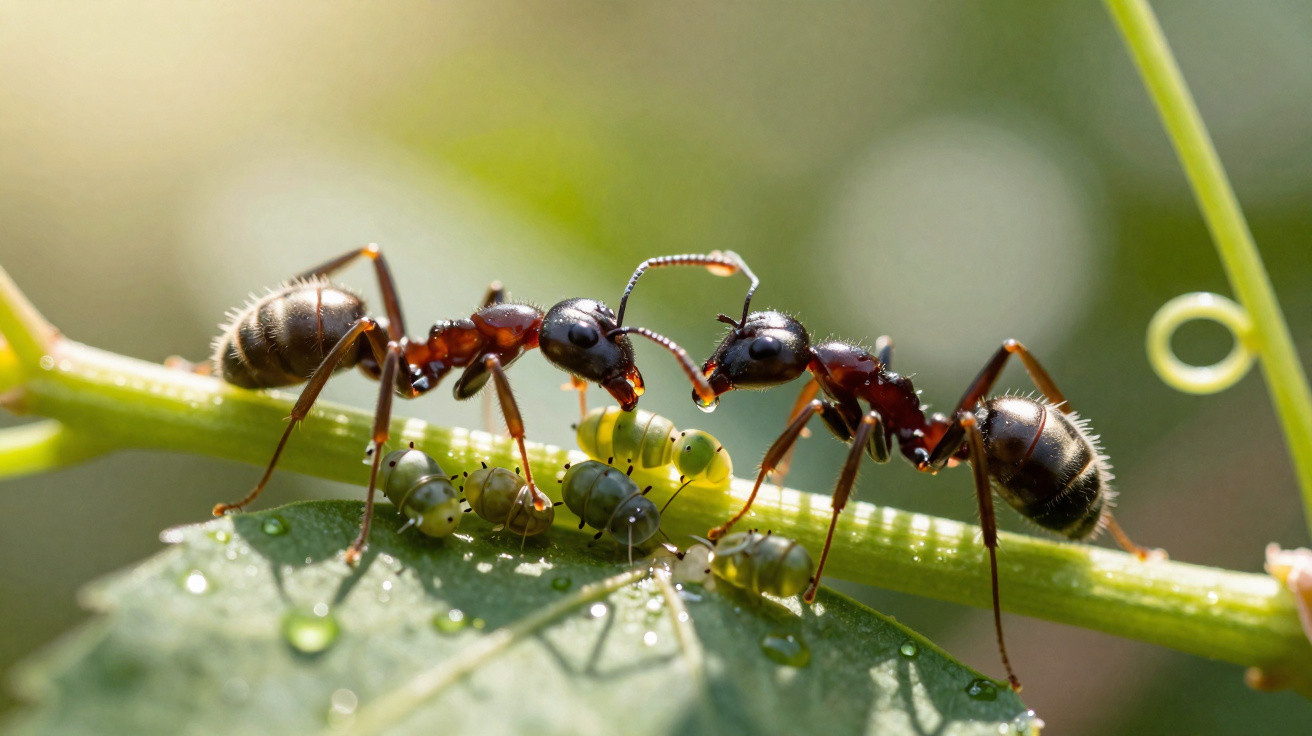
On some plants, a scene resembling a miniature farm unfolds among the leaves and stems: ants move around clusters of aphids, “milk” the tiny insects for sugary droplets and even drive away threats. The comparison with livestock farming may sound overstated, yet it describes a surprisingly real relationship between different species.
Why do ants stay close to aphids?
Aphids are tiny insects that pierce plant tissue to feed on sap. As they do so, they excrete a substance called honeydew, which is mainly rich in sugars. For several ant species, these droplets are a valuable carbohydrate source, making regular visits to aphid colonies worthwhile.
This explains why a plant affected by aphids may also be covered with highly active ants. They are not necessarily attracted to the plant itself, but rather to the reward produced by these small insects. In certain relationships, the benefit matters enough for ants to actively tend the aphids that supply this food.
How does the unusual “milking” of aphids work?
The most remarkable part occurs when some ants repeatedly tap aphids with their antennae. This stimulation can prompt the aphid to release a honeydew droplet, which the ant swiftly gathers. This behaviour is exactly why it is popularly compared to milking a cow, although it takes place on a scale of just a few millimetres.
At close range, the process resembles a carefully organised miniature farming operation. The aphid obtains food from the plant and provides the sugary substance, while the ant collects its reward and stays nearby. Not every species forms this kind of association, but in some cases the relationship has become especially close.
- Aphids draw sap from plants and produce sugary droplets of honeydew.
- Ants may encourage the release of these droplets by touching aphids with their antennae.
- The ants collect honeydew, which serves as a carbohydrate-rich food source.
- In some species, aphids receive protection and even transport in return for this dependable food supply.
Do ants truly protect their “herd”?
In some associations, they do. Ants tending aphids may confront or repel predators and other natural enemies approaching the colony. Ladybirds, lacewing larvae and parasitoids are among the threats that commonly attack these insects, so the ants’ presence acts rather like a security service.
The exchange is beneficial because keeping the aphids alive preserves a source of honeydew. This is why the farming image is fitting: just as a livestock keeper protects animals on which they depend, certain ants patrol the area around their “herd”. To anyone watching only from a distance, this partnership may go entirely unnoticed.
Watch the video shared by the YouTube channel Sempre Curioso, which shows the unusual manipulation of aphids by ants.
Do they also carry aphids and their eggs?
Some species take this relationship far beyond defence. There are records of ants collecting aphid eggs, keeping them safe inside their nests and later moving the young to places where they can resume feeding. A study of Lasius flavus, for instance, found that it protects the eggs of root-associated aphids and suggests that it transports the nymphs after they hatch.
Other species move aphids to better feeding sites. In particularly striking cases, ants may carry an egg when founding a new colony, ensuring they can establish another “herd”. It is a strategy that demonstrates how far natural selection can take a partnership involving food and protection.
A microscopic farm may be in your garden
The relationship between ants and aphids is a striking example of mutualism, an interaction in which both participants can gain advantages. However, it can also affect plants and other insects, as ant protection enables some aphids to evade their natural enemies more easily.
The next time you spot several ants walking along a plant stem, look more closely before moving on. Search beneath the leaves for small aphids gathered together, and you may find one of these “farms” in full operation. It is worth checking your garden straight away: one of nature’s most curious behaviours could be taking place just a few steps away.



Comments
No comments yet. Be the first to comment!
Leave a Comment