
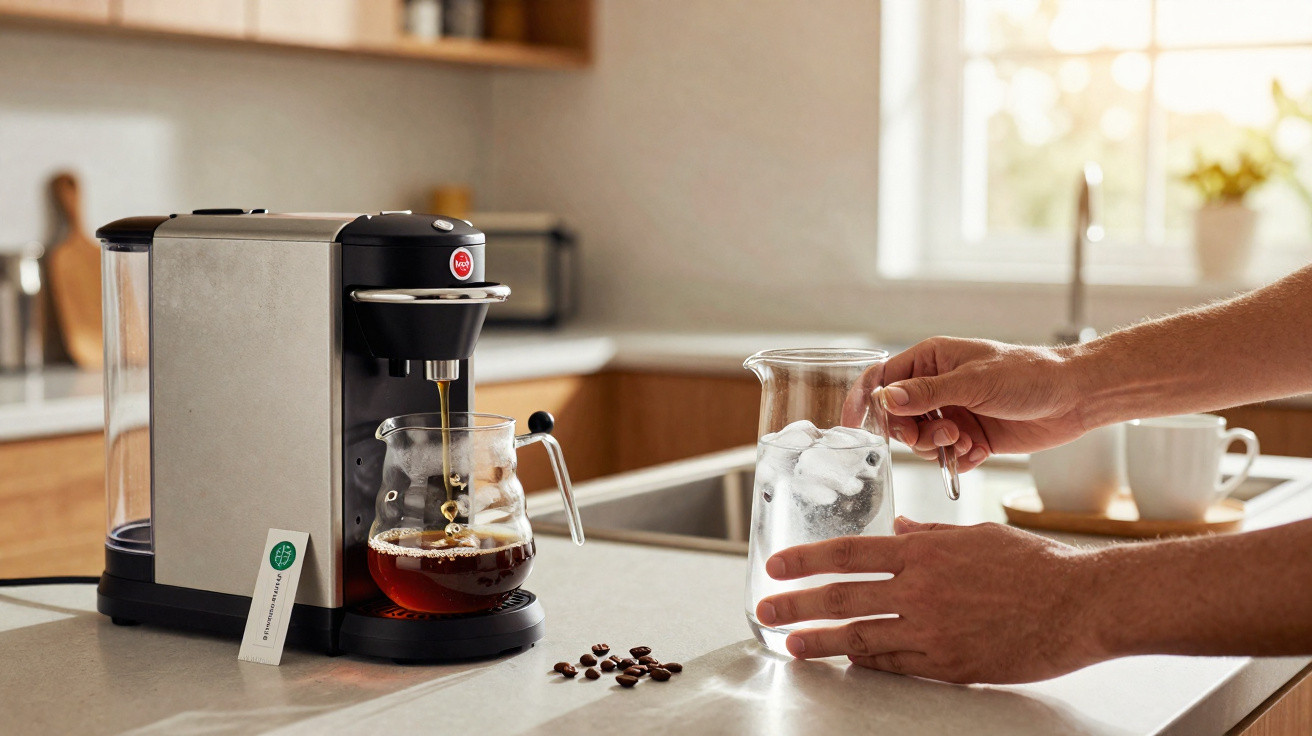
You are barely awake, wandering into the kitchen with untidy hair and a mind that has not quite started up. By habit, you turn the tap directly to hot, telling yourself: “This will heat faster in the coffee maker, I’ll save a minute.” The kettle buzzes, the machine bubbles away, and the familiar aroma of roasted coffee beans spreads through the room. Before the day has properly begun, it feels like a small, private triumph.
Then somebody says something that spoils it: “You know you shouldn’t use hot tap water in a coffee maker, right? It’s loaded with minerals from the pipes.”
Everything goes quiet.
Once that idea is in your head, it is impossible to ignore.
Why hot tap water isn’t as clean as you think
Most of us trust the water that comes from the tap, particularly when the local water supplier confirms that it is safe to drink. We grow up thinking cold water is for drinking and hot water is suitable for cooking. Filling a coffee maker with hot water can therefore seem like the sensible, grown-up way to save time.
But hot water has not travelled through your plumbing in the same way as cold water.
It has followed a warmer, slower route that tends to collect more minerals.
Think about where each type of water comes from. Cold water arrives from the mains supply and travels directly from the local network. It moves through quickly and does not spend much time sitting in your home. Hot water, however, may have remained in your water heater, where it can gradually interact with metal surfaces and mineral deposits already present. As it warms, minerals such as calcium and magnesium, along with occasional traces of metals, have greater opportunity to accumulate.
When you open the hot tap, some of those additional particles travel into your cup with the water. Your coffee maker does not remove them; it simply heats them once more.
That may sound insignificant in theory. Calcium and magnesium occur in “hard water” and are not toxic. The concern is the concentration and the gradual accumulation. Hot water is more reactive, meaning it can dissolve more minerals and collect more material from an ageing tank or old pipes than cold water. In time, this can create extra limescale inside the coffee maker, introduce unpleasant flavours into your drink, and make it more likely that traces of metals from older plumbing enter the water.
Your coffee may still look normal, yet both its flavour and the machine can suffer gradually.
The real impact on your coffee (and your machine)
If your coffee tastes strangely dull one week and overly sharp the next, the water may be the unnoticed cause. Since coffee is more than 95% water, the water quality influences the finished flavour much more than many people realise. Adding hot tap water to the reservoir does more than alter the starting temperature: it changes the water chemistry.
Your everyday morning routine then turns into a small experiment.
And the coffee maker becomes the laboratory.
Consider a straightforward example. A colleague buys a decent mid-range espresso machine and is pleased to pair it with premium beans. Initially, every espresso is rich and rounded. After several months of taking the “shortcut” of using hot tap water, though, the machine begins to sound as if it is under strain. The shots become weaker and develop a sour note. He blames the beans, then the coffee maker, and nearly sends it away for repair.
A brief inspection inside shows a heavy white layer of scale covering the internal components. The heating element is coated, the small pipes have narrowed, and extraction is no longer reliable. The additional minerals in the hot tap water have quietly fossilized his investment.
From a technical perspective, minerals influence both extraction and flavour. An excessive level of dissolved solids changes the way coffee compounds dissolve: bitterness may become stronger, delicate aromas can be dulled, and espresso crema may lose its texture. Scale also insulates the heating element, making it harder for the machine to reach the correct brewing temperature. This produces inconsistent brewing and coffee that rarely tastes identical from one cup to the next.
Your coffee maker becomes less a precision tool and more a tired appliance faking its way through the job.
The right way to fill your coffee maker (and what to avoid)
The easiest solution is often the one people overlook: fill your coffee maker with cold water every time. Use water straight from the cold tap, or filtered cold water if you live in an area with particularly hard water. Allow the machine to heat the water itself, as that is what it was designed to do.
If speed matters to you, fill the reservoir with cold water the evening before and leave the machine prepared. In the morning, you only need to press one button.
Many people attempt to “help” their coffee maker by pouring in hot tap water or heating water in a kettle first. The reasoning is understandable: it seems quicker, easier and more efficient. Yet it commonly has the reverse effect. Hot tap water can bring extra pipe minerals into the machine, while regularly adding very hot kettle water may put stress on components designed to warm water gradually.
Realistically, nobody follows every best practice perfectly every day. Everyone takes shortcuts occasionally. The point is not to feel bad about it, but to understand which shortcuts may cost more over time.
A barista once told me during a quiet morning shift: “You can have the best beans in the world, but if the water is bad, the coffee will always taste like a missed opportunity.”
Use cold water only
Fill the reservoir from the cold tap, or use filtered cold water if your plumbing is old or your water is hard.Descale regularly
Complete a descaling cycle in line with the manufacturer’s guidance, particularly if white deposits appear or the machine begins to sound less powerful.Skip the “hot tap” shortcut
Even when you are running late, do not fill the machine with hot tap water. It contains more dissolved minerals and may increase limescale.Watch for taste changes
A sudden change in flavour despite using the same beans may indicate that mineral deposits have built up inside the coffee maker.Check your plumbing context
If your home is an older property or your area is known for hard water, take extra care with the water used for coffee.
What your morning coffee quietly says about your home
Once you begin noticing the water used for your coffee, your kitchen can look different. The coffee maker stops being a mysterious black box that provides caffeine and becomes a small insight into what passes through your pipes each day. The scale visible in the tank, kettle or around the tap is the same material quietly making its way into your food and drinks.
Your mug starts to tell a story about your plumbing, your local area and your routines.
That does not mean you should panic or buy bottled water for every coffee. It is about making practical, modest changes: using cold water, perhaps fitting a basic filter, descaling more regularly and listening to how the coffee maker sounds during brewing. You may begin to spot the moment when flavour becomes muted or the crema vanishes.
Those small signals are like your coffee maker whispering, “Something’s building up in here.”
Noticing that whisper is already a kind of care.
Most people know the experience: you take a sip, notice that the coffee is “off”, and blame the beans, the roast or even your own brewing technique. Yet sometimes none of those is responsible. It may simply be the result of months of hot tap water shortcuts accumulating inside the machine. Viewing water as an ingredient rather than a background detail is not obsessive; it means taking notice of what you drink every morning.
One small adjustment at the tap can make the whole day taste slightly different.
| Key point | Detail | Value for the reader |
|---|---|---|
| Use cold water only | Cold tap water contains fewer dissolved minerals from pipes and water heaters than hot water | Cleaner flavour, less limescale, longer-lasting coffee maker |
| Watch mineral build-up | Hot water speeds up scale formation inside the machine and affects brewing temperature | More consistent extraction, fewer repairs, better coffee quality |
| Treat water as an ingredient | Water quality shapes flavour, aroma and mouthfeel as much as the coffee beans | Greater control over flavour through simple everyday habits |
FAQ:
Can I ever use hot tap water in a coffee maker?
You can, but it is not recommended. Hot tap water often has more dissolved minerals and may contain traces of metals, which accelerate scale build-up and can alter your coffee’s flavour.Does boiling water remove the minerals?
Boiling does not eliminate minerals such as calcium and magnesium. Instead, as some water evaporates, the minerals become more concentrated. This is why kettles develop a crust over time.Is hard water dangerous for my health?
Hard water is not generally harmful for healthy people, but it is hard on appliances. For coffee, very hard water can mute flavours and create substantial scale inside the machine.Is bottled water better for coffee than tap water?
In some cases, but not in every case. Certain bottled waters contain too many minerals for good coffee. Filtered tap water or moderately mineralised water usually performs best.How often should I descale my coffee maker?
This depends on your water hardness and brewing frequency, although every 1–3 months is a common schedule. If water flows more slowly, the machine becomes noisier or the flavour changes, it is time to descale.



Comments
No comments yet. Be the first to comment!
Leave a Comment