
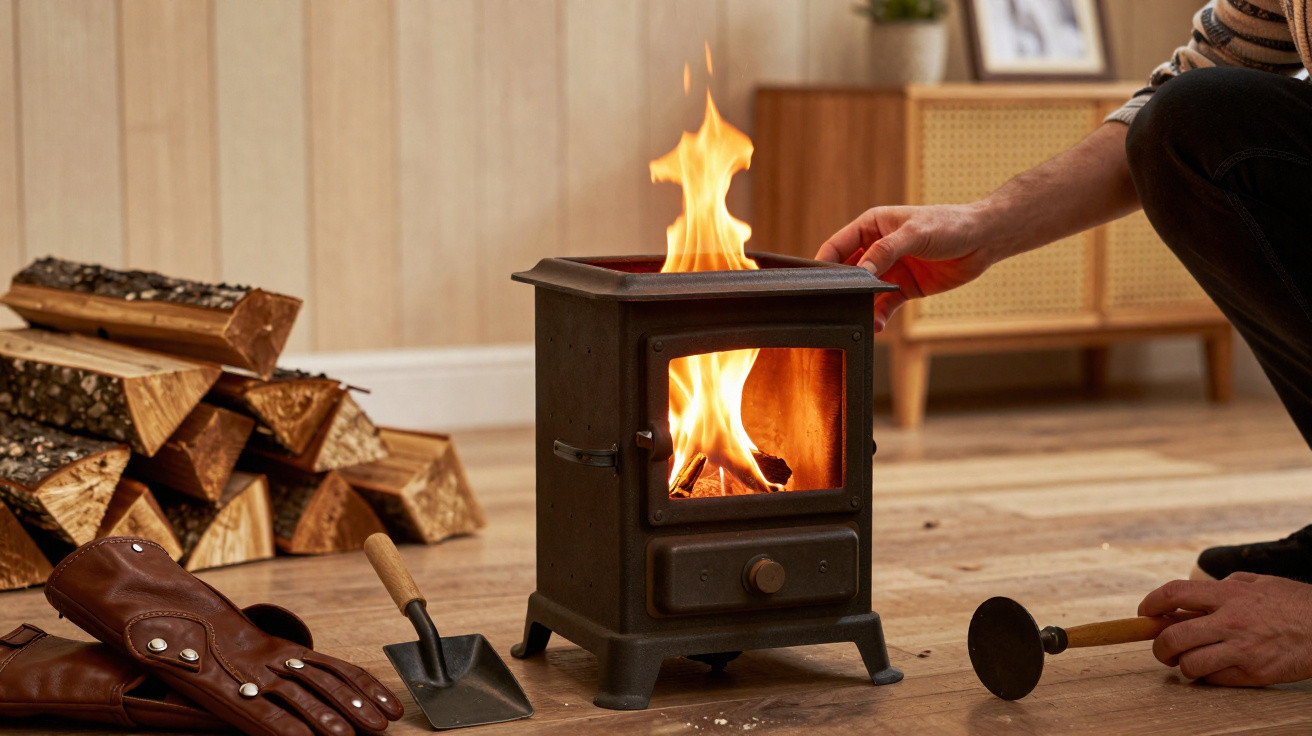
The wind battered the windows as the stove murmured from the corner, its subdued crackle seeming to resonate in your chest.
A modest pyramid of logs rested against the wall, and whenever the door opened, a blast of cold air crept inside, eager to reach that orderly stack of firewood. Resin and aged woollen blankets scented the room. It was comforting. Nearly.
With their sleeves pushed up, the homeowner scowled at a damp log that would not light. Beside the wood pile sat nothing at all: no implement, basket or unobtrusive protector to stop this arrangement becoming a gradual mix of ash, mould and squandered warmth.
That is when you realise there is an absence beside the centre of your home.
And it is not the thing most people would expect.
The overlooked issue beside your wood stove
Look around any sitting room with a wood stove and take stock of what stands near the firewood. There may be handsome iron pokers, perhaps a brass shovel and one or two baskets. Occasionally, a steaming mug balances on the hearth, tempting fate. The item you will seldom find is the one that silently affects how efficiently the wood burns: a straightforward, clearly visible moisture meter alongside a well-ventilated log rack.
It may seem almost absurdly simple: a small digital device and a rack beside something as ancient as fire. However, this modest pair reveals what your stove needs to know above all else: the true dryness of your wood and how well the next logs can breathe before they are burned. That distinction separates a sluggish, smoky flame from a fire glowing like coals in a blacksmith’s forge.
During one winter evening in Vermont, a chimney sweep said he could forecast creosote accumulation simply by looking at the way people kept their indoor wood. “Pile on the floor, no air under it, logs stacked tight to the wall? I already know my brush is going to work overtime,” he said, brushing ash from his sleeves. At another property, he indicated an unassuming metal rack raised a few inches from the floor, with an inexpensive moisture meter clipped to it like a pen. The stove glass was nearly immaculate, while the flames burned brightly and cleanly.
The homeowner tested one log from every fresh delivery. Whenever the reading exceeded 20% moisture, the logs remained outdoors a while longer. There was nothing elaborate about it, only a small repeatable routine enabled by an item costing less than a family takeaway. According to the sweep’s route notes, this led to fewer sooty problems, fewer smoky lighting attempts and roughly a third less wood used during the season.
Dry wood is not a minor consideration; it is what powers your stove. Burning logs that remain damp internally means much of the fire’s energy goes into boiling away water rather than warming the room. The flames become lacklustre, the glass turns black, sticky deposits form in the chimney, and you may blame the stove, its manufacturer or a “bad” load of wood. Keeping a visible moisture meter by the firewood stops that chain of assumptions. It provides a measurement rather than a hunch. Combined with a rack that raises logs above cold flooring and allows air to circulate, it makes your cosy corner a small but truthful heat laboratory.
This is not about technology. It is about feedback.
The wood stove setup that makes the difference
The useful step is remarkably uncomplicated: place a compact, ventilated log rack beside your wood stove and clip or hang a moisture meter directly on it. Do not leave it in a drawer or hide it in the garage. Keep it visible, where your hand instinctively goes for the next log. By lifting the wood a few inches above the floor, the rack permits airflow around every log and keeps the upper layer of firewood at a suitable indoor temperature before burning.
Whenever you bring a fresh load inside from the outdoor stack, split one log and push the moisture meter pins into its newly exposed surface. A reading below 20% means the wood can join the “ready” supply on the indoor rack. If it is higher, leave it somewhere dry and airy for longer. This 30-second routine can steadily alter your stove’s performance, night after night.
On a bleak, wet March morning in the UK, I saw a family follow this small ritual. The father entered carrying an armful of logs, with rain dripping from his jacket. He placed one log straight on the chopping block near the back door and split it with one quick, practised blow. Their teenage daughter took the meter suspended by string from the indoor rack, pressed it into the fresh face and announced the reading: 17%. “Good batch,” she said. Her parents smiled as though they had won a discreet private lottery.
The winter before had not gone so smoothly. That family had struggled with persistent smoke, continual stove-glass cleaning and a weighty odour that never quite disappeared from the room. Eventually, a local installer asked how they assessed their wood. They merely shrugged. “We knock on it, listen to the sound,” the mother said. He shook his head, produced a £25 meter and marked a straightforward 20% line on a piece of cardboard. They fixed the card beside the stove. By the following season, they were using less wood. Their sitting room remained warmer. The sour smoke smell gave way to the dry, reassuring scent of a fire that lightly lingers on books and curtains.
The principle is clear: the moisture meter establishes a firm threshold between “fuel” and “future fuel”. A rack prevents good fuel from returning towards dampness. Floors, particularly stone or concrete ones, retain cold and may contain concealed moisture. Logs placed directly on them can take on that chill and sometimes absorb humidity again. When wood rests on a rack with air beneath it, it reaches room temperature sooner and remains nearer the dryness your stove needs. It is a little like bringing ingredients to temperature before cooking. You are offering the fire the best possible form of the same material.
There is a further benefit: the deliberately defined area around the rack becomes your “wood zone”, rather than an expanding pile that gradually takes over the room.
How to use this “guardian” beside your firewood
First, select a compact rack that sits comfortably next to the stove without touching walls or obstructing the hearth. A metal model or a robust wooden one with slats will work, provided air can pass beneath and between the logs. Next, choose an uncomplicated pin-type moisture meter; there is no need for anything sophisticated. Attach it to the rack with twine, a magnet or a small hook. The purpose is entirely practical: you should see it every time you reach for a log.
Make one small household rule: each new firewood delivery must have a “test log”. Split that log, test the middle and say the result aloud. Below 20%? The delivery earns its spot indoors on the rack. Above 20%? Keep it outside under cover, with ample airflow, until you test it again. This turns an uncertain, instinct-led decision into a quick shared habit that children can take responsibility for too. That’s how a tool becomes part of the room, not just another gadget.
When life becomes hectic, especially halfway through the season, most people abandon this step. We arrive home late, feel cold and simply want a fire immediately. Let’s be honest: nobody really does it every day. That is exactly why the meter should remain on display beside the firewood instead of being put away. Missing several tests does not matter. You do not need to be perfect, only consistent enough to form a pattern. The genuine risks come from two practices: piling logs directly on the floor by the stove and treating “looks dry” as a dependable test.
Wet wood may appear convincingly seasoned, particularly when its outer surface has become grey and cracked through weathering. Your stove is unconcerned with the log’s exterior. It responds to what is at its centre. By the time heavy, sluggish smoke is rolling from the chimney, the issue is already developing inside the flue. The meter and rack do not criticise; they simply steer you back towards better fuel. On an exhausting Tuesday evening, that quiet prompt is more valuable than any manual read once and then forgotten.
“The best chimney cleaning is the one you never have to do,” a veteran sweep told me. “And that begins with what you put beside your stove, not what you burn in it by chance.”
The space around the rack can serve as a small fire-control area without making your sitting room feel like a workshop. A few uncomplicated extras are useful:
- Put a metal ash bucket on the opposite side of the stove to visually balance the wood rack.
- Keep a small brush and shovel nearby, ensuring that spills do not become a lasting grey ring.
- Place a fireproof mat or hearth rug beneath the rack to collect loose chips and embers.
- Keep only the amount of indoor wood you expect to burn in 1–2 days, so the area does not become cluttered.
- Tie a small “20%” label to the rack as an unobtrusive reminder of the dry-wood limit.
On a cold night, with low light in the room, the kettle humming and the familiar click of the stove door closing, this tidy little corner has more influence than it suggests. Your next comfortable hour starts there.
The object that changes how you watch your fire
After you begin storing a rack and moisture meter beside your firewood, other previously overlooked details become noticeable. The stove glass stays clear for longer. Kindling takes more quickly when the main logs are not secretly damp. You hear a fuller, drier crackle from a fire fed with genuinely seasoned wood, with fewer sharp, angry pops. You may even find yourself watching the stove as you might watch a sleeping child, listening for the settled, regular rhythm that signals all is well.
The small area by the firewood turns into a dialogue between you and the season. On some days, you might move the rack slightly nearer the wall to create room for additional guests. On others, you will fill it generously before a snowstorm, as though stocking a pantry. Every so often, you may touch the meter and think, “We really should order next year’s wood earlier.” That is the understated value of this neglected item: it links today’s routines with tomorrow’s warmth.
We have all experienced the moment when a fire dies too soon, the room becomes cool before bed and someone says, “This wood is rubbish.” At times, that may be true. More often, though, the wood is simply unready, poorly stored or untested. A modest rack and an inexpensive meter beside your logs cannot fix every issue at the press of a button. Yet they can create a small opening for attention in a part of the home usually left to run in the background. In that opening, the relationship changes. You move from guessing to knowing, from battling the fire to cooperating with it, and from merely burning logs to properly living with a stove.
Next time you stand before your wood pile with your hand hovering over the next log, ask yourself one quiet question: what is looking after this fuel before it reaches the flames? If the answer is “nothing, really,” perhaps it is time to bring in that simple, overlooked guardian and give it a permanent place beside your firewood.
| Key point | Detail | Benefit for the reader |
|---|---|---|
| Wood rack near the stove | Keeps logs off the floor with airflow under and around them | Improves burn quality and reduces indoor mess |
| Moisture meter in sight | Tests core moisture, aiming for under 20% | Prevents smoky fires and excess creosote |
| Simple “test log” habit | Split and measure one log from each delivery | Saves wood, protects the chimney, stabilizes room heat |
FAQ:
- What moisture level should my firewood be for a wood stove? Most stoves work most effectively with firewood containing 20% internal moisture or less. The most dependable check is a pin-type meter reading taken from the freshly split centre of a log.
- Can I just store logs directly on the floor next to the stove? You can, although the wood will often be colder, a little damper and surrounded by more dirt. A small rack keeps logs cleaner, drier and better prepared for efficient burning.
- Do I really need a moisture meter if my wood “looks” dry? Looking at wood or knocking it provides only rough estimates. A meter supplies a number, particularly with dense hardwoods that can retain hidden moisture long after their surface appears aged.
- Will a rack and meter actually reduce my heating costs? Properly seasoned wood produces more heat from each log, wastes less energy removing water and keeps chimneys cleaner. Many households consequently burn noticeably fewer logs throughout a winter.
- How often should I test my firewood with the meter? For most people, checking one split log from every new delivery is sufficient. Test again if fires seem slow, the glass blackens rapidly or chimney smoke appears thick and grey.



Comments
No comments yet. Be the first to comment!
Leave a Comment