
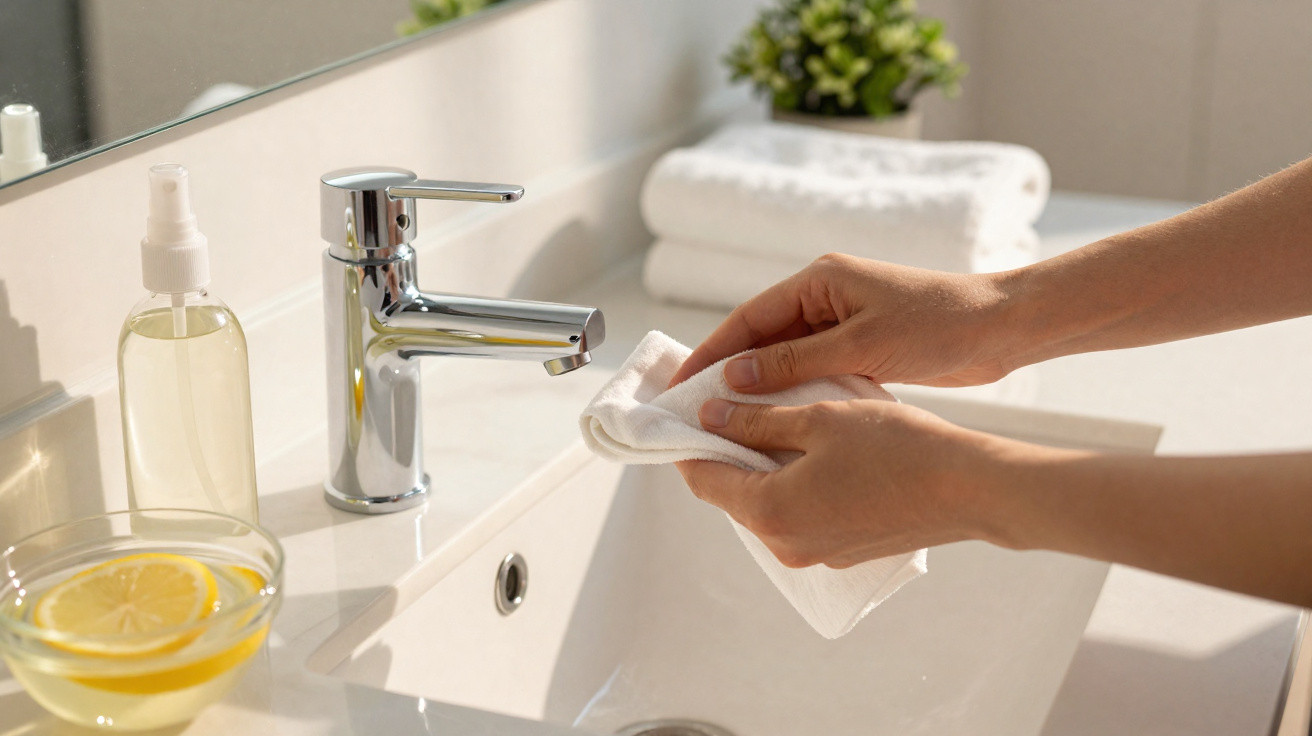
The tap shines only on the day it is newly fitted. Then everyday life quietly takes over: splashes of toothpaste, a ring of limescale, a faint layer of soap film. You turn on the water first thing in the morning, still half asleep, and your eye catches the dull marks for a moment. You think, “I really must deal with that”, then hurriedly wipe it with the towel, which of course leaves lint behind. Two hours later, it looks exactly the same again. Perhaps even worse.
We all know the moment when visitors are due and we suddenly look at the fittings with entirely different eyes. Every tiny mark feels like a minor accusation. Usually, the only option then is a rushed last-minute wipe-over. At some point, you start wondering whether there is a straightforward trick that actually works, without requiring a full-scale cleaning rehearsal every time. The answer is hiding in an unremarkable drawer.
Why fittings quickly look neglected – and what is really causing it
Fittings do not visibly age overnight. Instead, they change almost unnoticed until you find yourself wondering when the tap actually stopped looking shiny. A fine haze of limescale, tiny drops of water and microscopic scratches in the cleaning film: your eyes only register all of this partly, but the sense that it looks “unkempt” is unmistakable. Interestingly, the actual dirt is often not particularly dramatic at all.
It is usually the combination of hard tap water, cleaning-product residue and tiny soap particles. Together, they settle over chrome and stainless steel like a dull filter. Each day adds another faint layer. If you then reach for aggressive bathroom cleaners, they may remove some of the deposit, but they often attack the surface as well. The result is a duller shine, more visible scratches and marks that return more quickly.
Let us be honest: nobody polishes their tap every day. Most people wipe it “while they are at it”, perhaps as they dry their hands or clean the basin. That is precisely where the problem starts, because textile fibres, unsuitable cloths and excessive chemicals can leave microscopic damage behind. Those minute scratches provide perfect places for fresh limescale and dirt to cling to. It is less a matter of “not clean enough” than “cared for incorrectly”.
The simple water tap trick: hotel-bathroom shine with kitchen ingredients
The trick used by many hotels and household-cleaning professionals is remarkably simple: combine vinegar, water and a drop of washing-up liquid, then apply it with a soft microfibre cloth or an old cotton T-shirt. There is no specialist product and no expensive miracle paste involved. It is simply a mild, slightly acidic solution that loosens limescale, breaks down grease and remains gentle on the surface. What matters is not force, but patience.
In a spray bottle, mix roughly one third household vinegar with two thirds warm water, add a tiny squirt of washing-up liquid and lightly spray the fitting. Leave it to work briefly – two to three minutes is often enough – then gently wipe it with a soft cloth. No rubbing and no scrubbing. Finally comes the real game-changer: buff it dry until the tap is genuinely streak-free. That is when the kind of shine normally seen only in catalogue photographs appears.
What many people do not realise is that this trick works not only on chrome but also on many stainless-steel fittings, provided the surface does not have an explicitly delicate coating. After one thorough application, the result can be almost surprising. The fitting suddenly appears newer than it really is. More importantly, it stays clean for longer because fewer harsh residues are left on the surface. Put simply: little effort, a major visual improvement.
How to use the water tap trick properly – step by step in real life
First, a small reality check: a fitting does not need to shine like one in a furniture showroom for the bathroom to look well cared for. It simply needs to be clean, clear and free from marks. Start with a quick check, rinsing away any obvious dirt or toothpaste residue using plain water. Next, lightly spray on the prepared vinegar-and-washing-up-liquid mixture, or apply it with a slightly dampened cloth. Do not soak it; just moisten the surface.
This is where many people become impatient. Rather than wiping immediately, let the mixture do its job for a short while. In the meantime, you can clear the basin or wipe the mirror. After a few minutes, wipe the fitting with a clean, damp cloth. The final stage is almost meditative: polish it with a dry, lint-free cloth. This last pass is what makes the difference. Without it, streaks remain, later looking like fresh marks.
One point that is often overlooked is the aerator, the small mesh fitting at the water outlet. Feel free to include it in your routine regularly. Once a month, unscrew it, place it briefly in neat vinegar, rinse it and fit it back on. The water flow will feel softer afterwards, and limescale will build up more slowly. These small routines are what turn “Oh, that somehow looks grubby” into “Wow, it looks like new”.
The biggest mistakes do not happen because of laziness, but because of good intentions. Many people use abrasive sponges or highly acidic bathroom cleaners because they want to make things “properly clean”. This creates tiny scratches that are often invisible to the naked eye, but gradually destroys the shine. Chrome is particularly sensitive, although stainless steel can quickly develop a greyish haze too.
Another classic mistake is using water that is too hot and rough cloths. Going over a fitting with hot water and a coarse cotton rag increases abrasion and dries the surface out more quickly. It may sound strange at first, but it is like rubbing delicate skin with sandpaper. A soft microfibre cloth or an old, smooth T-shirt is considerably kinder. They also do not leave new cleaning marks behind.
Many people also underestimate how much residue fragranced cleaners and brightly coloured bathroom products leave behind. Something that smells pleasant automatically seems “cleaner” in our minds. In reality, a thin film remains on the surface, practically attracting dust, limescale and dirt. Here is one sober truth: the simpler your cleaning product, the better your fitting will look in the long term. Minimalism beats a chemical cocktail.
“Since I started using this vinegar trick, my washbasin no longer looks more tired than I do in the morning,” a friend says with a laugh as she buffs the tap with an old T-shirt. “It takes less than two minutes – and I spend the rest of the day being far less annoyed by that dull limescale film.”
To make the trick genuinely relaxed to use in daily life, a few small habits can help:
- Keep the vinegar-and-washing-up-liquid mixture in a labelled spray bottle in the bathroom.
- Store a soft cloth reserved solely for fittings beside or beneath the washbasin.
- Plan one “shine moment” each week – for example, after brushing your teeth on Sunday morning.
- When cleaning, deliberately avoid abrasive sponges and harsh bathroom cleaners on fittings.
- Briefly unscrew and descale the aerator once a month.
Why this small trick changes more than just the water tap
People who begin cleaning their fittings in this gentle, quick way often notice something else too: the bathroom suddenly feels calmer. There is no more irritating glance at marks whenever you wash your hands, and no lingering feeling of “I really ought to sort that out”. Instead, there is a clear tap that seems to shine almost proudly in the light. That tiny change alters how the entire room is perceived.
It is also interesting how quickly new habits become automatic. At first, the extra step of “buffing dry” may seem unnecessary. After a few weeks, it feels odd not to do it. What began as an annoying additional task becomes a brief, almost soothing movement. Many people report that this mini routine gives them a different relationship with cleanliness: less perfectionism and more small, manageable steps.
Perhaps that is the hidden magic of this trick: it is so simple that it does not put you off, yet so effective that you no longer want to go without it. Anyone who has tried it once is happy to tell others about it: the friend who is moving house, or the colleague complaining about hard water. Small everyday hacks spread quietly – and eventually there is a tap sparkling in the morning light as though it had only been fitted yesterday.
| Key point | Detail | Benefit for the reader |
|---|---|---|
| Gentle vinegar-and-washing-up-liquid solution | A mixture of vinegar, water and a drop of washing-up liquid removes limescale and grease | A simple, inexpensive alternative to harsh specialist cleaners |
| Buffing dry | Dry the fitting at the end with a soft, lint-free cloth | Noticeably more shine and a cleaner surface for longer, without streaks |
| Avoiding scratches | Do not use scouring sponges or strongly abrasive cleaners on chrome or stainless steel | Longer life and a better appearance for the fitting |
FAQ:
- How often should I clean my fittings using this trick? For a normal family bathroom, once or twice a week is completely sufficient; in between, a quick wipe with a damp cloth is enough.
- Is vinegar suitable for all fittings? For standard chrome and stainless-steel fittings, yes. For coated or matt designer surfaces, always test it first on an inconspicuous area or check the manufacturer’s guidance.
- Can I use citric acid instead of vinegar? Yes, in a heavily diluted form. Its strength varies, so choose a low concentration and test it briefly first.
- What should I do with very stubborn limescale? Soak a cloth in the vinegar solution, place it over the affected area, leave it for 10–15 minutes, then wipe gently. Do not scrape.
- Which cloth is genuinely suitable? A soft microfibre cloth or an old, smooth cotton T-shirt is ideal, as both clean gently and leave hardly any scratches.





Comments
No comments yet. Be the first to comment!
Leave a Comment