
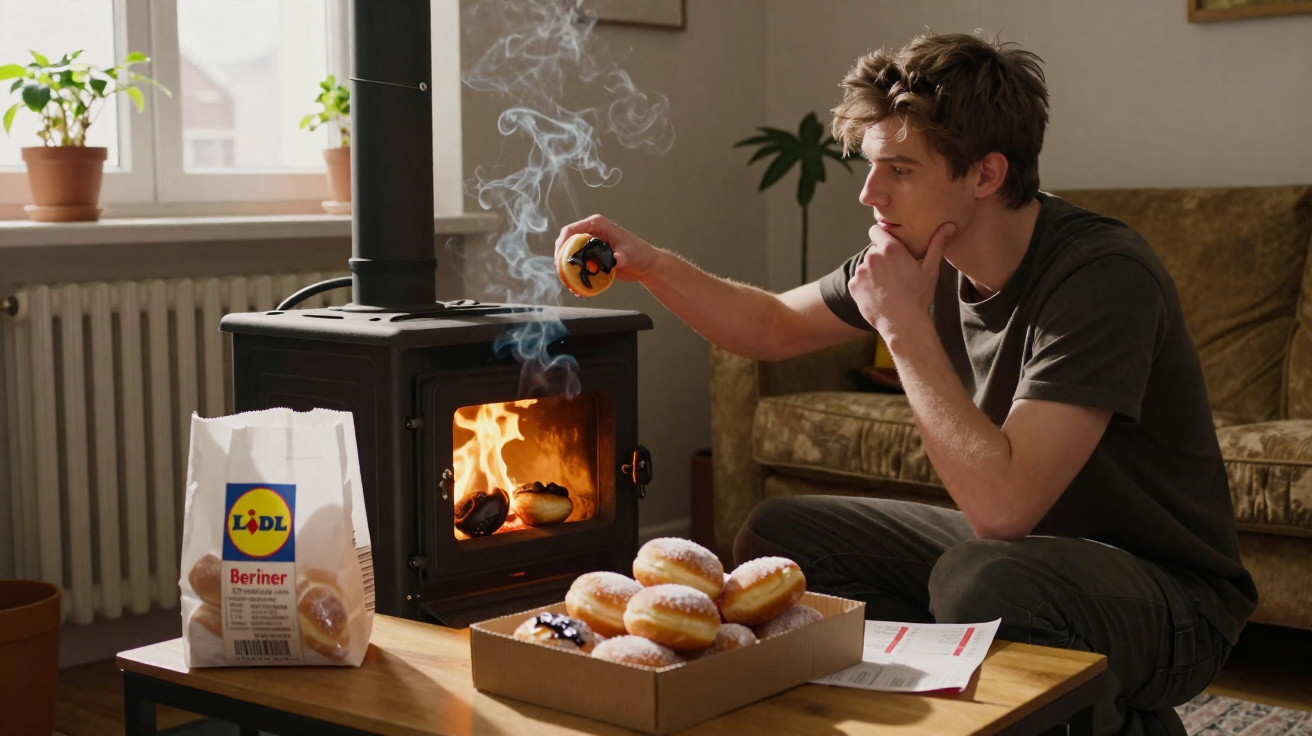
Amid rising energy prices across Europe, a Polish YouTuber has tested an absurd yet genuinely intended alternative to conventional heating. Rather than using wood pellets or briquettes, he put kilograms of discounted fried pastries into his stove. What sounds like an internet joke proved to be a surprisingly involved experiment carrying a clear message about the energy crisis.
133 Lidl jam doughnuts in a stove: what was behind the stunt?
Marek Hoffmann, known online as “AdBuster”, set out to find out whether heating bills could be cut with an entirely different type of fuel. The idea came after he looked at promotions ahead of Poland’s traditional Fat Thursday, when sweet fried pastries are especially popular.
In the run-up to the celebration, many supermarkets sharply reduce the price of these baked goods. Hoffmann noticed that the pastries cost less per kilogram than the wood pellets used by many Polish households to fuel their stoves. That observation became the basis for an idea he documented in a YouTube video.
For the trial, he bought:
- 133 fried pastries from Lidl
- Total weight: 10 kilograms
- Total price: €2.85
- Price per item: around two cents
This put the price per kilogram well below that of pellets. Hoffmann’s reasoning was simple: if the pastries burned reasonably well, they could theoretically offer a cheaper fuel source, at least during such discount promotions.
“Food as fuel: economically appealing, morally questionable – and technically surprisingly effective.”
Energy content fact check: fried pastries narrowly outperform wood briquettes
To ensure the stunt amounted to more than an eccentric spectacle, Hoffmann presented the figures. For any fuel, volume is not the key consideration; what matters is its calorific value, meaning the energy contained in each kilogram.
According to the data used for the experiment, the comparison was as follows:
| Fuel | Energy content (per kg) |
|---|---|
| Fried pastries | approx. 18.5 megajoules |
| Wood briquettes | approx. 18.27 megajoules |
The energy content of fried pastries is therefore marginally higher than that of briquettes. This is hardly surprising, as the dough contains substantial quantities of fat and sugar, both of which make a major contribution to heat output. From a chemical perspective, these pastries behave more like a combination of oil and carbohydrates than ordinary bread.
How the fried pastries burned in the cast-iron stove
Hoffmann carried out the test in a heavy cast-iron stove. He placed the pastries inside and lit them in the same way as conventional fuels. Even he was taken aback by what happened.
- The temperature in the stove quickly rose to several hundred degrees Celsius.
- Combustion continued for almost five hours.
- The oil and sugar allowed the pastries to smoulder and burn steadily.
The heat output was enough to keep the stove hot for an extended period. The pastries burned completely without requiring constant refuelling. From a purely technical standpoint, the experiment worked remarkably well.
“Five hours of warmth from €2.85 worth of fried pastries – economically it looks tempting, and energetically it makes perfect sense.”
When heating becomes a moral test: is it acceptable to burn food?
Despite the striking result, Hoffmann was left with an uncomfortable feeling. He had not burned waste, but food that was essentially still fit to eat, even if it had been heavily reduced in price. In his video, he openly describes the moral dilemma involved.
The central question is whether it can be justified to burn food simply because it costs less than traditional fuel. At a time when millions of people worldwide lack reliable access to food, putting edible products into a stove understandably feels unsettling to many.
This is precisely the issue Hoffmann places at the centre of the experiment. He illustrates what happens when an absurd market-price signal makes calories for the plate appear more expensive than calories for the stove. His action is therefore less an instruction to copy than a provocative comment on energy and food policy.
Energy crisis in Poland: why people are seeking alternatives
The background to the experiment is seriously grim. Poland has been heavily affected by rising energy prices. Many households depend on wood, coal or pellets, and when their costs increase there is little room to manoeuvre, particularly in rural areas.
During recent winters, reports have already circulated of some families turning to unusual fuels, including:
- oats and other grains
- maize cobs or maize meal
- outdated or damaged leftover food
The fried-pastry experiment fits into this wider pattern. It highlights the scale of the pressure to find alternative sources of heat, even where they offer only temporary help or appear questionable.
The limits and risks of experiments like this
However spectacular the footage may look, the dangers are equally clear. Anyone experimenting with unconventional fuels without specialist knowledge is taking considerable risks:
- Heavy smoke and soot: fats and sugars can create sticky deposits in the stove or chimney.
- Fire risk: oil-rich foods can flare up uncontrollably.
- Pollutants: burning at an incorrect temperature can release toxic gases.
- Insurance: damage caused by unauthorised fuels is often not covered.
Specialists therefore clearly advise against operating stoves with fuels for which they have not been approved. Experiments such as this are better suited to a controlled testing environment than everyday use in the home.
Why fat burns so effectively – and what it reveals about food
In purely physical terms, the result is not especially unexpected. Fats and oils have a very high energy content. Put simply, one kilogram of pure edible fat can provide more than twice as much energy as one kilogram of dry wood.
Fried pastries contain:
- large amounts of vegetable oil or fat
- sugar, which also burns well
- flour, which acts as a supporting ingredient
Their high energy density explains why these products deliver so many calories while also performing surprisingly strongly in a stove. Indirectly, the experiment also shows why heavily fried pastries can be so unforgiving for one’s figure: what can produce heat for five hours in a stove will not be without consequences in the body either.
What can be learned from the stunt beyond its spectacle
Hoffmann’s action can be dismissed as an internet joke, but it exposes several uncomfortable issues. First, it demonstrates just how distorted pricing structures can become. If fried pastries that have been extensively manufactured, packaged and transported are cheaper than straightforward fuel, something is wrong with the incentives.
Secondly, the idea points to a broader problem during times of crisis: people inevitably use what works in the short term, even if it offers no long-term solution. When the choice is between a home that is too cold and burning surplus food, people will generally choose warmth over principles.
Consumers would do well to examine the official energy data for different fuels rather than focusing solely on the price of a bag at a DIY shop. Relevant considerations include:
- price per kilogram
- energy content per kilogram
- compatibility with the household heating system
- approval and safety
Anyone seeking to heat efficiently and responsibly cannot avoid making this calculation. Experiments such as the one involving 10 kilograms of fried pastries starkly demonstrate how strong the demand for affordable heat has become – and how closely economic desperation and moral boundaries can sometimes sit together.





Comments
No comments yet. Be the first to comment!
Leave a Comment