
Between the stack of plates and the washing-up liquid bottle, almost every kitchen has the same inconspicuous item: the washing-up sponge. Most people reach for it without a second thought when rinsing a glass or cleaning pans quickly. Hygiene researchers now issue a clear warning, however: this small kitchen essential is among the most heavily contaminated household items. A German study supports that concern – and draws attention to a simple Action accessory costing around €3 that can noticeably improve the situation.
Why the traditional kitchen sponge is a magnet for bacteria
When people think about germs in the home, the toilet is usually the first place that comes to mind. Research shows, however, that the unremarkable sponge beside the sink is often colonised by considerably more bacteria than the toilet seat.
This is due to a combination of several factors:
- constant moisture within the sponge
- warmth in the kitchen, particularly after cooking
- leftover food particles and grease
- numerous tiny pores and fibres with a large surface area
These conditions provide an almost ideal environment for microorganisms to multiply. Even regularly squeezing out the sponge or rinsing it with hot water does little to solve the problem.
Hygiene specialists class the kitchen sponge as one of the household objects with the highest bacterial contamination.
A research team at Furtwangen University in Baden-Württemberg found that, after only a short period of use, the number of germs in the material rises so sharply that it soon returns to the level seen before the last “cleaning attempt”. Measures such as rinsing it under very hot water, briefly putting it in the microwave or adding a splash of vinegar may reduce individual germs, but they do not provide a genuine fresh start.
What the study specifically suggests
The researchers tested various methods households use to try to keep a sponge clean. Their conclusion was sobering: over the longer term, none of the common measures maintains a reliably low germ load.
Their central recommendation is therefore:
- replace the sponge very regularly, ideally every week
- allow it to dry as completely as possible between uses
- do not use it to quickly clean glasses after tackling heavily soiled pans
- dispose of it immediately if it develops a noticeable smell or discolouration
Washable microfibre or cotton alternatives reduce the amount of waste, but they do not automatically resolve the underlying moisture issue. If a cloth remains permanently wet in washing-up water, bacteria can multiply just as readily as they do in a conventional sponge.
The Action solution: washing-up liquid dispenser with a sponge tray
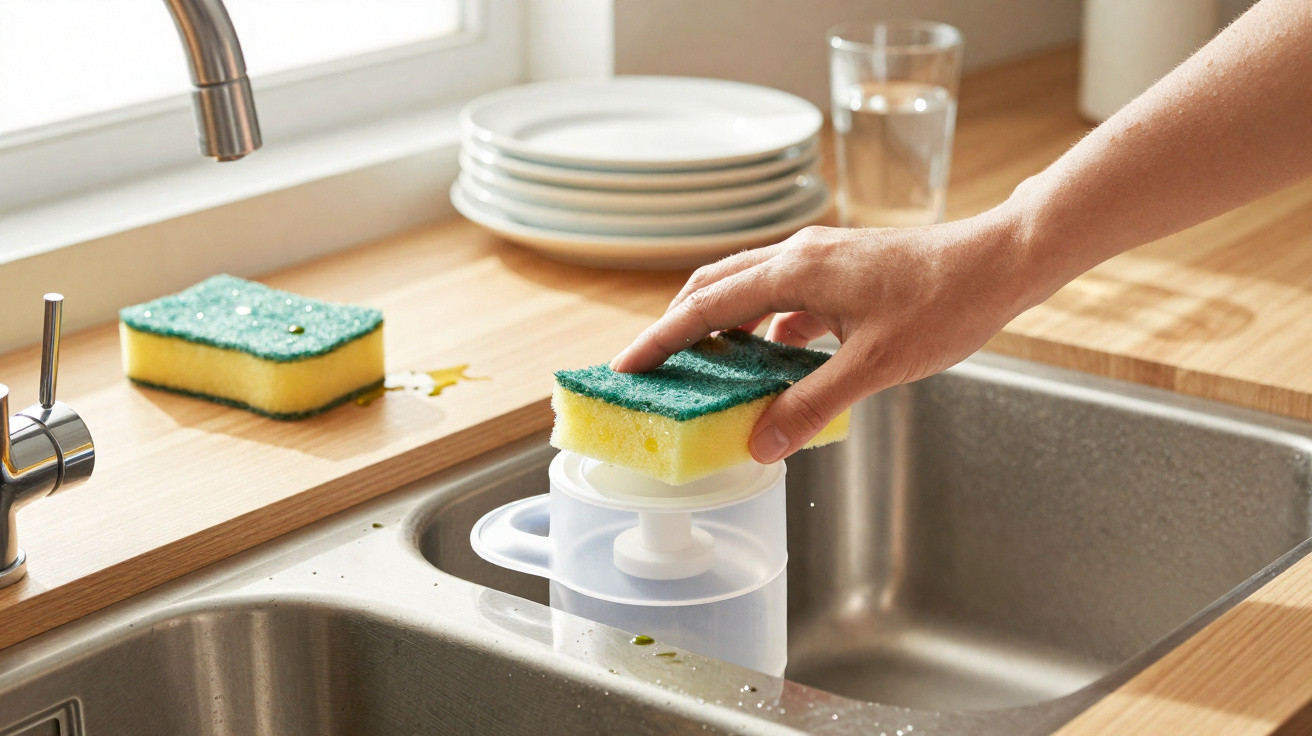
This is where an accessory currently sold in Action’s household section for under €3 comes in. It is a compact washing-up liquid dispenser with an integrated tray for the sponge.
Its design is straightforward:
- a container at the bottom, filled with washing-up liquid
- a small pump above it, which pushes the liquid upwards
- a solid platform on top where the sponge is placed
- a non-slip base underneath, keeping the unit secure at the edge of the sink
To dispense the liquid, simply press down on the sponge positioned on top with your hand. A hole in the centre allows only a limited amount of liquid to reach the underside. Instead of half a “washing-up liquid bath” ending up in the sink every time dishes are washed, the amount is much more controlled.
The clever part: the sponge is raised up and dries more quickly instead of sitting in a puddle of dirty water.
Experienced users particularly praise three aspects: the tidier appearance around the sink, less wasted washing-up liquid and the fact that excess water can drain from the sponge into the lower container. This container can be taken apart and cleaned separately.
How the washing-up liquid dispenser improves hygiene
The accessory is not a substitute for disinfection, nor can it turn an old sponge that is already “on the turn” into a sterile tool. However, it changes the conditions in which germs multiply in several important ways.
Faster drying rather than permanent dampness
Since the sponge rests on the upper platform, it does not remain permanently submerged in wet washing-up residue. Air can reach it from every side, allowing the material to dry substantially faster after use. Drying periods are crucial because many bacteria require moisture to grow.
More precise washing-up liquid dosing
Many households tend to use overly generous amounts of washing-up liquid straight from the bottle. One quick squeeze and half the plate is covered. This not only increases costs, but can also leave soap residue trapped in the sponge.
With a dispenser, one or two short presses are enough. This results in:
- less unnecessary foam in the sink
- more economical use of each bottle
- less time for the sponge to remain in thick soapy water
Easier cleaning around the sink
The lower container collects both washing-up liquid residue and draining water. It can be dismantled and washed with hot water. Cleaning this container briefly every few days removes a large share of the nutrients on which bacteria feed.
The dispenser creates clearer organisation around the sink: a fixed place, a controlled process and less chance involved.
Important rules that still apply despite the gadget
Hygiene experts stress that even with a well-designed dispenser, a sponge remains a consumable item. Anyone who uses one for months still risks high germ levels – regardless of how clean the container appears.
Practical minimum rules for everyday use include:
- discard a washing-up sponge no later than after one week
- use separate sponges or cloths for the bathroom, kitchen and worktops
- after handling raw meat, fish or eggs, it is better to use disposable kitchen paper or a separately washable cloth
- quickly wipe the sink edge every day with hot water and a little cleaner
Those aiming to live more sustainably can wash reusable cloths at 60°C. The important thing is to let them dry completely and not leave damp textiles scrunched up together.
How serious is the health risk really?
Not every bacterium in the home automatically causes illness. Many germs are harmless, and some are even beneficial. The main risk is for people with weakened immune systems, older people, young children or those with chronic illnesses. For them, gastrointestinal pathogens or certain germs from spoiled food can genuinely become a problem.
In this context, the kitchen sponge acts as a “taxi”: it picks up microorganisms from chopping boards, worktops, meat juices or plates, then spreads them widely elsewhere. The longer a sponge is used, the denser this “microfilm” becomes inside it.
Tips for a more hygienic kitchen with little effort
Many measures can be incorporated into everyday routines with only a few simple steps. Combining them has the greatest effect:
- use a washing-up liquid dispenser or soap dispenser with a tray
- squeeze the sponge thoroughly after every use and store it openly
- replace it immediately if it smells unpleasant, rather than using it for “a few more days”
- wipe worktops after cooking with a fresh cloth
- wash tea towels regularly at high temperatures
The dispenser from Action is therefore one of several small aids that can make a chaotic washing-up area a little more organised and predictable. Anyone who needs to buy more washing-up liquid anyway can test relatively cheaply whether it reduces their consumption and keeps the sponge drier.
Behind this lies a fundamental question: how much hygiene does a kitchen really need? Studies indicate that a small number of measures, applied consistently, can make the difference – such as replacing sponges regularly and allowing drying time. A simple gadget cannot replace an awareness of cleanliness, but it can make everyday routines noticeably easier.





Comments
No comments yet. Be the first to comment!
Leave a Comment