
The man standing in the garden centre car park hardly fits the image of a scammer. He has grey hair, a spotless polo shirt and an easy smile. Dropping the tailgate of his pick-up, he reveals a six-seat spa: its shell is slightly faded, with droplets still clinging to it after a recent wash. “Perfect for your retirement,” he says. “We’re moving, no space at the new place.” Its asking price is half that of the gleaming models in a showroom. Then he adds, “The pump is a bit noisy, but these things last forever.” You find yourself nodding, partly persuaded and partly carried away by the thought of soaking in hot bubbles on a Tuesday morning.
He connects it to a temporary extension lead. The resulting hum is distinctly wrong.
You are caught between the bargain’s appeal and a growing sense of unease.
Why secondhand spas appeal at 55… and so often let buyers down
At 55, purchasing a brand-new spa can feel rather like buying a sports car: overly showy, costly and perhaps a touch extravagant when your grown-up children may still need help with their rent. A secondhand model tells a much more reassuring story: “You’ve worked hard, you deserve this, and you won’t blow the retirement fund.” Classified listings are packed with them, photographed at sunset with blue-lit water and candles set around the decking. As you browse, you picture relief for your back pain and long winter evenings.
Then comes the wording that alters the picture completely: “Pump to be checked” or “small hydraulic issue”.
Suddenly, the dream has acquired a technical dossier.
Those imprecise descriptions conceal a very real problem. Hot-tub technicians report the same pattern: around 4 out of 10 secondhand spas they attend require major pump repairs during the first year. This is not simply a minor seal or an easy filter change. It can mean replacing motors, rebuilding hydraulic circuits and prising open access panels because humidity has caused everything to swell. Depending on the make and extent of the fault, bills can rapidly reach £700 to £1,800.
The difficult part is that sellers are not always being dishonest.
Many sincerely believe that it “just needs a little clean-up”.
After a spa reaches five to seven years old, its pump often becomes the vulnerable component, particularly when water chemistry has been managed inconsistently. Limescale, tiny leaks and unnoticed periods of overheating while nobody is at home all take their toll on the motor. With a new spa, the manufacturer carries some of that risk through a warranty and available replacement parts. With a used one, the responsibility quietly shifts to you. The spa can still appear superb on the outside, while its pump is already approaching the end of its life.
That is why so many apparent bargains become unplanned and difficult refurbishment projects.
How to test a used spa pump before agreeing to buy
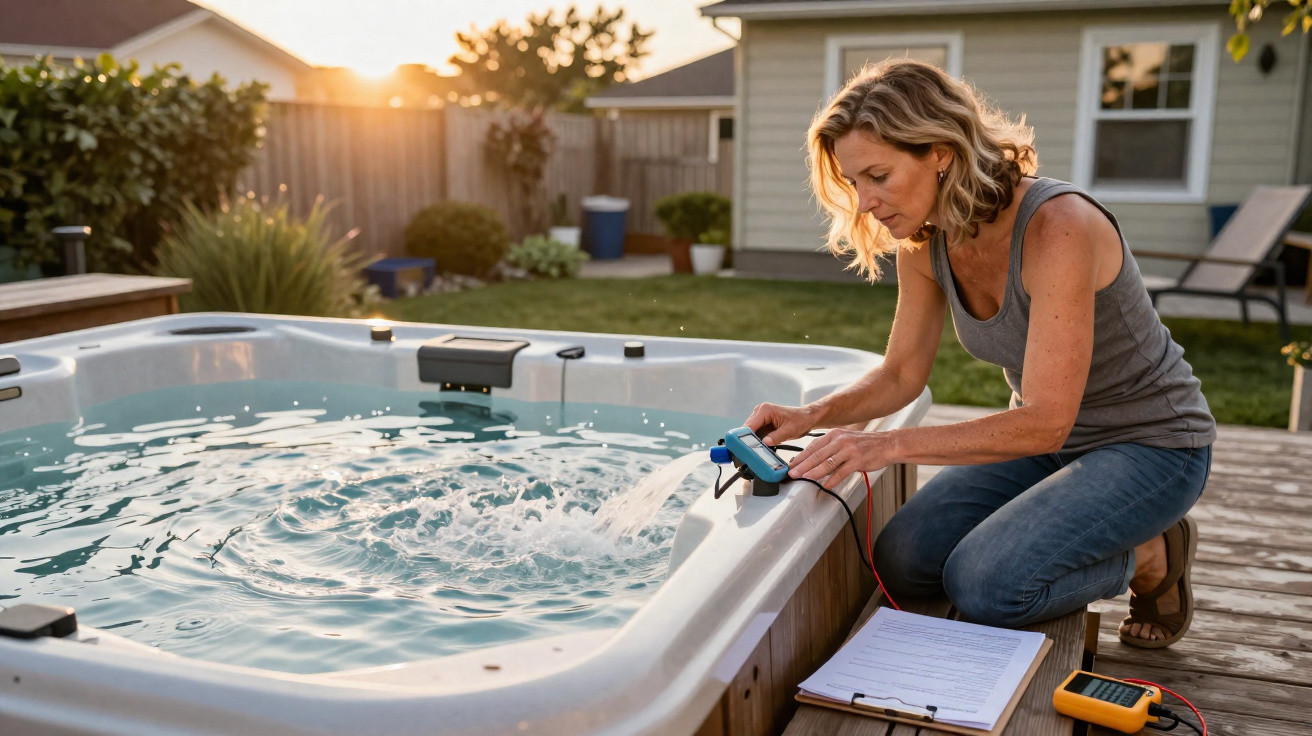
The first thing to do before purchasing a used spa is not remotely romantic: listen. Do not listen to the seller’s account or to the soothing noise of the water; listen to the machine’s heart. Request that the spa is filled, switched on and heated on the day before you visit. On arrival, the pump should be operating in genuine conditions, rather than for two minutes with an empty tub.
Move close, crouch down and listen carefully. A sound pump produces a steady hum; it should not grind.
Loud vibrations, metallic sounds or a hesitant start are warning signs, not “little quirks”.
Next, rest your hand on the spa’s casing or base. A mild vibration is normal, but it should not shake violently. You should not feel as though a washing machine is spinning while out of balance. Ask to test every massage setting and zone.
We have all encountered the moment when a seller races through the demonstration and says, “It’s always a bit like that when it starts.”
Do not be hurried.
Check the control display for error messages, and demand at least ten uninterrupted minutes of operation. The pump that “only makes noise at the start” is often the same pump that fails three weeks after you have handed over the cash.
Nobody, realistically, reads an old spa manual from beginning to end. Even so, one step is especially useful: ask for invoices covering previous servicing, particularly pump work. A spa with evidence of a major pump replacement and regular water maintenance is less concerning than one described as “never opened, never serviced, works perfectly” after spending twelve winters outdoors.
Where the seller has no paperwork, technician contact details or water-testing records, remember this: you are not buying a spa; you are buying a mystery.
That may be exciting at 25.
At 55, it is more often simply costly.
Set your limits: budget, repairs and knowing when to walk away
Before becoming attached to a secondhand spa, write down one figure: your full budget, including both purchase and repairs. It should be the realistic budget, not the idealised one. On top of the sale price, allow an additional 30–40% specifically for unexpected technical problems.
If the spa is priced at £3,000 and a £1,200 pump repair would cause you to panic, the sums do not work.
Your rule should therefore be straightforward: no documented pump inspection, no purchase.
No safe access to the equipment compartment, no purchase.
Many buyers at 55 feel slightly uncomfortable negotiating or asking “too many questions”. They do not wish to upset a seller who may be of a similar age and have a similar story. That is understandable. However, a spa is not a table or a lamp: it is a complicated machine involving electricity, water and high pressure.
Give yourself permission to speak plainly: “If the pump fails in three months, I can’t afford a heavy repair.”
You may be surprised by the number of sellers who feel relieved enough to say, “Yes, the technician already warned me.”
At that point, you either step away politely… or renegotiate the price substantially.
Sometimes, a good spa technician is your best ally.
“People call me after they’ve bought the used spa,” explains Marc, 20 years in the business. “Honestly, I wish they called me before. I could save them 1,000 euros in ten minutes, just by listening to the pump and opening the side panel.”
- Request a pre-purchase inspection from a local spa technician, even if you cover the call-out fee yourself.
- Take a photograph of the pump’s label and model number, then contact a dealer to confirm the availability and cost of parts.
- Agree a written condition: the sale is confirmed only after a successful technical inspection.
- Arrange transport and installation so that the pump side remains accessible rather than being pressed against a wall.
- Put aside a modest emergency fund for pump or leak problems during the first year.
Living with your decision: from impulse purchase to everyday comfort
There is something odd about spas. People imagine them as a pass to a different life, yet some end up using them only three times a year. The gap between a purchase you regret and a genuine improvement in comfort depends less on the brand than on how calmly you made the decision. Once the spa is installed on your decking, the state of its pump governs everything: whether the water heats when you need it to, whether the massage jets continue to flow properly and whether your evenings end without an emergency call to an electrician.
The used market will continue to expand because new models are becoming more expensive, while many owners underestimate the real cost of maintenance.
Buying at 55 also involves a different time horizon. You are not seeking ten years of service “if all goes well”; you want three to five dependable, trouble-free seasons. That changes the calculation. The true bargain may not be a heavily discounted spa sold by a stranger, but a somewhat pricier model from a retailer who has refurbished it and guarantees the pump. You may reject three appealing listings before finding the spa that suits your actual life rather than simply looking good on your screen.
You may still get burned one day.
But you can shift the odds in your favour, quietly, one question and one inspection at a time.
At 55, a used spa can be a wonderful present to yourself: a daily ritual that eases your back and improves your evenings. Equally, it can become a heavy, humming box of regret fixed in the garden. It is the same item, but with two very different outcomes.
The divide between them runs through a metal component you rarely see: the stubborn pump working unseen while you relax in the light.
Discussing money, risk and faults does not destroy the dream. It protects it.
Perhaps that is the real luxury at this age: not the bubbles… but knowing that, for once, the things in your life continue to work as promised.
| Key point | Detail | Value for the reader |
|---|---|---|
| Test the pump under real conditions | Spa filled, heated, all speeds tried for at least 10 minutes | Reduces the risk of hidden breakdowns in the first months |
| Integrate repair costs into the budget | Add 30–40% of the sale price as a potential pump reserve | Avoids financial shock if a major repair appears |
| Use professional help | Pre-purchase inspection by a spa technician and parts check | Transforms a blind buy into an informed decision |
FAQ:
- Question 1 Is a used spa really worth it at 55, or should I save for a new one?
- Question 2 How can I tell if a pump is near the end of its life just by listening?
- Question 3 What’s a reasonable age limit for buying a secondhand spa?
- Question 4 Can I negotiate the price based on a potential pump replacement?
- Question 5 What’s more dangerous: an old pump or an old electrical installation?


Comments
No comments yet. Be the first to comment!
Leave a Comment